

Forum explores ways to improve world's largest free trade pact amid challenges
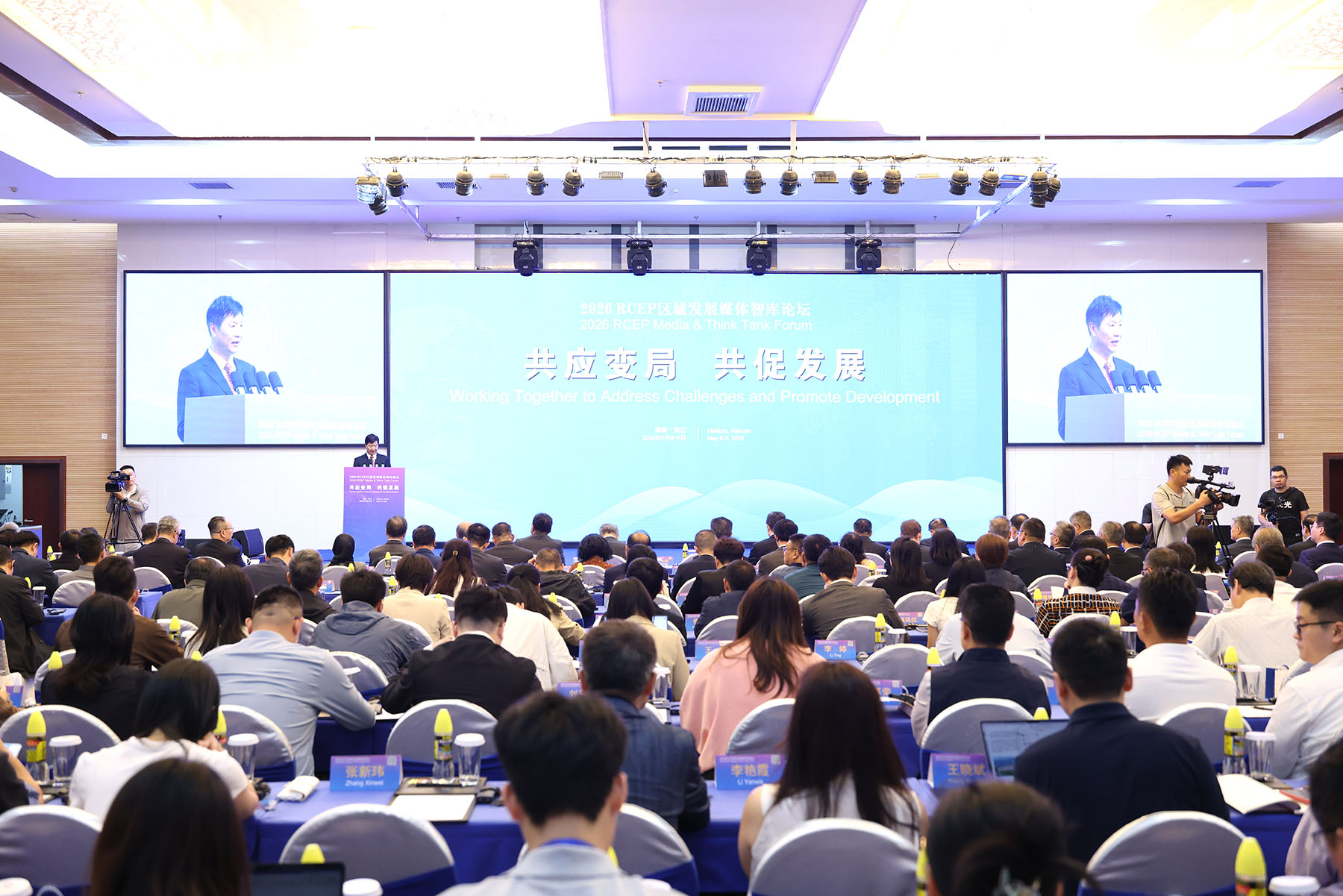
The world's largest free trade pact is gearing up for its next phase amid growing protectionism and other challenges, a forum in Hainan heard.
Experts weighed in, calling for the Regional Comprehensive Economic Partnership to expand its membership, focus more on the service industry and keep pace with other trade agreements.
They discussed the present and future of the agreement at the 2026 RCEP Media & Think Tank Forum held in Haikou, Hainan province, over the weekend. The event was hosted by China Daily and the China Institute for Reform and Development.
READ MORE: RCEP seen as key anchor for Asian growth
The sustained efforts of China, as a key player of the bloc, to advance high-standard opening-up, they say, would allow other member economies to share in its massive market for inclusive development.
RCEP economies are projected to grow at a rate of about 4.5 percent this year, with their contribution to global economic growth expected to remain at over 32 percent, according to the RCEP Industry Cooperation Committee.
By contrast, the IMF in April cut its global growth forecast for 2026 to 3.1 percent, citing the severe disruptions caused by conflicts in the Middle East.
RCEP members are looking at how to improve the pact amid a worsening external environment as the trade agreement enters its next phase following a general review in 2027, according to experts.
It will be the first time for such a review since the agreement came into effect in 2022.
Expanding RCEP membership is high on the agenda, as it will not only broaden the pact's footprint, but also strengthen its resilience against rising protectionism, said Wang Yiming, former deputy director of the Development Research Center of the State Council.
The RCEP opened its doors to welcoming new members since July 2023. China's Hong Kong, Sri Lanka, Chile and Bangladesh have expressed their interest in joining the RCEP.
"The RCEP's attractiveness and influence are continuously increasing. More and more economies are submitting applications," Wang said. "We need to actively respond to these applications and push for the expansion of RCEP membership."
But growing membership cannot address the pact's structural weaknesses, said Zhao Jinping, vice-president of the China Association of Trade in Services.
The agreement faces a significant gap in services trade, where RCEP commitments lag behind those of other major trade pacts, he said.
In 2024, services accounted for 26.4 percent of total cross-border trade worldwide, a historic high, according to WTO data. Yet the share of services in RCEP's total trade remains relatively lower.
The scheduled general review could serve as "a critical window" to expand commitments to the service industry, expanding intra-regional trade and investment, Zhao said.
Digital transformation
Lee Hee-sup, secretary-general of the Trilateral Cooperation Secretariat, said that digital commerce, cross-border data flows, green development and innovation-driven industries are emerging as new growth drivers.
The pact should actively promote digital transformation to stay relevant in a fast-changing global landscape, he added.
The China-ASEAN Free Trade Area 3.0 Upgrade Protocol, signed last October, could provide experience that the RCEP can draw from, observers note. The China-ASEAN agreement has incorporated the digital economy, green economy and supply chain connectivity into its framework — areas that are also at the forefront of the RCEP's next phase.
ALSO READ: China, ASEAN to pool strength in blue economy
China, with its continuous efforts to advance high-standard opening-up and open its door wider, will enhance market connectivity, factor mobility and regulatory alignment between China and other RCEP economies, said Guo Da, executive president of the Hainan Institute for Free Trade Port Studies.
Data from the RCEP Industry Cooperation Committee showed that in the first quarter, China's trade with other RCEP members surged 20.2 percent year-on-year to 3.73 trillion yuan (about $515 billion), with imports jumping 25 percent.
Contact the writers at wangkeju@chinadaily.com.cn
