

Beijing E-Town facility tweaks services as machines put into action
At the Ronghua subdistrict smart eldercare hub in Beijing's southern outskirts, 74-year-old Ren comes for the food. The steamed buns are soft, the vegetable dishes change daily, and the canteen's robot chef — a stainless-steel contraption that stir-fries with mechanical precision — never takes a day off.
"The cafeteria is very good, and the food is delicious," said Ren, who took a one-hour bus ride from her home to visit the facility for the second time. She said she initially came to solve what she called the "dining problem" of old age.
"When I can't take care of myself anymore, then I'll think about how to get through those days. For now, I just need good meals."
READ MORE: 'Sympathetic' humanoids at vanguard of robot solutions to elderly care
Ren has yet to try the exoskeleton suits on the fourth floor or the artificial intelligence-powered massage robots on the third. But she is exactly the kind of customer that the Beijing Economic-Technological Development Area — better known as Beijing E-Town (Yizhuang) — is betting on as it races to build a "smart eldercare" model that pairs an aging population with the district's booming robotics industry.
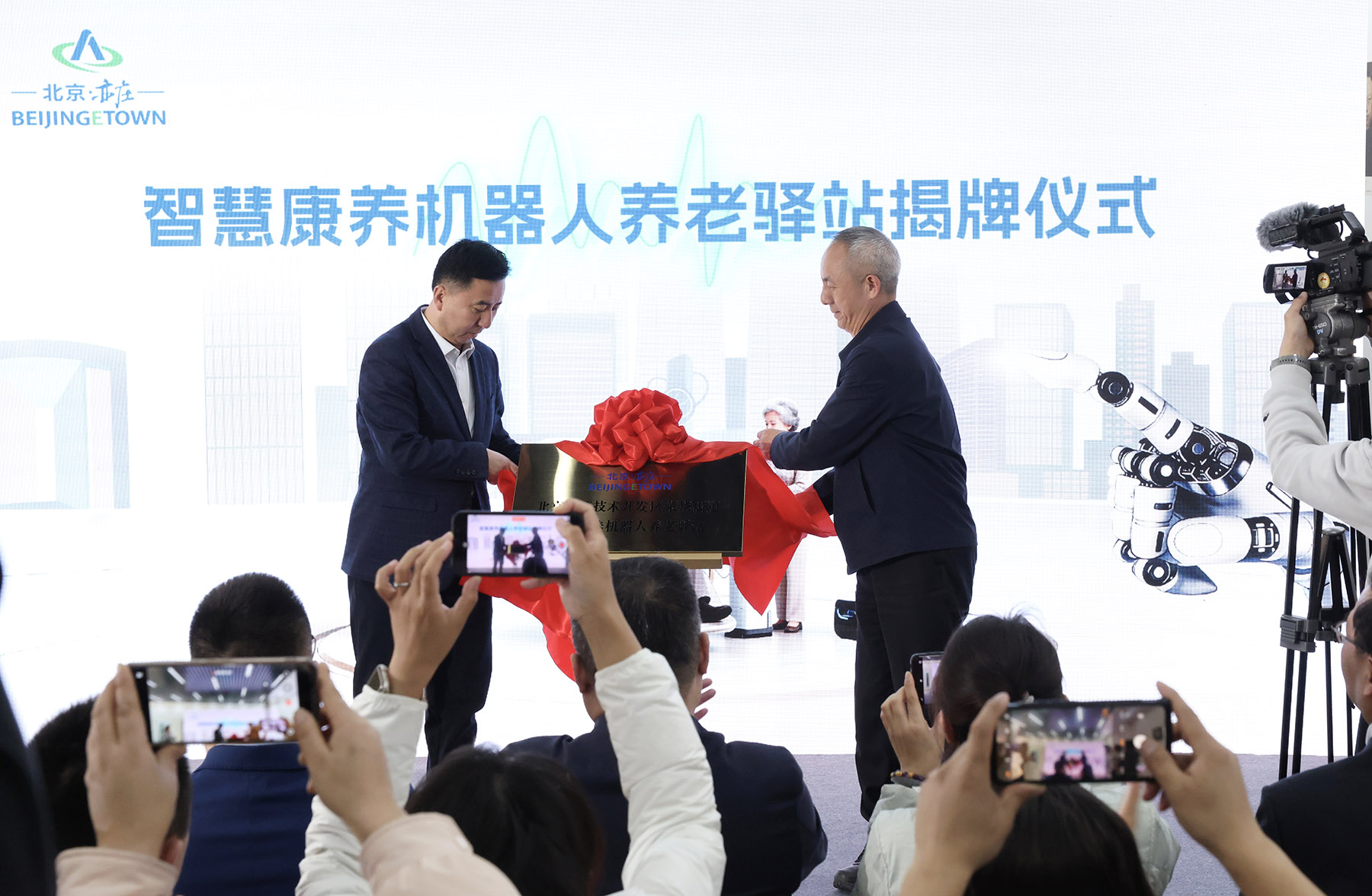
The 1,100-square-meter facility, which opened in March, is a cross between a community center, a tech showroom, and a nursing home. It is one of four such stations (the other three being traditional ones) in the Ronghua subdistrict, where officials say more than a quarter of residents are over 60 — a figure that climbs to 35 percent in some neighborhoods.
"The aging situation is severe," said Zhang Li, a subdistrict official responsible for eldercare services."We wanted to go beyond the basic services of traditional stations and bring in the frontier technology that Yizhuang is known for."
The station's operating model is a three-way partnership: the local government provides funding and oversight, a private operator runs daily services, and a platform called the "Robot Mall" — a State-backed enterprise — curates and supplies machines from 24 robotics firms.
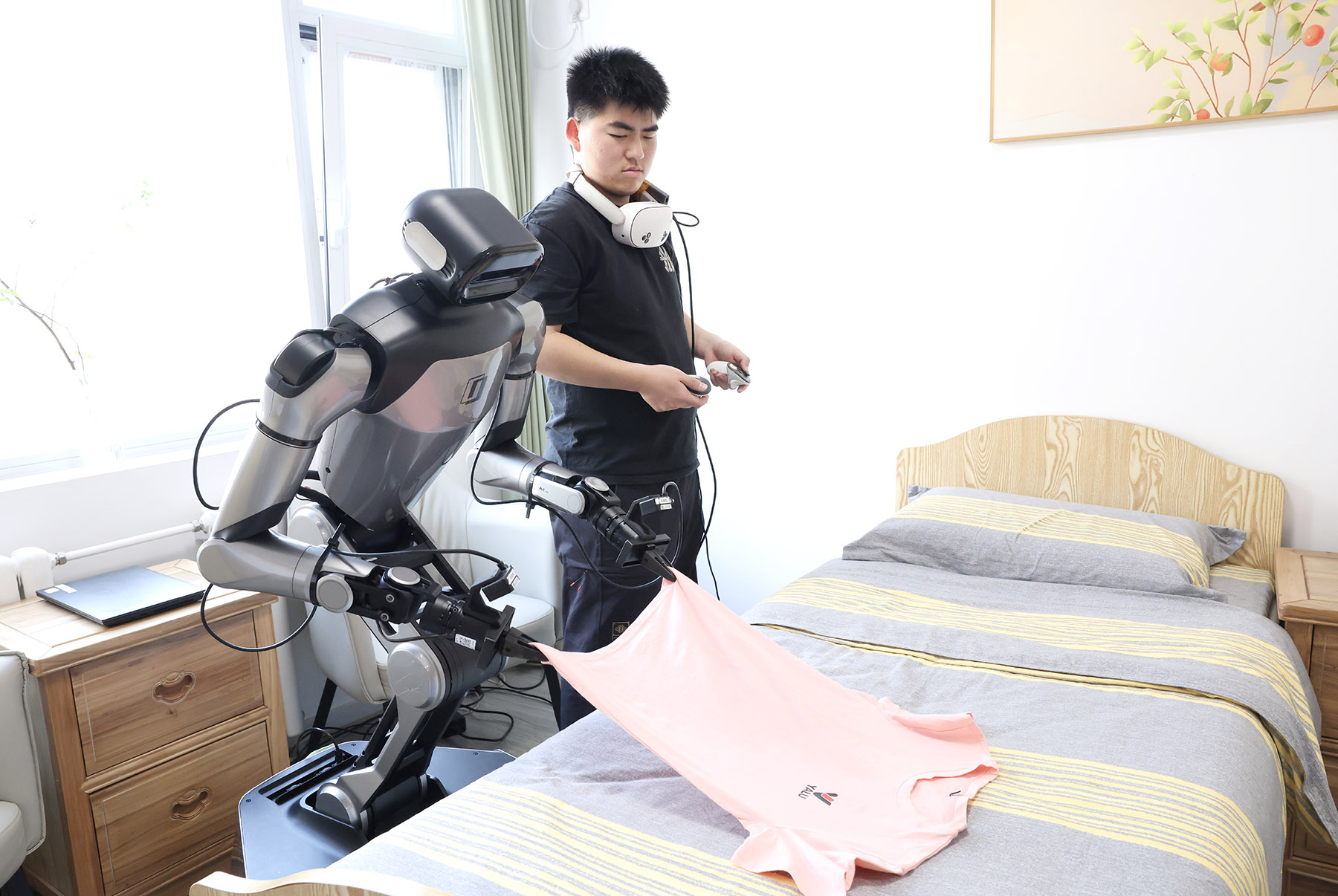
Since its opening, 43 different robots have been deployed across the building, ranging from a pancake-making machine near the facility entrance to a chess-playing robotic arm in the recreation room. Officials said about 10 of those robots have since been withdrawn for modifications based on user feedback.
'Not a showpiece'
On a recent morning, a dough-spinning robot churned out savory pancakes for 6.9 yuan ($1.0) each, while a delivery bot shuttled trays of braised pork to a dining area packed with seniors. At the checkout, an AI-powered camera identified dishes on a tray and calculated the bill in under a second.
"None of these machines are just sitting there — every one of them is being used," said Han Xin, the facility's private operator.
"They are not showpieces. They have truly moved from the laboratory into our daily life."
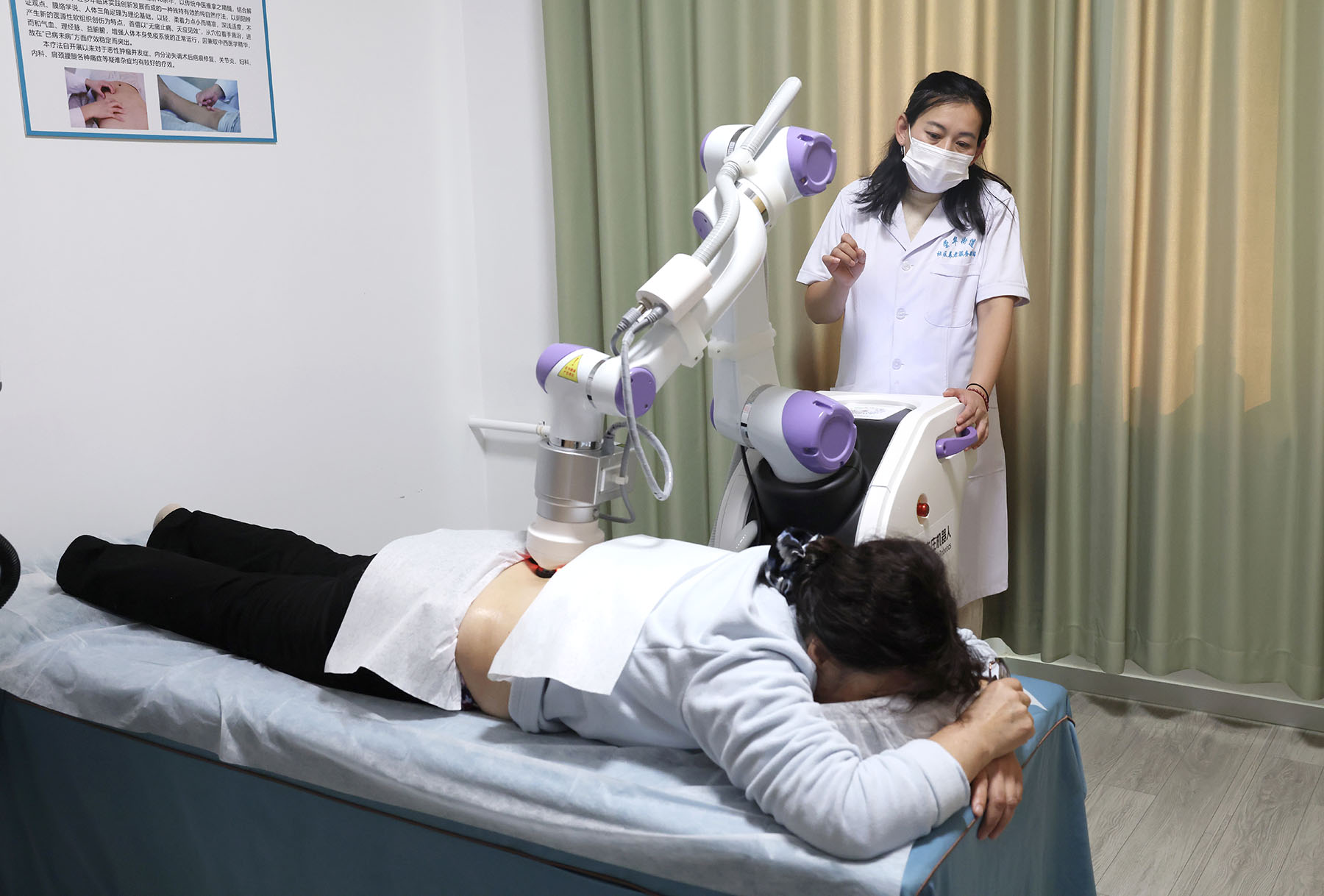
Han said the station's most popular service is the third-floor rehabilitation room, where three massage robots and an AI-guided moxibustion machine are booked solid every day. "I've tried them myself," she said. "The touch is not hard or mechanical — it's very comfortable."
The machines use visual recognition to locate acupoints on the bodies of different shapes and sizes. Qi, a rehabilitation therapist who works at the station, said the robots allow one human therapist to supervise several devices at once.
"For routine health maintenance, the robots are excellent," she said."Our human therapists are fully booked, but a single therapist can operate three or four robots at the same time. The robots don't get tired."
A 71-year-old woman who gave only her surname as Wang was lying facedown while a massage robot's four silicone-tipped arms kneaded her lower back.
Wang, who injured her ankle in a fall three years ago and still struggles with chronic pain, said she prefers the machine's consistency to a human masseur.
"A human feels more casual and natural, but the robot hits one spot very precisely — you really feel it," she said as the mechanical arms worked along her spine. "The doctor set it to the lowest intensity, and it's just right for me."
Wang said she had heard about the station from colleagues and decided to travel across town to try the machines. "I've done six rehab sessions at a hospital, and they were so painful I cried every time," she said. "This is different. It doesn't hurt the same way."
Prose and cons
Not every robot has been a hit. Han said a life-size humanoid robot modeled on the Song Dynasty (960-1279) poet Su Dongpo, also known as Su Shi — which could recite verse and banter about food — cost over 600,000 yuan but was pulled from the floor after just days because almost no one used it.
"Seniors would try it once, but it didn't address any real need," Han said. "What they care about is health, rehabilitation, and daily living."
One elderly visitor, an 80-year-old man surnamed Zhuang who came to the station with his grandson, said he was thrilled by the Su Dongpo robot before it was removed.
"I asked it, 'How do you make Dongpo pork?' and it told me immediately," he said. "Then it composed a poem with me. That kind of interaction makes you feel like the technology is really for us."
He said he had brought his grandson to the station specifically to see the robots. "Things are developing so fast," he said. "I want the younger generation to see what's possible."
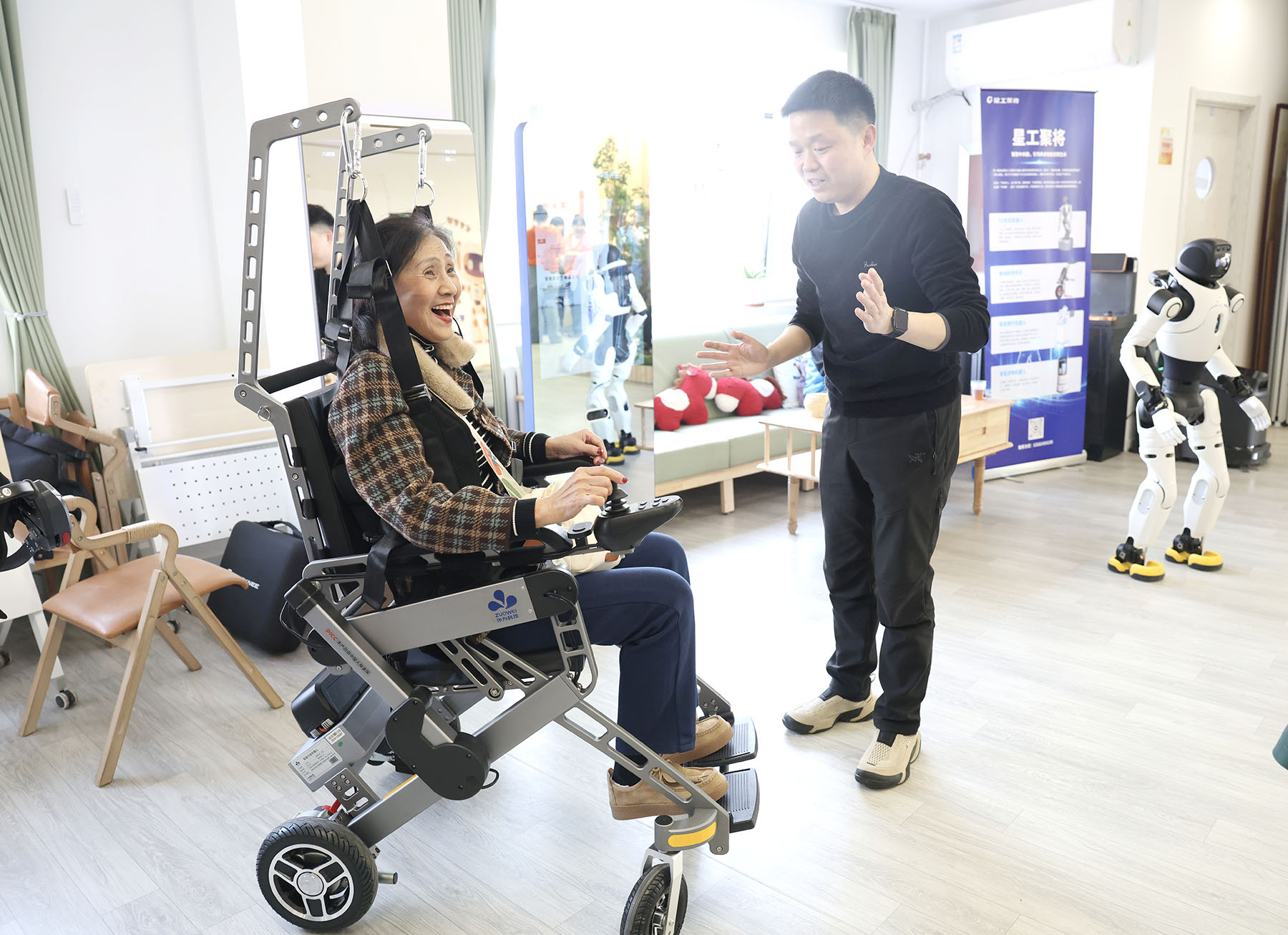
What many seniors do want, according to Zhen Zishuo, a rehabilitation specialist from resident tech firm Beijing AI-robotics, is help with the mundane tasks of aging. His company supplies the exoskeleton suits.
After an 80-year-old visitor pointed out the stair-climbing problem, Zhen's team accelerated work on a new mode.
"That feedback came directly from an elder using our device in this station," Zhen said. "His primary need wasn't walking on flat ground — it was going up and down stairs. We didn't realize how urgent that was until we heard it here."
Testing ground
The station has become a live laboratory where robotics companies can observe how older users interact with their products. Zhen said his company stations a full-time rehabilitation therapist on-site to help seniors try the equipment and collect feedback.
"Some of these devices are complex, and seniors need someone to show them how to put them on and adjust the settings," he said. "But once they try it, many of them want to buy one. We've had several customized orders already."
Li Minglian, a representative from Robot Mall — which curates and supplies machines from robotics firms — said the station allows manufacturers to move beyond theoretical design.
"R&D people often sit in labs and guess what old people need," she said."Here, they can watch an 80-year-old try to put on an exoskeleton and see exactly where the design fails. You can't get that feedback any other way."
Li said the most requested robot, the one that involves close contact with its owner, has not yet been widely deployed.
"That's the holy grail," she said."But the technology for physical assistance is the most cautious area of development, especially when it's for the elderly. We will not put an unsafe product on the market."
China's population is aging faster than almost any major economy. As of the end of 2025, the number of people aged 60 and above reached 323.38 million, or about 23 percent of the total population, according to the National Bureau of Statistics. The Ministry of Civil Affairs has said that roughly 35 million of those elderly individuals have disabilities requiring long-term care — a figure that underscores the growing strain on the country's family-based care system and fuels demand for robotic alternatives.
'No resistance'
Han, the operator, said she has been surprised by how readily seniors have taken to the gadgets.
"I haven't seen much resistance at all," she said. "When they walk in and see what the robots can do, they say,'Wow, it can do that?' It creates a sense of expectation and hope for life."
She recalled one visitor in his 80s who initially seemed hesitant. "After he tried the massage robot, he said, 'This is not the cold, hard machine I imagined. It feels warm and soft.' That kind of reaction tells me we are on the right track."
Still, the technology has limits. A painting robot on the second floor, designed to teach children shapes and colors, took nearly a minute to sketch a simple car — a delay that tried adults' patience.
The station's robots are funded largely by the local government, which buys or leases the most-used machines. Suppliers provide display robots for free. User fees — 68 yuan for an hour of robot massage — remain well below market rates, suggesting heavy subsidies.
But officials say the immediate goal is not profit.
ALSO READ: Do androids dream of domestic feats?
"We are still in the data-collection phase," said Zhang, the subdistrict official. "The real value is creating a virtuous cycle: technology improves services, services generate feedback, and feedback drives better technology."
Back in the canteen, Ren finished her lunch and wiped her mouth. She said she would return for the food, not the robots.
"I can still walk and take care of myself," she said. "But it's good to know that when the day comes that I can't, this place is here. And they have all these machines that might help."
She paused and looked around the dining room, where other seniors were laughing over plates of stir-fried greens and braised tofu.
"Having a place like this in your neighborhood — it gives you confidence," she said. "You don't feel so alone facing old age."
Contact the writers at lilei@chinadaily.com.cn
