

Zardari's China trip aims to upgrade industrial and agricultural cooperation
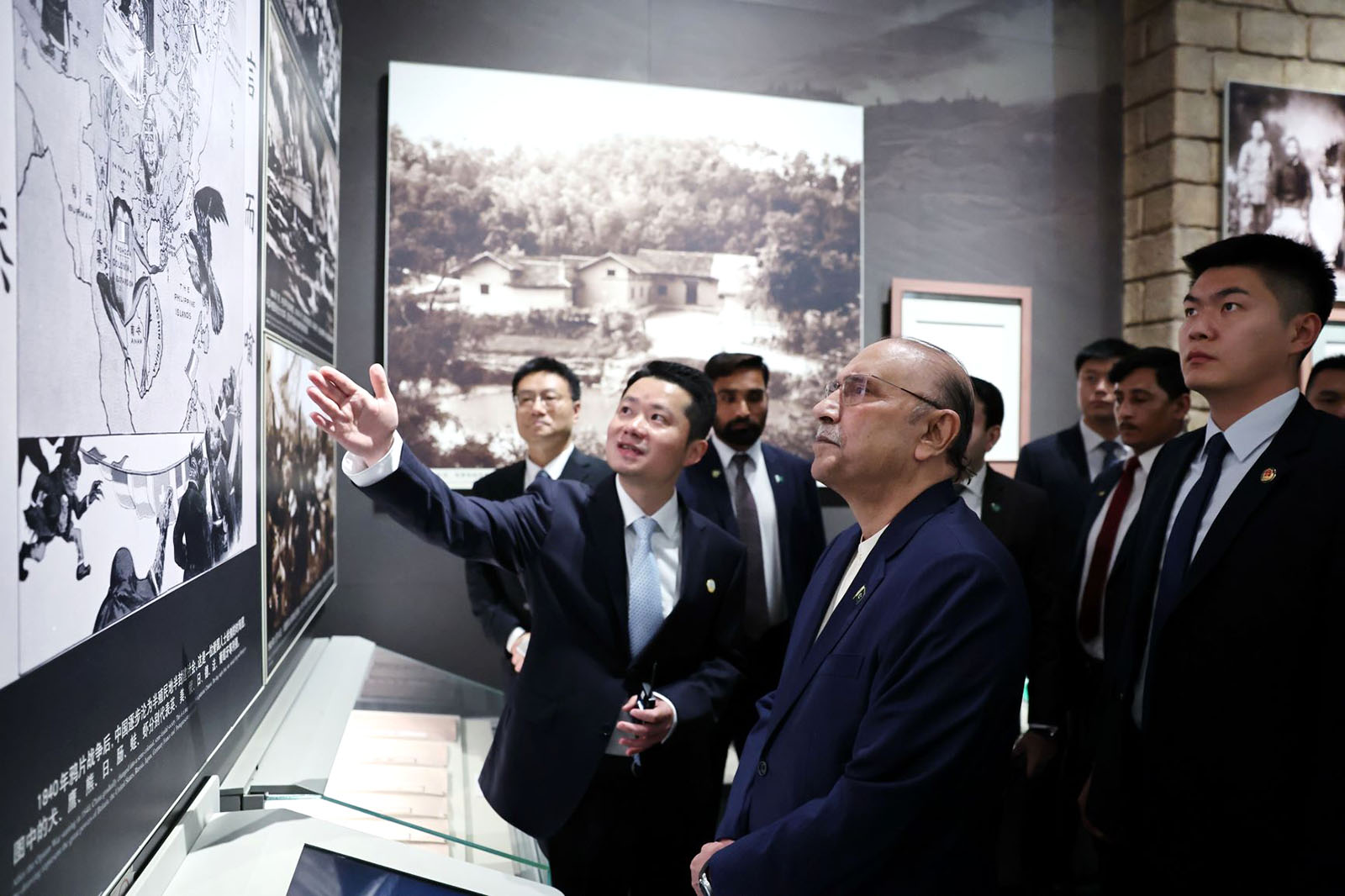
Pakistani President Asif Ali Zardari's weeklong China visit, from Saturday to Friday, opened with a focus on factories, farming and provincial-level cooperation, underscoring the two countries' efforts to move their long-running economic partnership beyond infrastructure and into industrial upgrade, agricultural modernization and technology-driven growth.
During his visit on Sunday to Changsha, the capital of Hunan province, the first stop of the tour, Zardari visited SANY Heavy Industry, one of China's leading machinery manufacturers. He was briefed on the company's advanced manufacturing systems, product lines and investment in research and development.
READ MORE: Pakistani president in China for week-long trip
Zardari showed strong interest in products including unmanned counterbalanced forklifts, telling Pakistani officials that he hoped such products could also be produced in Pakistan.
He also visited Hunan Tea Group on Sunday and was briefed on the company's operations, supply chain and international market presence.
According to Pakistan's Press Information Department, Zardari saw potential for cooperation in value-added processing, agro-processing and export development, and he invited the group to explore collaboration with Pakistan in these fields.
Observers said that Zardari's engagements in Hunan reflect the evolving nature of Sino-Pakistani economic cooperation. The first phase of the China-Pakistan Economic Corridor, a flagship project under the Belt and Road Initiative, was largely associated with roads, power plants, ports and other infrastructure projects.
Chinese Ambassador to Pakistan Jiang Zaidong has said that CPEC 2.0 will focus on industry, agriculture and mining. He said that the two sides would accelerate the development of demonstration industrial parks to help Pakistan strengthen industrial capacity, boost export earnings and create jobs, while also working to bring more Pakistani agricultural products into the Chinese market.
Liu Zongyi, director of the Center for South Asia Studies at the Shanghai Institutes for International Studies, said that for Pakistan, the priority is to draw on China's experience to strengthen its industrial capacity and advance modernization.
Liu added that, as this year marks the 75th anniversary of the establishment of diplomatic relations between the two countries, the latest visit suggests that both sides are seeking to translate their long-standing political trust into more concrete economic cooperation through provincial-level exchanges and enterprise-to-enterprise engagement.
The broader relationship was also evident in medical and people-to-people cooperation.
Zardari on Sunday conferred the Star of Pakistan honor on Chinese doctor Pan Xiangbin, in recognition of his work leading a Chinese medical team that provided free minimally invasive heart surgeries for Pakistani children and trained local doctors.
On Monday, Zardari visited Shaoshan, where he laid a wreath at Mao Zedong Square and toured the former residence and memorial hall of the late Chairman Mao Zedong.
ALSO READ: Pakistani president hails China's role in socio-economic development
A frequent visitor to China, Zardari once cited Mao's emphasis on self-reliance when asked about the biggest takeaway from his China trips, saying that China had grown stronger and more prosperous through its own efforts and offered an example for other developing countries. Every visit to China, he added, left him feeling there was still much more to learn.
Zhao Hongyan, a professor at the University of International Business and Economics in Beijing, said that the Shaoshan stop added a historical and cultural dimension and signaled Pakistan's respect for China's development path, as the site embodies the memory of New China's pursuit of independence and self-reliance.
Zardari is scheduled to continue his China visit in Sanya, Hainan province, from Tuesday to Friday.
Contact the writers at zhaojia@chinadaily.com.cn
