

Leading maker to commence mass production of sodium-ion products this year
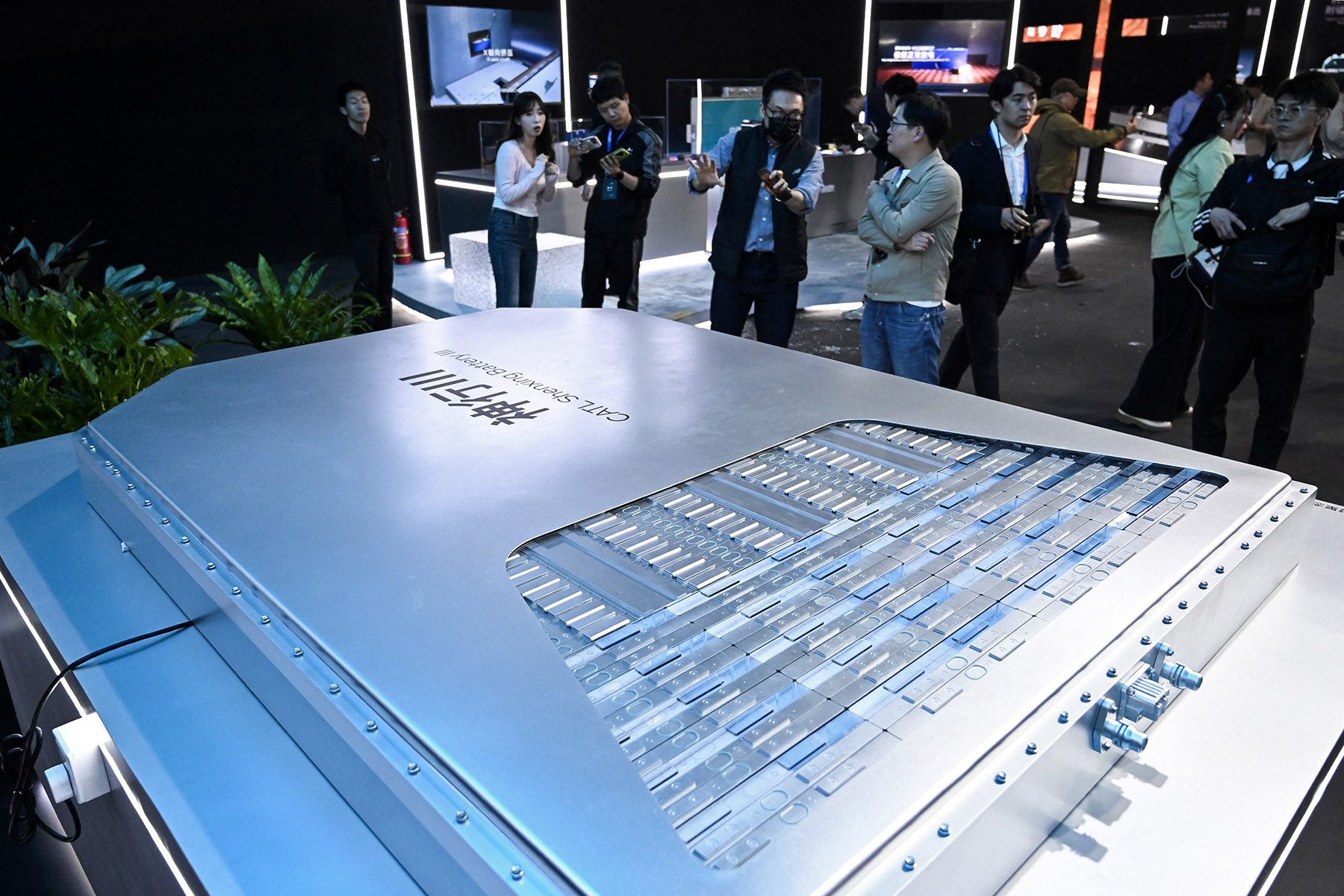
Contemporary Amperex Technology Co Ltd, the world's largest electric vehicle battery maker, said on Tuesday that its sodium-ion batteries will enter large-scale production within the year, marking a potential shift in the global race to secure cheaper and more resilient energy storage.
Speaking at a company press conference, Wu Kai, CATL's chief scientist, said that key manufacturing bottlenecks of its sodium-ion batteries had been resolved, clearing the path for commercialization of a technology long viewed as a backup to lithium-ion batteries.
"Sodium-ion batteries are ready for scale," Wu said, positioning them as both a complement and, in some scenarios, an alternative to lithium-based systems.
READ MORE: Sodium-ion touted as energy option
CATL is also advancing next-generation battery technologies at the high-performance end.
Gao Huan, also a chief scientist at CATL, said the company is in talks with several Chinese premium automakers on condensed-state batteries, an emerging category related to solid-state designs. Prototype development is progressing smoothly, Gao said.
Originally unveiled in 2023 for electric aviation, CATL's condensed-state battery boasts an energy density of up to 500 watt-hours per kilogram. The technology has already completed a maiden flight in a 4-ton-class commercial aircraft and is set for further validation in larger 8-ton-class platforms.
The company now aims to adapt such aviation-grade technology for passenger vehicles. A planned Qilin condensed-state battery would deliver 350 Wh/kg at the cell level, potentially extending EV range while improving safety.
The announcement came as concerns grow over lithium supply constraints and geopolitical competition around the metal, which underpins the EV boom.
CATL's timeline signals that competition in battery chemistry is entering a new phase, as automakers and governments seek both technological edges and supply chain resilience in the transition to electrification, industry experts said.
Sodium-ion batteries use sodium, an element abundant in seawater and the Earth's crust, rather than lithium, which is comparatively scarce and concentrated in a handful of countries. Sodium-ion batteries are unlikely to displace lithiumion systems outright in the near term, particularly in high-performance vehicles where energy density remains critical.
China has identified sodium-ion technology as a strategic priority and has singled out next-generation energy storage — including sodium-based systems — for accelerated development.
ALSO READ: CATL overtakes PetroChina in market value as green bets ramp up
Hu Yongsheng, a researcher at the Chinese Academy of Sciences' Institute of Physics, said, "Sodium offers a more secure and scalable resource base, which is of significance as a backup solution to safeguard energy security."
It could gain traction in entry-level EVs, grid storage and cold-weather applications, where its stability and cost advantages are more pronounced, Hu said.
With production lines largely compatible between sodium-ion and lithium-ion technologies, manufacturers can switch or diversify output with limited retooling — an advantage that could accelerate adoption, Hu added.
Contact the writers at chengyu@chinadaily.com.cn
