

Northwest China's Gansu province is transforming its industrial base by pushing forward an industry-driven development strategy to modernize its economic structure and achieve high-quality growth.
"As a traditional industrial base, transformation through innovation is imperative," said Ren Zhenhe, governor of Gansu and a deputy to the 14th National People's Congress.
"We are focusing on strengthening leading enterprises, reinforcing industrial chains and fostering competitive industrial clusters," he said. "At the same time, we are developing strategic emerging industries to modernize our industrial system and reshape the foundations of development."
During the 14th Five-Year Plan (2021–25) period, Gansu's economy maintained steady momentum with the GDP reaching 1.37 trillion yuan ($197.9 billion) last year. The province's growth rate has consistently outpaced the national average since 2022.
Ren said the province is determined to build on its manufacturing strengths while accelerating structural transformation. Since 2021, Gansu has launched around 300 upgrade projects each year, promoting intelligent and green development across traditional sectors.
Green transformation is now an intrinsic part of the local industrial upgrade. By the end of 2025, energy consumption per unit of industrial added value had decreased by 13.5 percent, while water use per output unit was also declining.
Digitalization is reinforcing this green shift. More enterprises are connecting equipment and production lines through industrial internet platforms, while the spread of 5G and smart manufacturing is helping factories increase efficiency and cut emissions. Rather than replacing traditional sectors, Gansu is using technology to lift them up the value chain.
Resource industries, long a pillar of the local economy, are also being restructured.
'Gansu strengths'
Leveraging its abundant energy and mineral resources, the province is stepping up exploration, production and value-added processing to turn "Gansu resources" into "Gansu strengths", Ren said.
The province has been advancing a new round of mineral exploration initiatives, accelerating the development of gold resources and upgrading metal industries, including silver and copper. Output of key metals and energy products has risen steadily in recent years, consolidating the province's role as an important national resource base.
All these efforts have laid the groundwork for strong and coordinated industrial clusters. Gansu has established two national-level advanced manufacturing clusters and nurtured 14 provincial-level ones. Its nickel-copper-cobalt new materials cluster has been recognized as a national characteristic industrial cluster for small and medium-sized enterprises.
By 2025, advanced manufacturing clusters had generated more than 900 billion yuan in industrial output, contributing 88 percent of the province's overall industrial growth.
Innovation prioritized
Innovation, meanwhile, is emerging as a central driver. Research into core technologies in major industrial and supply chains has been enhanced in State-owned enterprises in the province.
"We focus on breakthroughs in critical technologies and deepen the integration of technological and industrial innovation," Ren said. "By increasing investment in key 'bottleneck' technologies, we have developed new technologies and products of internationally advanced levels, demonstrating Gansu's unique role in strengthening the nation's strategic, scientific and technological capacity."
Digital infrastructure is emerging as another pillar of modernization in the province.
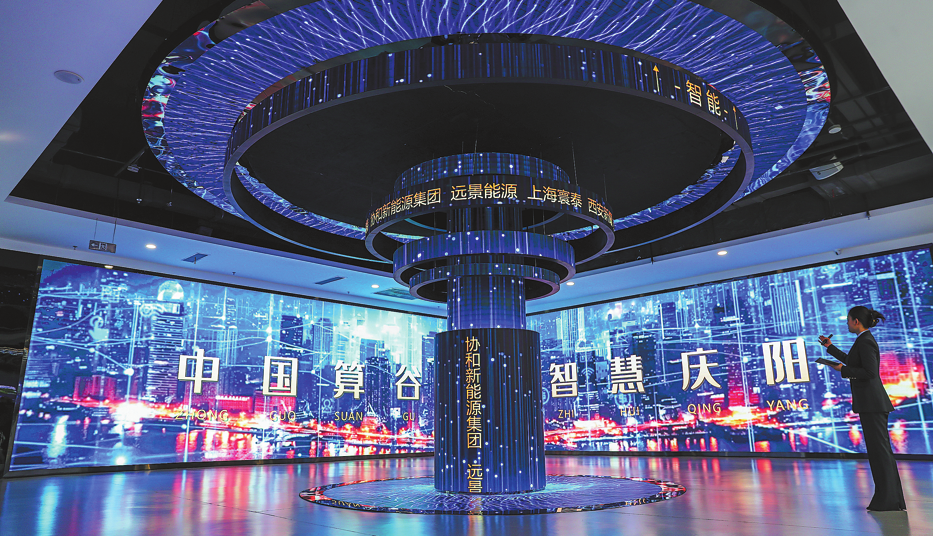
Under the national "East Data, West Computing" initiative, the Qingyang data center cluster has attracted more than 370 enterprises connected to the digital economy. Total computing capacity is expected to exceed 150,000 petaflops in 2026, facilitating artificial intelligence and other data-intensive industries.
Looking ahead, Ren said Gansu will continue integrating the digital and real economies while advancing strategic emerging sectors like hydrogen energy, new energy storage, the low-altitude economy, and commercial aerospace. The province is prioritizing improving business environment for market-oriented, law-based, and internationally competitive conditions.
"Our goal is to achieve more resilient, higher-quality development and contribute to the country's modernization drive," he said.
Zheng Jinran in Beijing contributed to this story.
Contact the writers at majingna@chinadaily.com.cn
