

Young Chinese experiment with unplugging — less scrolling, more running, handwriting and real-world chats — to ease digital fatigue.
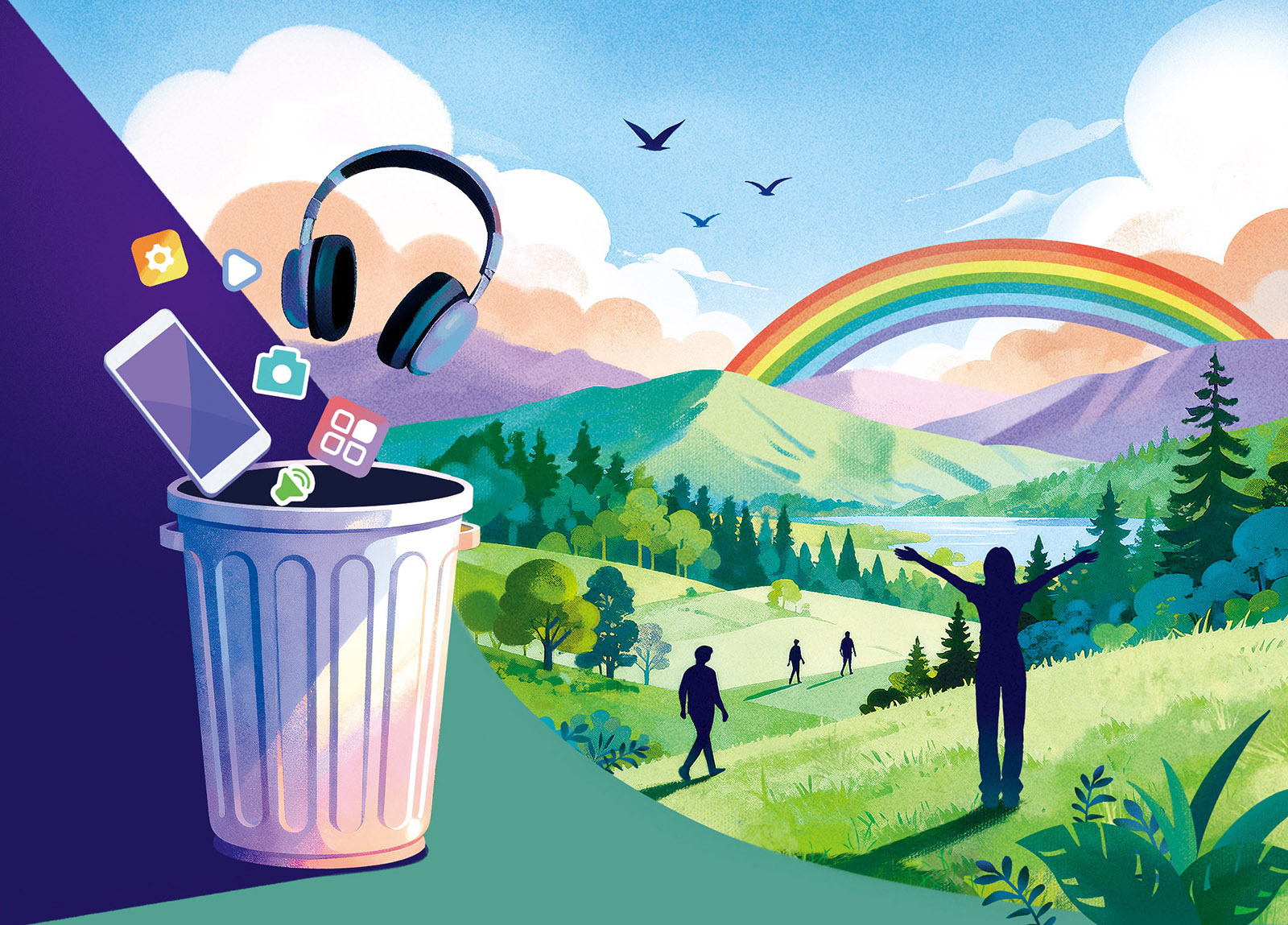
Finding your way without online maps, keeping relationships alive without social media, and holding on to precious photos and memories without cloud storage — these are the scenarios Alyssa (pseudonym) asked readers to imagine when she founded an anti-tech addiction group on Douban, a Chinese platform where users post reviews and join discussion communities.
Each scene, she explained, describes a life in which people must relearn skills they hadn't realized they'd outsourced. "The group was an experiment in loosening those ties," she said.
The group now has nearly 40,000 members. Many share small victories — moments when they accomplished something without an app that would normally do it for them. Others post everyday observations about tech-dependent habits, sparking conversations about their consequences and the impulses behind them.
Alyssa sees these efforts as aligned with "digital minimalism", a philosophy popularized by US computer science professor and author Cal Newport. It urges people to strip their digital lives down to the tools that genuinely serve their values.
For a growing number of young people, that shift has become a quiet trend — an attempt to reclaim attention, ability, and time.
Kai Yijing, 27, who lives in Hangzhou, Zhejiang province, has kept a habit of recording her reading for the past three years. But in the last two months of 2024, she noticed something that unsettled her: the time she spent scrolling social media could easily have gone toward finishing several books.
"I'm instinctively cautious about entertainment," she said. "To me, scrolling short-form content for hours can feel like freedom, but it's really dependence — and it comes at a cost."
In today's constant information deluge, she added, truly necessary content is harder to find — and people end up spending hours wading through unnecessary posts to get to the small part that matters.
After discovering the idea of digital minimalism in Newport's book, she decided to put it to the test.
From May to October last year — conveniently a transition period between two jobs — she began a digital detox. She tried to keep her social media use under two hours a day, but the hardest part was resisting the habitual pull of endless scrolling, especially at dawn, when she was most likely to reach for her phone.
"You have to replace it with alternative activities," she said.
So, she turned those hours into a fixed running slot. She also started chatting with the people downstairs who collect garbage or sell snacks and began noticing small moments of human connection that had previously slipped by.
With a solid block of time reclaimed, Kai immersed herself in films, TV series, and books. She also began writing reviews and diary entries and adding them to her personal archive. In 2025, she finished 116 films and 56 books.
Now, Kai has started a new job in the internet industry, but she continues her small acts of resistance against digital fatigue: limiting social media and regularly writing handwritten letters and emails to friends.
Her advice is simple: be selective about what you let into your life. "Be prudent when a tool wants to enter your world. Choose the ones that support reflection and mental clarity, and reject the ones that erode independent thinking," she said.
Similarly, for Deng Xiaole, a geodesy scholar from Hubei province who now works at the Institute of Geodesy at the University of Stuttgart in Germany, digital minimalism is a key part of his lifelong learning habits.
Five years ago, Deng began recording his daily schedule with pen and paper. Before long, he also found himself drafting his thesis by hand — a practice that is rare among his colleagues.
He believes handwriting encourages deeper focus and clearer thinking."When typing on a computer, any new idea can prompt me to open a browser to look it up, which is distracting. With handwriting, I get a complete block of time and a single, uninterrupted space to think," he said.
Deng also tried a 30-day digital detox, deleting accounts on several commonly used apps. He replaced checking the time on his phone with a watch, music apps with a CD player, and social media with radio broadcasts.
"The key is to move certain functions off the phone," he explained. "If I pick it up less often, I'm much less likely to get pulled into it."
He shares what he has learned about digital minimalism by posting programs and methods through RSS(Really Simple Syndication), a subscription tool that lets readers follow updates from selected websites in one place — without constant checking or reliance on social media feeds.
"What you're meant to know will find its way to you," he said. "It might just arrive a bit later than it does for others."
For him, digital minimalism is less a rigid rule than a daily experiment — one that reshapes both thought and routine.
He suggests starting small: a week without social media or relying on a single RSS feed can quickly reveal which tools are truly necessary, which are merely convenient, and which can be dropped entirely.
"What this approach does is help you see clearly what you really need and what you can do without," he said.
Contact the writers at mengshuyan@i21st.cn
