

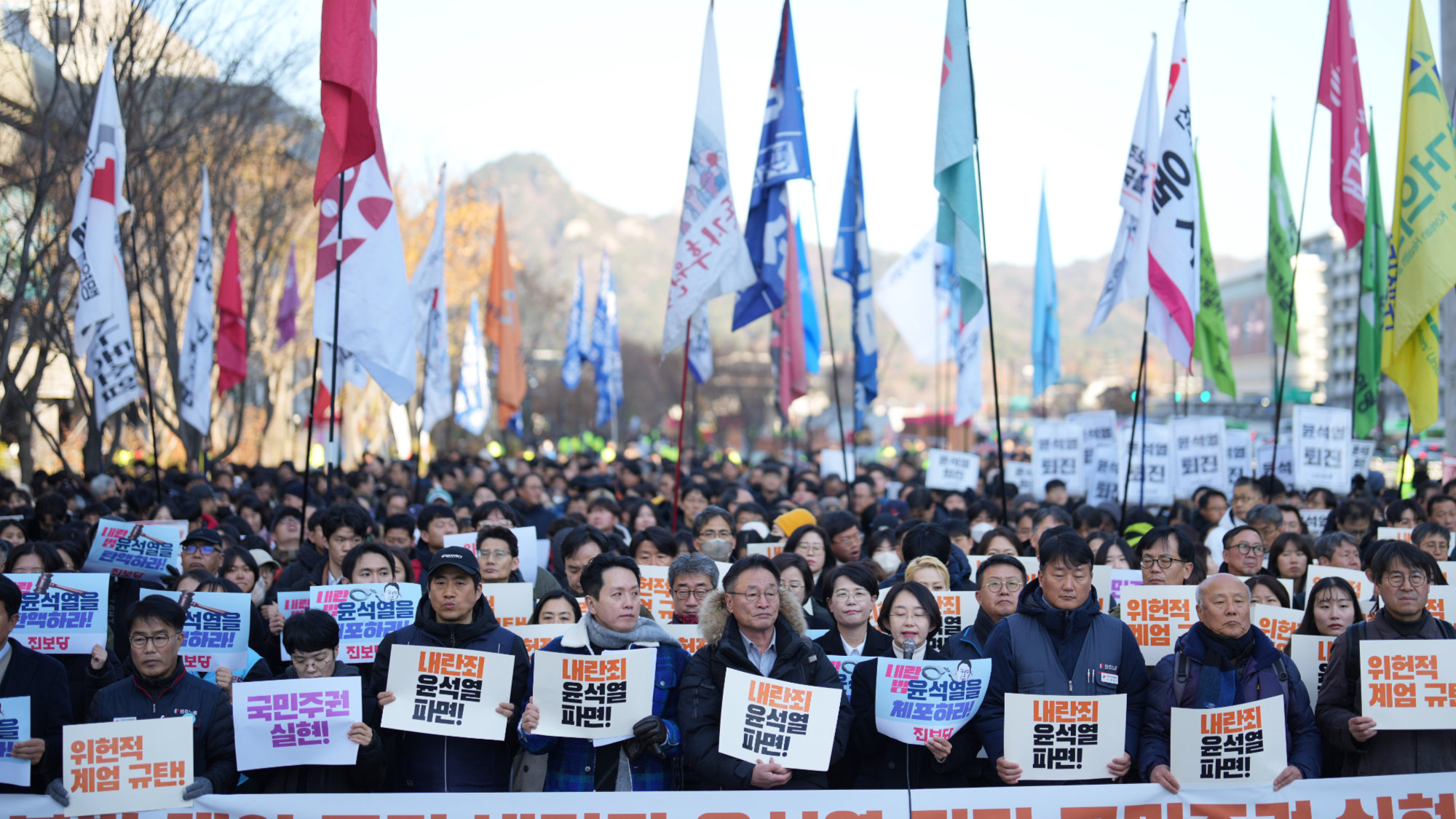
Opposition parties of the Republic of Korea, including the main opposition Democratic Party (DP), submitted an impeachment bill against Yoon to the National Assembly on Wednesday, according to Yonhap News Agency.
The bill is expected to be formally submitted to the National Assembly on Thursday, with the voting to take between 24 and 72 hours after it is introduced to a plenary session.
According to the law, a presidential impeachment motion requires the agreement of at least two-thirds of the National Assembly members to pass.
READ MORE: Yonhap: S. Korea opposition leader indicted for misuse of public funds
In the April legislative elections, the DP and other smaller opposition parties won 192 seats. As only eight votes are needed from the ruling People Power Party (PPP) it is very likely that the impeachment bill will pass, said Woo Su-keun, head of the Institute of East Asian Studies of Korea in Seoul.
In a statement, PPP party chief Han Dong-hoon said Yoon’s declaration of martial law was “wrong” and called for the cabinet ministers to resign.
Protesters also gathered in front of the National Assembly and the Gwanghwamun Square in Seoul, demanding Yoon’s resignation, impeachment, and arrest.
President Yoon Suk-yeol had earlier shocked the nation by declaring “emergency martial law” in a late-night televised address on Dec 3, the first time the law had been invoked in the country in over 40 years.
Accusing the opposition of “anti-state activities plotting rebellion”, Yoon said the aim was to eradicate pro-Democratic People’s Republic of Korea forces and protect the constitutional order of freedom.
However, two hours later, the National Assembly, ROK’s parliament, moved to block the presidential decree, with 190 of its 300 members present voting against it. Yoon then agreed to lift martial law in the early hours of Dec 4 in accordance with law requirements.
The impeachment bill states that Yoon’s declaration did not meet the requirements for martial law and that it violated the constitution and the law.
Yoon’s senior aides, including his chief of staff, also offered to resign en masse after his martial law declaration was blocked by the National Assembly.
“A lot of people were shocked by President Yoon’s declaration because it is not the situation for implementing martial law … it can only be declared in circumstances of war or similar situation,” said Woo.
He told China Daily that Yoon’s martial law declaration has given the opposition a solid reason to push forward the impeachment process.
“It is very dangerous to make a martial law declaration without meeting the requirements. With troops dispatched, this also threatens the stability of the society,” said Woo, noting that the opposition can also use the reason that Yoon might declare martial law again to impeach against him.
About 280 martial law troops had entered the National Assembly after martial law was declared, according to the parliament’s secretary-general.
President Yoon frequently invokes the term “anti-state forces” in his remarks at various cabinet meetings, a euphemism aimed at describing the opposition parties and their members, said Hoo Chiew-ping, co-founder and senior fellow of the East Asian International Relations Caucus in Malaysia.
However, “using such Cold War rhetoric to target a modern, democratic opposition is not only illogical but also profoundly inappropriate,” Hoo told China Daily.
Calls for the president to resign and impeachment have been growing across the nation. The Korean Confederation of Trade Unions, the country’s largest labor union, launched an indefinite nationwide labor strike on Dec 4, urging its members to stop working until Yoon resigns.
“If the president resigns from his position, then a presidential election must be held within 60 days,” said Ryu Yong-wook, assistant professor at Lee Kuan Yew School of Public Policy of National University of Singapore.
If the impeachment bill is passed in the National Assembly, the president may decide to challenge its legality in the Constitutional Court, and this could take months before the court makes a decision. If Yoon accepts the National Assembly’s decision, a presidential election must be held within 60 days, Ryu told China Daily.
READ MORE: S. Korean president faces impeachment calls after martial law debacle
Posts related to the political chaos in ROK attracted billions of views on Chinese social media platforms.
On microblogging platform Sina Weibo, the hashtag “what happened in the ROK over the night” became the mostly searched topic on Dec 4 morning.
Though social order had returned to normal, the Chinese embassy in Seoul, in a statement posted on its official WeChat account, told Chinese nationals in ROK to pay attention to the local situation and strengthen self-safety precautions.
Contact the writer at kelly@chinadailyapac.com
