

 People wait for their turn to get a coronavirus vaccine at a COVID-19 treatment center in the city of Kochi, Kerala, India, on May 7, 2021. (ARUNCHANDRA BOSE / AFP)
YANGON / JERUSALEM / BEIRUT / BAGHDAD / SINGAPORE / COLOMBO / AMMAN / ANKARA / BANGKOK / SEOUL / SYDNEY / WELLINGTON / TOKYO / PHNOM PENH / ULAN BATOR / BENGALURU / TASHKENT / BISHKEK / ISLAMABAD - More than 70 percent of people in eight of India’s large states are estimated to have COVID-19 antibodies, a government survey showed on Wednesday, suggesting that a second surge in infections affected many more people than the reported figures.
The survey, which tested a sample of the population for the presence of COVID-19 antibodies, was conducted in June and July and showed that two-thirds of India’s 1.3 billion people were likely to have been exposed to the virus.
The sero-prevalance survey, which tested around 29,000 people across the country, showed that in eight of India’s largest and most populous states, more than 70 percent had antibodies for COVID-19, according to a government statement.
In the central state of Madhya Pradesh, 79 percent of its estimated population of 70.3 million had antibodies, the survey showed.
Vietnam
Vietnam's major cities may extend or tighten restrictions on movement to contain the spread of COVID-19 as new daily cases have surpassed 6,000 for seven consecutive days, authorities said on Wednesday.
After successfully containing the virus for much of the pandemic, Vietnam has been facing record daily surges of infections since an outbreak which emerged in late April.
Vietnam reported 6,559 new COVID-19 infections on Wednesday, raising its total number since the start of the pandemic to more than 120,000. Around 450,000 people in the nation of 98 million people have been fully vaccinated, according to official data.
The government has imposed strict curbs on movement in about a third of the sprawling Southeast Asian country, including the commercial hub Ho Chi Minh City in the south and the capital Hanoi in the north.
Thailand
Thai volunteers on Wednesday turned a cargo warehouse at Bangkok's Don Muang Airport into a 1,800-bed field hospital for COVID-19 patients with less severe symptoms, as the country deals with its biggest outbreak to date.
The Southeast Asian nation reported a daily record of 16,533 new cases, plus 133 new deaths on Wednesday, bringing the total accumulated cases to 543,361 and 4,397 deaths.
Workers drilled walls for toilet installations and set up beds and blankets.
"This is a level 1+ field hospital where it can receive a large number of patients, who have less severe symptoms," Rienthong Nanna, director of Mongkutwattana Hospital, told Reuters.
Myanmar
Myanmar is looking for greater cooperation with the international community to contain the coronavirus, state media reported on Wednesday, as the Southeast Asian country struggles with a surging wave of infections.
Senior General Min Aung Hlaing called in a speech for more cooperation on prevention, control and treatment of COVID-19, including with fellow members of the Association of Southeast Asian Nations (ASEAN) and "friendly countries", the Global New Light of Myanmar reported.
The leader said vaccinations needed to be increased, through both donated doses and by developing domestic production, aided by Russia, the newspaper said, adding Myanmar would seek the release of funds from an ASEAN COVID-19 fund.
Infections in Myanmar have surged since June, with 4,964 cases and 338 deaths reported on Tuesday, according to health ministry data cited in media.
Australia
Australia's biggest city, Sydney, extended a lockdown by four weeks on Wednesday after an already protracted stay-at-home order failed to douse a COVID-19 outbreak, with authorities warning of tougher policing to stamp out non-compliance.
Far from a planned exit from lockdown in three days, the city of 5 million people and neighbouring regional centres spanning 200 km of coastline were told to stay home until Aug. 28 following persistently high case numbers since a flare-up of the virulent Delta variant began last month.
The state of New South Wales, of which Sydney is the capital, reported 177 new cases for Tuesday, from 172 on Monday. That is the biggest increase since an unmasked, unvaccinated airport driver was said to have sparked the current outbreak. The state also reported the death of a woman in her 90s, the 11th death of the outbreak.
Of particular concern, at least 46 of the new cases were people active in the community before being diagnosed, raising the likelihood of transmission, said authorities. They have cautioned that active community transmission must be near zero before rules are relaxed.
Cambodia
Cambodia on Wednesday logged 766 new COVID-19 infections including 307 imported cases, pushing the national total caseload to 75,152, the Ministry of Health (MoH) said in a statement.
Fifteen more fatalities had been registered, taking the overall death toll to 1,339, the ministry said.
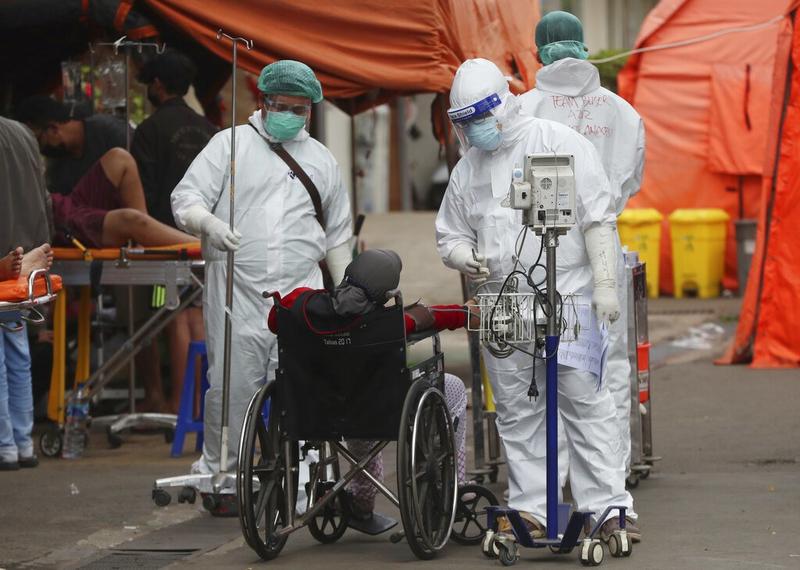 Paramedics tend to people at an emergency tent erected to accommodate a surge of COVID-19 patients at a hospital in Bekasi, on the outskirts of Jakarta, Indonesia, July 10, 2021. (ACHMAD IBRAHIM / AP)
Indonesia
Indonesia marked another grim record as 2,069 people died from COVID-19 over 24 hours. The Southeast Asian country has been reporting the highest number of deaths worldwide in recent days.
The delta variant has crippled the country’s health-care system and depleted supply of oxygen tanks. Indonesia’s number of new confirmed cases reached a three-week low Monday before rebounding to 45,203 on Tuesday.
Iran
Iran reported a record number of daily new cases for the second straight day at 34,951.
The death toll rose for a fourth day to 357, the highest in 10 weeks, the latest health ministry data showed.
The country has reported 89,479 fatalities and over 3.7 million known infections
Iraq
Iraq reported on Tuesday 12,185 new COVID-19 cases, the highest daily count since the outbreak of the pandemic, raising the nationwide caseload to 1,577,013.
A statement by the health ministry also confirmed 71 more deaths, bringing the death toll from the virus to 18,418, while the total recoveries in Iraq climbed by 8,547 to 1,429,542.
Israel
Israel's Ministry of Health on Tuesday announced that children aged 5 to 11, who are at high risk of developing severe COVID-19 disease, could be vaccinated against the virus.
Currently, only 12-year-olds and over are eligible to receive the vaccine against the virus in Israel.
Thus, vaccination may be considered for children aged 5-11 who suffer from severe chronic lung disease, severe immunosuppression, cancer, severe obesity, neurodevelopmental disorders, congestive heart failure, pulmonary hypertension and sickle-cell anemia.
The ministry reported 1,911 new COVID-19 cases on Tuesday, bringing the tally of infections in the country to 864,470.
The death toll from the virus in Israel remained unchanged at 6,461, according to the ministry.
ALSO READ: Asia's air travel may take three years to recover from pandemic
Kyrgyzstan
Kyrgyzstan's COVID-19 tally rose to 160,085 after 996 new cases were reported over the past 24 hours, the Republican Headquarters for Combating COVID-19 said on Wednesday.
Meanwhile, 13 more deaths were reported, taking the respective totals to 2,288.
Japan
Olympic host city Tokyo recorded 3,177 new COVID-19 cases on Wednesday, authorities announced, hitting a daily record high for a second straight day as a spike in infections puts pressure on hospitals.
The rise - up from 2,848 on Tuesday - will add to worries about the Games, which are taking place under unprecedented conditions including a ban on spectators in most venues.
Daily COVID-19 cases were expected to rise further in coming days, as testing may have been delayed during holidays last week, said Yasutoshi Nishimura, who is leading Japan's COVID-19 response.
 Officials wipe down seats to disinfect them, to halt the spread of the coronavirus, after the Tokyo 2020 Olympic Games men's group C first round football match between Egypt and Spain at Sapporo Dome in Sapporo on July 22, 2021. (ASANO IKKO / AFP)
Tokyo is under its fourth state of emergency, which that will last through the Olympics, while the other three regions are implementing looser "quasi-emergency" steps.
Governors of three prefectures near Olympics host Tokyo will ask the government to declare states of emergency for their regions, a cabinet minister said on Wednesday.
Tokyo Olympics organizers on Wednesday reported 16 new Games-related COVID-19 cases, for a total of 169 since July 1. Olympic athletes, staff and media must follow strict rules to prevent the virus's spread, including frequent testing.
“As a city resident myself and as an organizer, my heart hurts that case numbers are rising (in Tokyo)," Tokyo 2020 spokesperson Masa Takaya told a news conference.
He repeated that strict measures were in place inside the “Olympic bubble”. Many Japanese have worried about a spread of infections from Olympics participants.
Prime Minister Yoshihide Suga on Tuesday urged people to stay home as much as possible and watch the Olympics on television. He said cancelling the Games was not an option.
Many Japanese have grown weary of the largely voluntary restrictions and some experts say the government decision to go ahead with the Olympics sent a confusing message about the need to stay home, posing a greater risk than direct contagion from Olympic participants.
Jordan
Jordan's Interior Minister Mazen Faraya on Tuesday stressed the necessity for reoperating Jaber border crossing with Syria at full capacity during a phone call with his Syrian counterpart Mohammed Al Rahmoun.
Rahmoun welcomed the gesture, expressing Damascus's readiness to take the necessary measures in this regard, according to a statement by the Prime Ministry.
Last August, the Jordanian government temporally closed the Jaber border due to a noticeable increase of COVID-19 infections, and gradually resumed truck traffic and limited the number of travelers crossing later.
 People queue up to receive a dose of a coronavirus vaccine during the first day of the al-Adha feast, at a vaccination centre in Kuwait City, on July 20, 2021. (YASSER AL-ZAYYAT / AFP)
Kuwait
Kuwait on Tuesday said only citizens who have been vaccinated for the coronavirus will be allowed to travel abroad starting on Aug 1.
A government statement said the rule excepted children under age of 16, those with a health ministry certificate saying they cannot be vaccinated, and pregnant women who have a pregnancy proof certificate from authorities.
Also on Tuesday, the civil aviation authority said that all arrivals in Kuwait must have a negative COVID-19 PCR test before they board their flights and must not be showing any symptoms.
All arrivals will have to be home quarantined for seven days unless they take a COVID-19 PCR test inside Kuwait that comes out negative.
The Kuwaiti government on Monday eased some coronavirus related restrictions and resumed all activities except for gatherings which include conferences, weddings, and social events.
Lebanon
Lebanon registered on Tuesday 1,502 new cases, the highest number of daily cases since April, according to the Health Ministry.
The total number of infections now stands at 557,145 while the death toll went up by one case to 7,895.
Mongolia
Mongolia registered 1,243 new COVID-19 cases in the past 24 hours, taking its nationwide tally to 160,344, the country's health ministry said on Wednesday.
The latest confirmed cases were local infections, added the ministry.
A total of 1,956,183 Mongolians or 60.1 percent of Mongolia's population have received both doses of COVID-19 vaccines, the ministry reported on Wednesday, adding that 66.2 percent of the country's population have received their first doses of COVID-19 vaccines.
New Zealand
New Zealand reported one case of COVID-19 in a recent returnee in a managed isolation facility, and no cases in the community on Wednesday.
The newly imported case came from the United States and has remained in a managed isolation and quarantine facility in Auckland, according to the Ministry of Health.
Pakistan
Pakistan reported the highest single-day spike of COVID-19 cases in two months with 4,119 new cases over the last 24 hours, the National Command and Operation Center (NCOC) said on Wednesday.
The country last recorded more than 4,000 cases in a single day on May 21, when 4,007 new cases were reported.
Saudi Arabia
Saudi Arabia will impose a three-year travel ban on citizens travelling to countries on the kingdom's 'red list' under efforts to curb the spread of coronavirus and its new variants, state news agency SPA said on Tuesday.
It cited an unnamed interior ministry official as saying some Saudi citizens, who in May were allowed to travel abroad without prior permission from authorities for the first time since March 2020, had violated travel regulations.
"Anyone who is proven to be involved will be subject to legal accountability and heavy penalties upon their return, and will be banned from travel for three years," the official said.
Saudi Arabia has banned travel to or transit at a number of countries including Afghanistan, Argentina, Brazil, Egypt, Ethiopia, India, Indonesia, Lebanon, Pakistan, South Africa, Turkey, Vietnam and the United Arab Emirates.
"The Ministry of Interior stresses that citizens are still banned from travelling directly or via another country to these states or any other that has yet to control the pandemic or where the new strains have spread," the official said.
Singapore
Health Sciences Authority has given approval for IHH Healthcare Singapore to import the Sinopharm vaccine via the special access route, a company executive told the Straits Times.
The details are still being worked out and formal announcement is to be made soon, the paper cited IHH Healthcare Singapore’s Chief Operating Officer Noel Yeo as saying.
South Korea
South Korea on Wednesday reported 1,896 new COVID-19 cases for Tuesday, its highest-ever daily increase, as the country struggles to subdue a fourth wave of outbreaks fanned by the more contagious Delta variant of the coronavirus.
The daily tally broke a previous record set on July 22 as infections are spreading beyond the capital Seoul and its neighbouring regions where the toughest social distancing rules are in place.
There were 1,823 domestically transmitted cases on Tuesday and 33.5 percent, or 611, of the were from areas outside the capital regions, according to the Korea Disease Control and Prevention Agency (KDCA).
This is the first time the number of cases outside the Seoul metropolitan region has exceeded the 600 mark since the first COVID-19 wave emerged from a church in the southeastern city of Daegu.
Tighter social distancing curbs took effect across most of the country on Tuesday and will last for two weeks. Those areas will be under Level 3 curbs on a four-level scale, which will mean a 10 pm (1300 GMT) dining curfew and ban on gatherings of more than four people.
The tighter curbs were enacted to prevent the further spread of the coronavirus during South Korea's peak summer holiday season. read more
The great Seoul area region remains under Level 4 curbs that include a ban on gatherings of more than two people after 6 pm.
ALSO READ: S. Korea vaccine rollout grinds to a halt as 'new cases hit record'
Sri Lanka
Sri Lanka on Tuesday received the largest COVID-19 vaccine donation from China which arrived here on board two chartered Sri Lankan Airlines flights, the Chinese Embassy to Sri Lanka said in a statement.
China also donated syringes to Sri Lanka's Health Ministry to facilitate the country to administer the jabs.
This donation will greatly help save more lives in Sri Lanka, strongly support the nationwide vaccination drive and greatly contribute to an early resumption of economic and social normalcy, the statement said.
Sri Lanka has to date vaccinated over 6 million people with Sinopharm being the leading vaccine.
The Philippines
The Philippines' Department of Health (DOH) reported on Wednesday 4,478 new COVID-19 infections, bringing the total number of confirmed cases in the Southeast Asian country to 1,566,667.
The death toll climbed to 27,401 after 84 more patients died from the viral disease, the DOH added.
Turkey
Turkey on Tuesday registered 19,761 new COVID-19 cases, raising its tally of infections to 5,638,178, according to its health ministry.
The death toll from the virus in Turkey rose by 51 to 51,048, the ministry said.
Uzbekistan
The COVID-19 cases in Uzbekistan rose by 843 in the past 24 hours to 126,627, the highest daily count since the beginning of this year, the health ministry said Wednesday.
The Central Asian nation also reported eight new coronavirus-related deaths, bringing the nationwide death toll to 853.
