

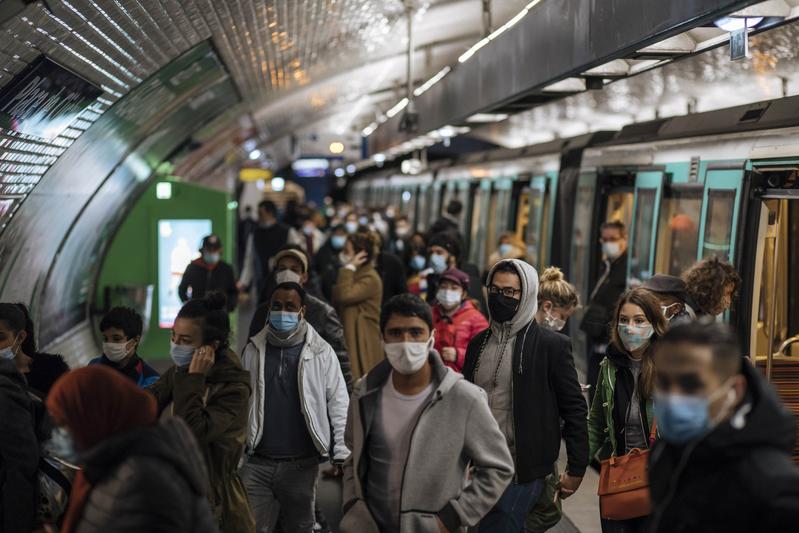
 Commuters wearing face masks walk on the platform, of a Paris subway, Oct 25, 2020. A curfew intended to curb the spiraling spread of the coronavirus, has been imposed in many regions of France including Paris and its suburbs. (LEWIS JOLY / AP)
GENEVA - Europe needs a “serious acceleration” in the fight against the coronavirus and a lack of contact-tracing capacity could drive the disease into the darkness, a top World Health Organization official said on Monday.
Europe, comprising 46 countries at WHO, accounted for 46 percent of global cases and nearly one third of deaths, said Mike Ryan, the WHO’s top emergencies expert
In Europe the picture is unrelentingly grim as a string of countries reported record increases, led by France, which posted more than 50,000 daily cases for the first time on Sunday, while the continent passed the threshold of 250,000 deaths.
The vast region, comprising 46 countries at WHO, accounted for 46 percent of global cases and nearly one third of deaths, said Mike Ryan, the WHO’s top emergencies expert.
READ MORE: France reports record 50,000 daily COVID-19 cases
“Right now we are well behind this virus in Europe, so getting ahead of it is going to take some serious acceleration in what we do,” Ryan told a news conference.
Clinical capacity to manage COVID-19 hospitalised patients has increased in Europe and death rates are “very very low”, Ryan said, paying tribute to health systems and medical workers.
“But we are seeing a large number of cases, we are seeing widespread disease, we are seeing very very high positivity rates and an increasing lack of capacity to do any effective form of contact-tracing which is further going to drive the disease into the darkness,” he said.
“And many countries are now facing the spectre of shutdowns in the coming weeks. It is not a situation where I’m sure any country in Europe or in the world would want to be in,” he added.
Maria Van Kerkhove, the WHO’s technical head for COVID-19, said: “We are still hopeful that countries will not have to go into these so-called national lockdowns.”
WHO director-general Tedros Adhanom Ghebreyesus said that during the first wave, Italy and Spain “took serious action to protect the vulnerable but at the same time reduce transmission”, adding: “The combination of this is very important.”
Tedros said governments and citizens needed to do their share and must “do everything to minimise transmission”.
READ MORE: WHO Europe warns of 'emergency fatigue'
“And that’s why we are saying, although we agree with the chief of staff (Meadows), that protecting the vulnerable is important, but giving up on control is dangerous,” he said.
He was referring to comments that White House Chief of Staff Mark Meadows made to CNN on Sunday, when he said: “We’re not going to control the pandemic. We are going to control the fact that we get vaccines, therapeutics and other mitigation areas.”
READ MORE: US trial of Lilly's virus antibody therapy to end; no safety issue
