

Breakout short video on Douyin wins online fame for painter’s ‘bamboo brush’ strokes
 Deng Yu experiments with various materials in his pursuit of combining Eastern and Western art styles. (PHOTO PROVIDED TO CHINA DAILY)
Instead of a pencil, Deng Yu uses a “bamboo brush” to sketch most of his artwork. Inspired by writing brushes in China, his brush is made of bamboo twigs, which is also his latest attempt in seeking an unpredictability for its splatter effect. He focuses on Peking Opera figures.
“After trying various materials, including paper, plastic and Styrofoam, I found the handmade bamboo brush handles the heavy and thick acrylic paint well. On canvas, its effect is close to the art of Chinese calligraphy,” said the 44-year-old artist from Shenyang, Liaoning province.
Anything at hand, such as a rag, sprayer and even a broom, can be used in his painting, Deng said.
Through Western and Chinese painting techniques, Deng has been looking for a crossroads between the two art styles.
His technique has gone viral on short-video platform Douyin, known as TikTok outside China. His breakout video recording his painting process of Qitian Dasheng (The Monkey King) received more than 408,000 “likes”. He has about 200,000 followers on the platform.
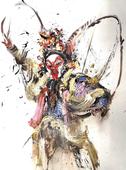 His best-known works include Qitian Dasheng. (PHOTO PROVIDED TO CHINA DAILY)
In the 36-second video, after several strokes with the twigs that seem random at first, the painter uses a variety of tools, including a painting knife and brushes, for his work. Finally, a lively Monkey King with vibrant colors appears on canvas.
Deng took months to study the character’s face through various local art forms. It took him about two months to finish the artwork.
Facing his sudden fame online, Deng said it could be “his Chinese way” of painting — including themes, techniques and calligraphy — that is capturing attention. Deng has been practicing Chinese calligraphy for about 20 years.
Peking Opera characters, such as Zhong Kui (a mythological demon killer) and Guangong (an ancient general worshipped as a symbol of loyalty, righteousness and bravery), have been important themes for his artwork, because the traditional art form’s makeup and costume give him space to create, he added.
“Calligraphy, xieyi (a style of drawing that highlights the ‘spirit’ of subjects with prominent lines), Peking Opera, tai chi, kung fu and folk art are the resources for my paintings,” Deng said.
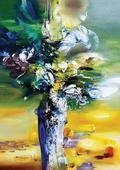 His best-known works include The Blooming Life. (PHOTO PROVIDED TO CHINA DAILY)
His recent painting has merged elements of Chinese calligraphy, showing the abstract beauty of lines, rhythm and structure.
Deng said many of his fans on Douyin are younger than 30.
“Their interest in traditional culture is my motivation in sharing my creation online,” he said, adding that the internet is making art more accessible to the public and collectors.
“In the past decades, painting was my own thing, but the internet has shortened the distance between creators and viewers,” Deng said.
His training in painting started when he was 10 years old. Deng graduated from the Luxun Academy of Fine Arts in Shenyang. In 1995, he was impressed by paintings of the Chinese-French abstract artist Zao Wou-ki (1920-2013) after he saw the artworks in a magazine. He took Zao as his spiritual guide.
In 2000, Deng continued his study at Tsinghua University’s Academy of Arts and Design in Beijing, where he took up jianbi (minimal brush strokes) in ink art as his painting style. The painting method dates back to Liang Kai, a Song Dynasty (960-1279) court painter. The art style uses bold lines, abbreviated brushwork and dynamic imagery to reveal the essence of a subject.
In 2015, his solo exhibition entitled The 20-year Retrospective was held in Shenyang. Last year, his exhibition was held at the Luxun Academy of Fine Arts.
Deng wanted to make his contribution through painting during the COVID-19 outbreak in China. He created two paintings in January, which were donated to online auctions, and the earnings went to the Wuhan Charity Federation to help in the fight against the virus.
