

Adaptive legal framework supercharged nation's renewable network rollout
Editor's note: As protection of the planet's flora, fauna and resources becomes increasingly important, China Daily is publishing a series of stories to illustrate the country's commitment to safeguarding the natural world.
When the Renewable Energy Law took effect in 2006, China's clean tech sector was a fraction of its current size, struggling to compete as the country wrestled with severe, localized power shortages.
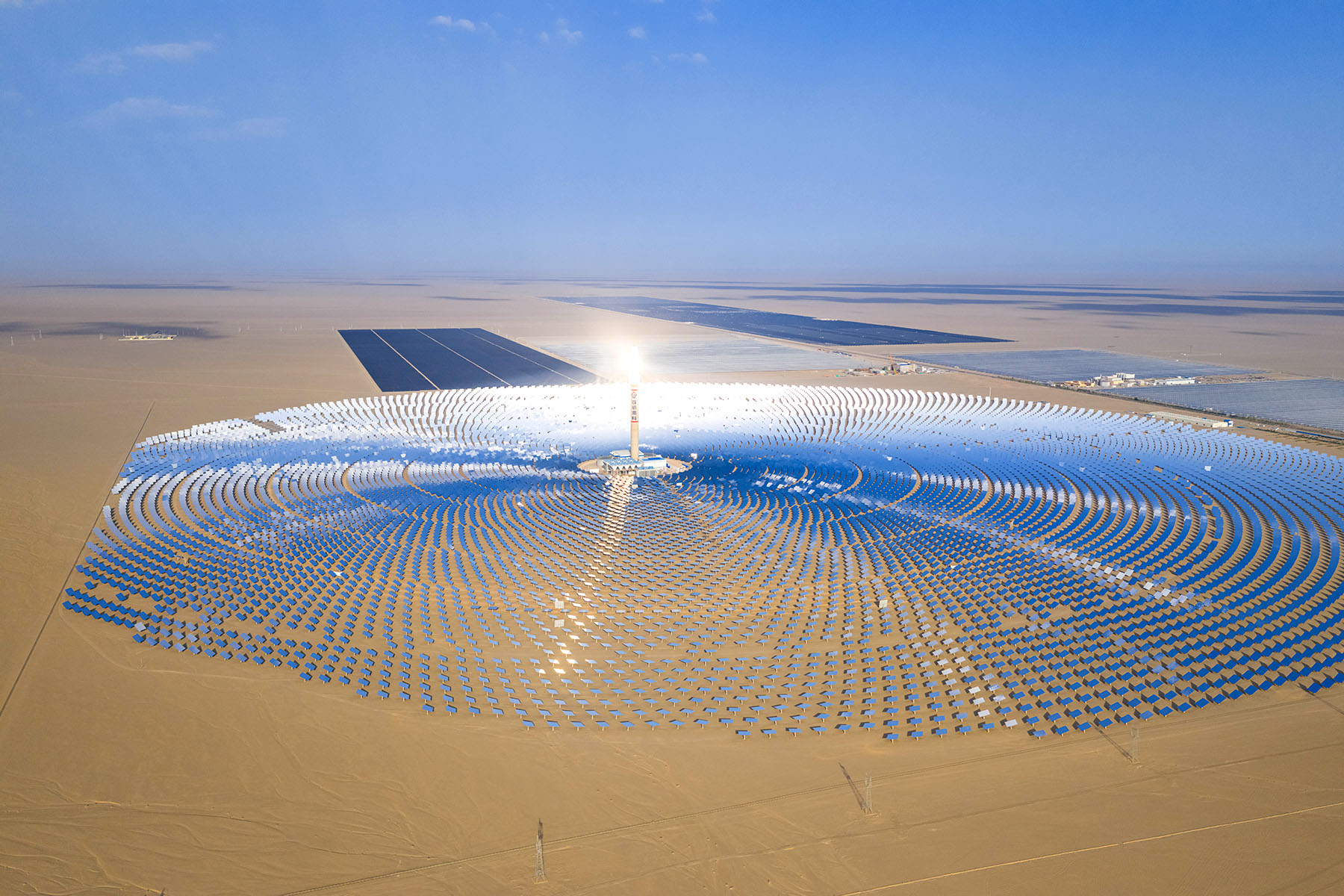
Two decades later, the transformation is staggering. By 2025, renewable electricity generation in China reached approximately 4 trillion kilowatt-hours, exceeding the total consumption of the European Union's 27 member states. More than 60 percent of China's installed power generation capacity comes from renewable sources.
This meteoric rise from a marginal player to the global leader in renewables was not an accident of the market; it was engineered by forward-thinking legislation. According to energy experts, the 2006 law provided the vital regulatory foundation required to transform an energy crisis into an economic opportunity.
READ MORE: China's green transition applauded
Zhou Dadi, executive vice-chairman of the China Energy Research Society, explained that the law was enacted against the backdrop of severe domestic electricity shortages and intensifying international climate negotiations.
Accelerated economic development following the country's reform and opening-up in 1978 further worsened the electricity supply, making rolling blackouts a frequent occurrence, he told China Energy News. On the international front, the United Nations Framework Convention on Climate Change, signed in 1992, established the principle of "common but differentiated responsibilities".
Although developed countries accounted for 60 percent of global greenhouse gas emissions at that time, and China's emissions remained far lower than those of developed economies, the country's total energy consumption — given its vast population — could no longer be overlooked, Zhou said.

The enactment of the Renewable Energy Law proved to be the decisive answer. It established renewable energy as a priority category, granted it policy preferences, and provided the legal guarantees required to launch the industry.
In 2003, the National People's Congress, China's top legislature, listed renewable energy legislation on its priority agenda.
Wang Zhongying, a key participant in drafting the law, recalled 2004 as a critical turning point that sped up its passage. That year, China announced to the world that it would enact the law at the International Conference for Renewable Energies in Bonn, Germany.
Wang highlighted the important role of international cooperation in shaping the law.
"Through renewable energy research projects with the World Bank and the United Nations Development Programme, as well as group study tours organized by different departments to Germany and Denmark, we deepened our understanding of renewable energy and accelerated the law's drafting," he said.
The efforts of Wang and his team saw the law, featuring classified pricing, guaranteed purchase and special funds, adopted in February 2005.
Qiao Liming, former head of Asia at the Global Wind Energy Council, said that while the law initially provided the framework and policy direction, it was the subsequent series of implementation rules that truly drove the market.
She pointed to the fixed feed-in tariff policy — borrowed from the German model — as the most critical element. "It allowed renewable power to be stably connected to the grid and sold, thus opening the door to the market," she said.
China's feed-in tariff mechanism — with classified price levels for different technologies and resource regions — requires grid operators to purchase renewable electricity at government-set prices, a guaranteed above-market rate funded through a small surcharge on electricity bills.
After six adjustments to subsidies for wind power and eight for solar, newly approved onshore wind and solar projects in China have achieved grid parity, with their on-grid tariffs set at the same level as local coal-fired power since 2021.
For the first decade after the law's enactment, China's wind power capacity grew 120-fold, from 1.26 million kilowatts to 150 million kW, while solar module prices fell to just one-tenth of their original cost.
However, as the industry expanded, challenges emerged. By the first half of 2016, the volume of curtailed wind and solar power had already surpassed the total for all of 2015. To address this, authorities replaced the full-guaranteed purchase mechanism with renewable portfolio standards in 2019, setting out binding targets for renewable consumption in each province.
In 2017, the Green Electricity Certificate was launched to provide a standardized way for businesses to track and verify that the power they consume comes from clean energy.
Dimitri de Boer, director for China at ClientEarth, an environmental law organization, noted that legislation must not remain static in order to be effective.
"Over time, the law, together with supporting policies, has gradually optimized the framework from administratively set prices, to competitive allocation, to full market integration and grid parity," he said.
De Boer said the second and current revision of the law provides an opportunity to further enhance its effectiveness in light of new and emerging trends.
He said further incentives for energy storage, demand-side response and flexible electricity pricing, for example, can help the energy system to adapt to the next stage of the energy transition, especially as China moves toward very high renewable penetration scenarios.
Equally, it's important to clarify the role of coal in the new system, repurposing it from base-load power to peaking power provision, he added.
De Boer suggested the circular economy and recycling in renewable energy industry chains, especially as the early installations begin to retire, become key focuses of the revision.
"At the same time, we need to ensure that renewable energy doesn't have an excessive impact on biodiversity," he said.
ALSO READ: Report: China's rapid renewables growth bolsters export resilience
Beyond its domestic impact, China's rapid expansion of clean energy spurred by this legislation has had global significance. By driving down component costs and turning climate action into an economic opportunity, China has made the global energy transition faster, more efficient and far more accessible to developing nations.
De Boer said the share of oil and gas in China's primary energy needs is now only half that of the United States or the EU, meaning China is better insulated from global energy price shocks than many other major economies.
Reducing exposure to volatile fossil fuel markets, he suggested, offers a practical lesson for other nations.
The incredible progress in renewable energy sectors in China is one of the greatest contributions to climate action globally, as it provides the solutions needed by the entire world, De Boer said.
"China has helped to turn climate action from a burden into an economic opportunity," he said.
"Without China's clean energy achievements, the global energy transition would be more expensive, less efficient and take much longer."
Contact the writers at houliqiang@chinadaily.com.cn
