

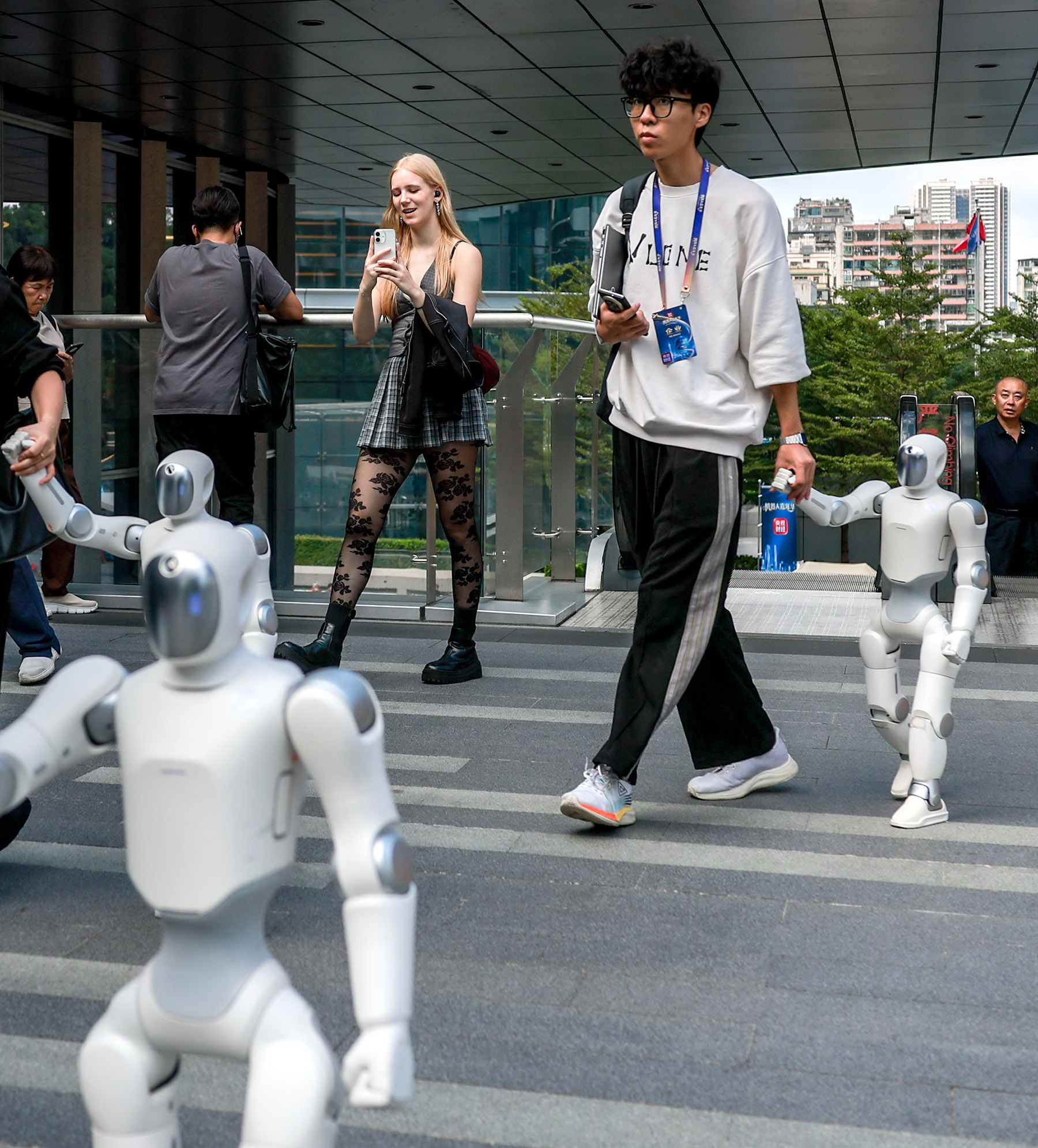
A robot sits at a piano, its two seven-axis arms and dexterous fingers moving in sync. Nearby, a solar panel-cleaning robot demonstrates its ability to scrub more than 1,120 square meters per hour. Across the hall, an underwater drone showcases its capability to descend 350 meters to inspect pipelines and submerged structures.
These are just a few of the technologies on display at the Robot Block in Shenzhen, Guangdong province, where robots are moving beyond showroom demonstrations and finding applications in an increasingly diverse range of real-world scenarios.
Longgang district, home to the Robot Block, has more than 12,700 companies across the robotics industry chain and more than 800 artificial intelligence companies, forming an ecosystem spanning core components, complete machines and application services, according to local authorities.
READ MORE: APEC reporters tour Shenzhen tech showcases
"The development of the robotics industry here is remarkable, and the ecosystem and supply chain are highly integrated," said Fan Binji, head of overseas markets at Shenzhen Future Era Robotics. "The concentration of visitors and industry professionals here also gives us opportunities to develop new products, test them in real-world scenarios and continuously improve them."
Fan said Shenzhen's extensive supply chain is a major reason companies choose to establish a presence in the city. His store works with more than 570 robotics companies and has access to local suppliers of components and chips, as well as dedicated technical support, maintenance and educational teams.
The robotics cluster is also attracting growing international attention. Fan said he has received visitors from North America, Europe, Southeast Asia and other regions, as well as government and business delegations from countries including Mexico, Japan, South Korea, Vietnam and Cambodia.
"The word I hear most often from foreign visitors is 'amazing'," he said, adding that robotic coffee art demonstrations, wearable exoskeletons and humanoid robots performing complex movements, including somersaults and martial arts, are among the biggest attractions.
Many visitors, Fan said, have expressed interest in bringing Chinese robotic products, or even his company's business model, to their home markets.
Fan said his perception of how closely robots are integrated into everyday life has also evolved.
"Does entering daily life necessarily mean a humanoid robot has to go into your house and do the housework? I don't think so," he said.
"Robots are already part of our lives," he said, pointing to reception robots in hotels and cleaning robots operating in transport hubs as examples.
Making AI and robotics more accessible to the public is another priority for Shenzhen. Chen Guoqing, a guide at the Global Pioneer • AI 6S Hub, which provides integrated services for software development and hardware manufacturing, said demonstrations play an important role in helping ordinary people understand the complexity of robotics and the technologies behind it.
"Everyone is a maker, and everything has a possibility," Chen said. "Everyone can come here with an idea, and the store will help turn it into a tangible product."
ALSO READ: GBA tours reveal true story behind nation's rapid rise
For Polish visitor Cezary, the humanoid robots on display in Shenzhen are particularly impressive. Watching demonstrations, including robot soccer, he was struck by how naturally the machines moved.
"They move like humans," he said, describing the experience as impressive and interesting. He also praised Shenzhen as a modern, clean and well-organized city.
With Shenzhen hosting the 2026 APEC Economic Leaders' Meeting this week, the Robot Block is also serving as a window into the city's technological capabilities, Fan said.
He said the event offers an opportunity to showcase China's latest innovations to international business and government representatives.
Contact the writers at jihaisheng@chinadaily.com.cn
