

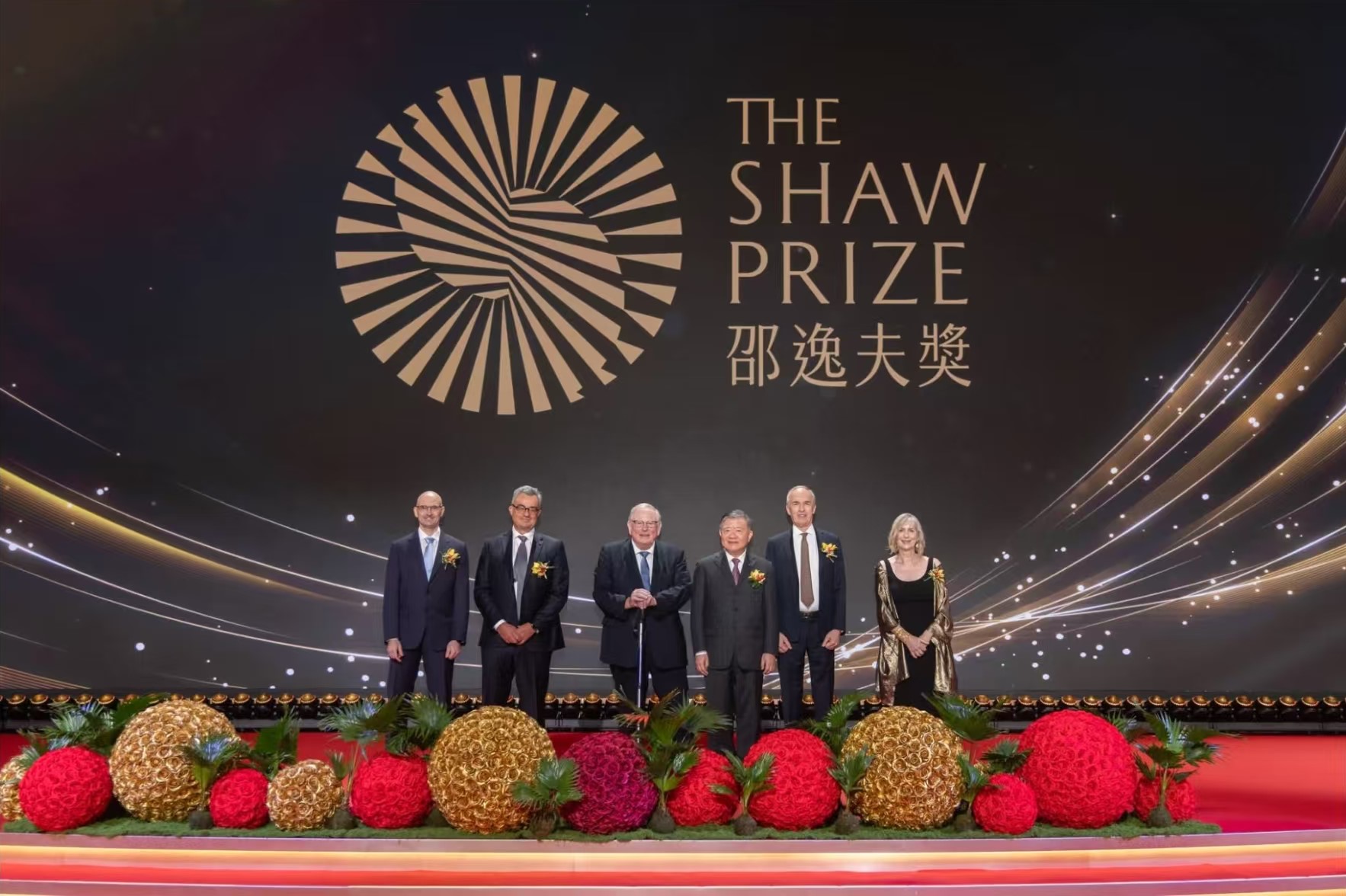
Seven scientists were awarded the Shaw Prize in Hong Kong on Tuesday for their work in astronomy, life science and medicine and mathematical sciences.
The Astronomy prize was awarded to Ken'ichi Nomoto, an emeritus professor from the University of Tokyo, and Stanford Woosley, a professor from the University of California at Santa Cruz, for their studies of stellar explosions and the origin of the elements.
The Life Science and Medicine prize went to Anne Dejean, a professor from the Institut Pasteur; Hugues de Thé, a professor from the College de France; and Zhu Chen, a professor from Shanghai Jiao Tong University, for their discovery of the molecular and cellular bases of acute promyelocytic leukemia and the pioneering of a synergistic targeted therapy.
The Mathematical Sciences prize was given to Camillo De Lellis, a professor from the Institute for Advanced Study in Princeton, and Emmanuel Candès, a professor from Stanford University, for their breakthrough contributions to the use of deep techniques from mathematical analysis to rigorously understand applied problems.
“It is a great pleasure to be the recipient of this year’s Shaw Prize in Astronomy. Especially, it’s a great honor that I am the first Asian researcher to receive the Astronomy prize,” said Nomoto in a pre-recorded message.
ALSO READ: Shaw Prize Foundation launches new award in computer science
Woosley said he and Nomoto took theories of stellar evolution, supernovae and nucleosynthesis that were very approximate and qualitative and made them “accurate and capable of prediction.”
“We originated in some cases and refined in others the models for how stars explode as supernovae and calculated the yields of every isotope,” he said.
“We are stardust, or at least 90 percent stardust by weight, the result of the deaths of 100 million stars that died before the sun was born. Ken and I have provided a detailed explanation of how that worked.”
In accepting her award, Dejean said the prize symbolizes the power of synergy between basic and clinical research and across countries and disciplines. “And just as importantly, it has also been built on a continuous cooperation and friendship between France and China since the very beginning,” she said.
De Thé said his first thoughts as he received the award were for patients with acute promyelocytic leukemia (APL). “As a trainee, I was in contact with many acute leukemias, something I will never forget. I am so glad that our work on the cure of APL was shared with the world to become the gold standard of therapy,” he said.
Zhu said winning the prize encouraged him to work even harder to tackle the challenges of other types of blood cancers and to promote collaboration between Chinese scientists and the international cancer research communities.
“I would also like to pay my highest tribute to Mr Run Run Shaw, the founder of the Shaw Prize Foundation. Throughout his life, Mr Run Run Shaw upheld the principle of ‘for the benefit of the humankind’ and dedicated himself to philanthropy and to humanity’s progress driven by science and education,” he said.
In his acceptance speech, De Lellis advised young mathematicians who are feeling uncertain as artificial intelligence solves complex problems at breathtaking speeds. “I understand the fear that we might one day become mere compilers of what machines tell us. But human curiosity is too fundamental to delegate away.”
“Instead, imagine a future where we use these tools to handle the heavy lifting, freeing ourselves from the constraints that have historically restrained our creativity. Let this technology unlock your imagination, rather than replace it,” he said.
READ MORE: Shaw Prize honors work by 5 scientists
Candès said his current work explores how careful thinking about AI inputs and outputs can produce more powerful and safer AI.
“It aims to address questions such as: How do we train language models under cost constraints? What happens when we have exhausted all available data? If I begin a clinical trial using the drug that AI predicts is best, will it succeed?” he said.
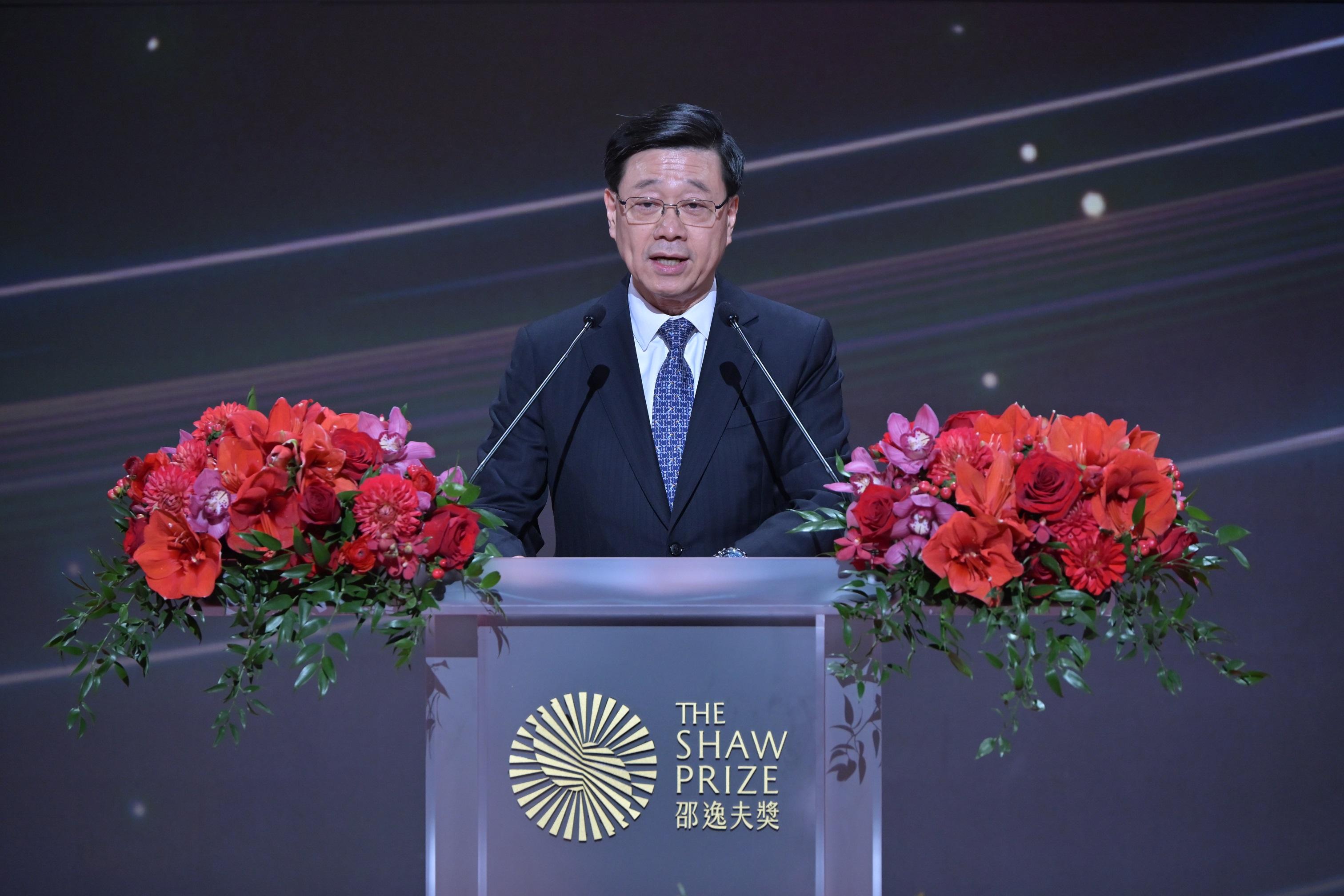
Around 600 guests from the Hong Kong Special Administrative Region government, and political, business, science and education sectors gathered at the Hong Kong Convention and Exhibition Centre for the awards ceremony, which was officiated by Chief Executive John Lee Ka-chiu.
Conveying his congratulations and commending the laureates’ contributions to advancing knowledge and inspiring younger generations of scientists, Lee said, "Your work reflects a deep commitment to science and the pursuit of knowledge. Hong Kong shares that commitment, and we are turning it into action."
"The Shaw Prize celebrates curiosity, rigor and discovery. Those are also the qualities behind our investment in the university towns," the CE said, referring to three university towns being developed in the Northern Metropolis.
