

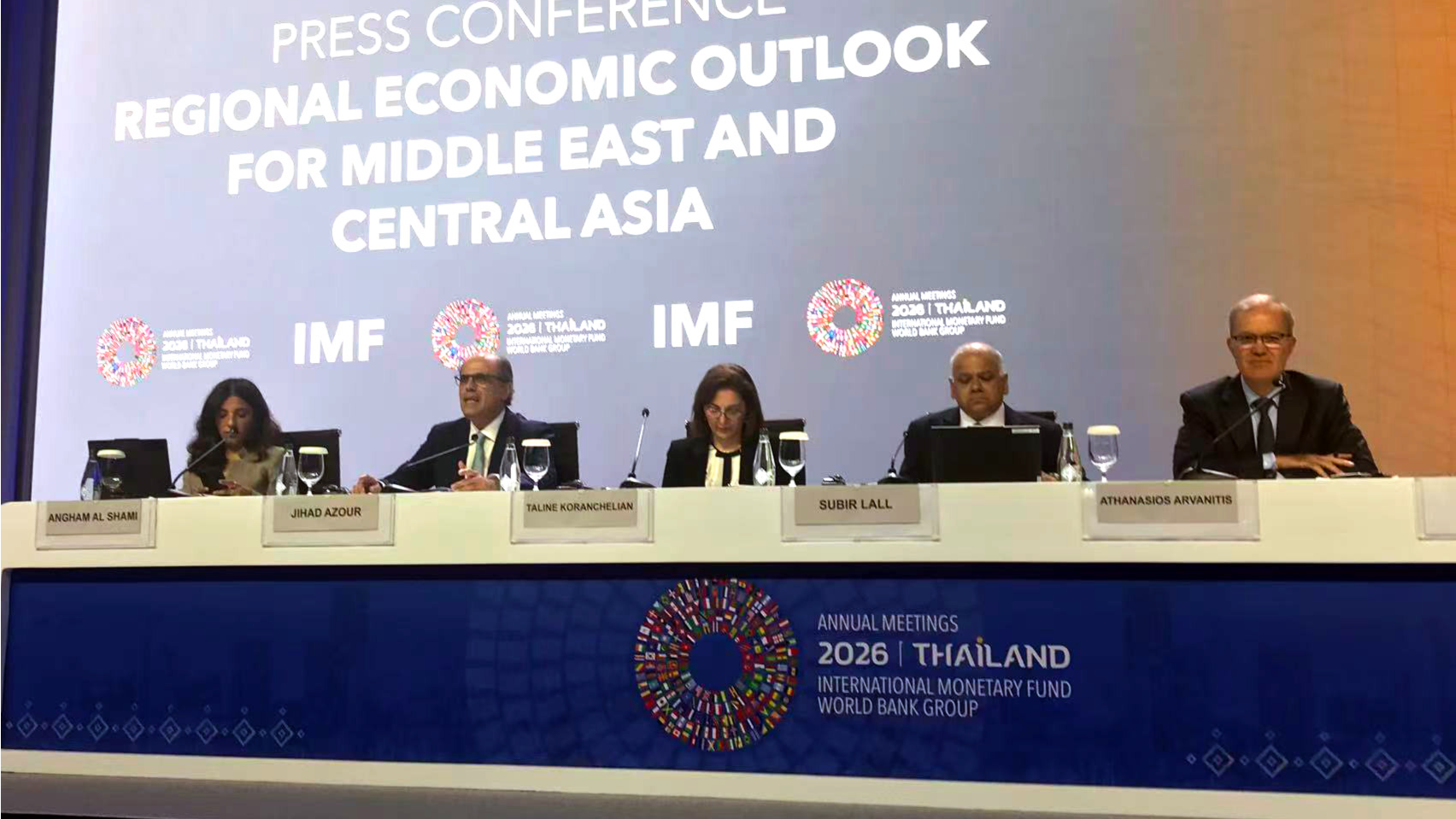
Senior officials from International Monetary Fund have highlighted the role played by the Hong Kong Special Administrative Region’s capital contribution in the economic transformation of the Middle East and Central Asia.
Both parties have forged increasing connectivity in cross-border payments, financial technology and investment collaboration, the officials said.
Central Asian countries are trying to expand beyond their traditional focus such as energy and commodities, and this requires more investment in non-traditional areas and greater role for the private sector.
“The relationship between the Middle East and Central Asia with Asia is set to grow and to become even more deeper, reaching not only energy supply but also some joint infrastructure projects and technology,” said IMF Middle East and Central Asia Department Director Jihad Azour at a press conference on Thursday during the 2026 Annual Meeting of IMF and the World Bank Group, which is being held in Thailand.
ALSO READ: Northern Metropolis to boost regional economic integration, says IMF
“The Chinese mainland is one of the main trade partners for Gulf Cooperation Council Member States. There is strong cooperation between GCC financial centers and Hong Kong in areas of cross-border payment, financial technology and investment collaboration,” Azour added.
As the Middle Eastern and Central Asian countries are seeking economic diversification, this shift necessitates regional reforms to attract capital because Asia remains a critical partner for energy security, technology and infrastructure.
“The investor base coming out of Hong Kong and East Asia can be a very important source of capital especially for the (the Middle East and Central Asia’s) private sector to be able to make those investments,” said Subir Lall, deputy director of IMF Middle East and Central Asia Department.
ALSO READ: HK pitches itself as Asia-Pacific's 'harbor' for trade as routes shift
“Hong Kong and East Asia could be a very important source for private sector-led growth which will be necessary to sustain the momentum in the region that we have seen over the last few years to carry on for the medium and longer term,” Lall noted.
The deputy director added that the economies in the Middle East and Central Asia need to make more reforms to create space for the private sector and make it attractive for overseas companies to set up business there.
In June, Hong Kong SAR Chief Executive John Lee Ka-chiu led a high-level joint Hong Kong-Chinese mainland business delegation to Kazakhstan and Uzbekistan. As a result, 15 memorandums of understanding and agreements covering areas such as commerce, education and development projects were signed between the special administrative region and Kazakhstan and Uzbekistan.
READ MORE: CE: HK's strengths key to developing new quality productive forces
The governments agreed to commence bilateral discussions on agreements in various areas, including discussions with Kazakhstan and Uzbekistan on comprehensive avoidance of double taxation agreements, negotiations on a bilateral investment promotion and protection agreement, and cooperation with Uzbekistan on customs clearance facilitation.
