

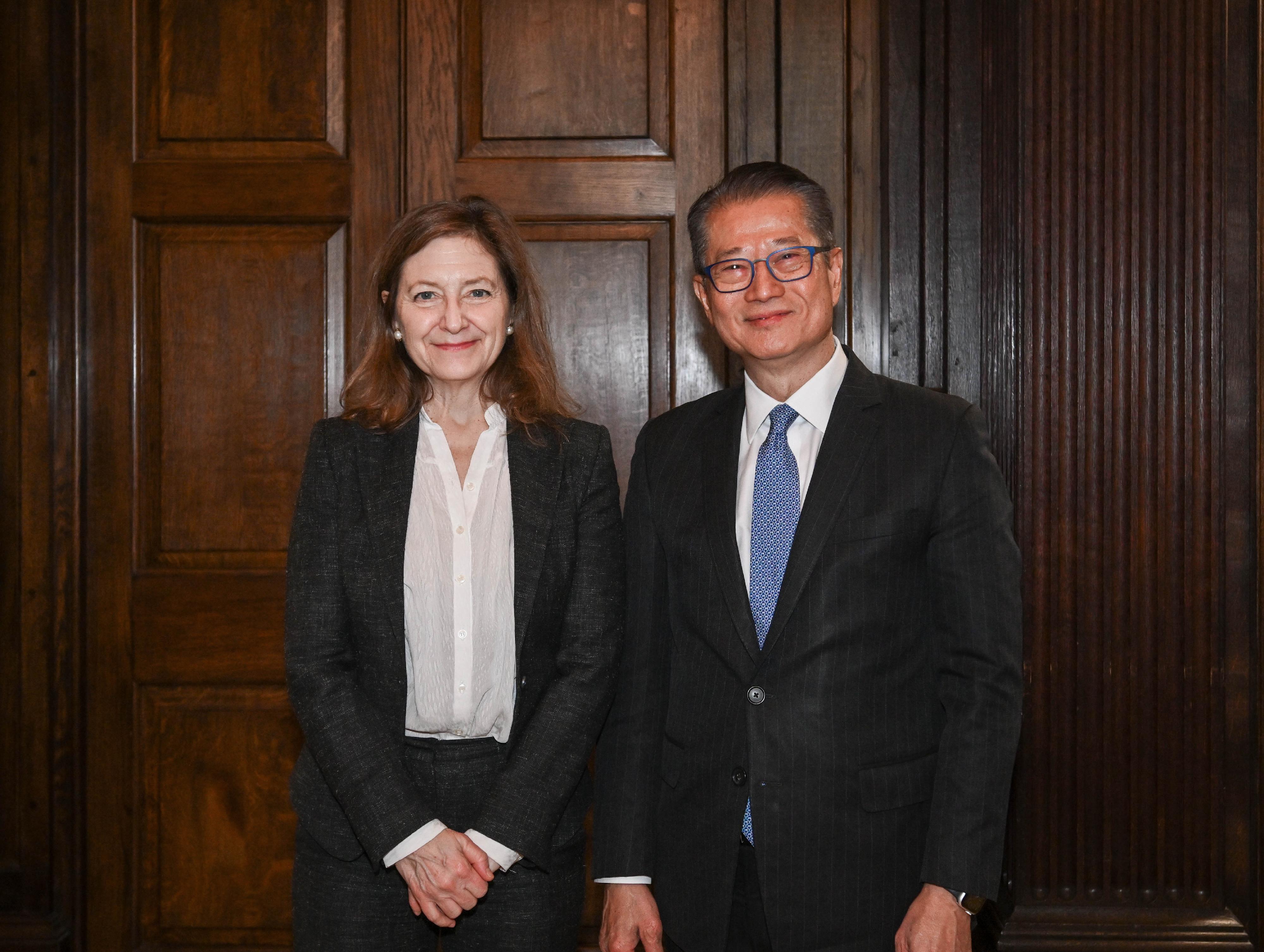
To strengthen business and scientific ties, Financial Secretary Paul Chan Mo-po led a delegation on a visit to the University of Cambridge on Monday and urged UK research institutions and enterprises to open offices in Hong Kong and collaborate in bringing research outcomes to the wider Asian markets.
Chan met with Deborah Prentice, vice-chancellor of the University of Cambridge, and discussed further strengthening cooperation between Hong Kong and the university in scientific research, talent nurturing and the commercialization of research outcomes.
He briefed her on the latest innovation and technology (I&T) developments in the city and the development of the Northern Metropolis University Town, while welcoming the University of Cambridge to strengthen its ties and research collaboration with universities and research institutions in the territory.
ALSO READ: Chan: New partner ports to boost Hong Kong’s global hub status
Chan also introduced the advantages of Hong Kong to several UK academic institutions, think tanks, I&T enterprises and the investment sector.
Attending the UK-Hong Kong Innovation Dialogue, a roundtable co-organized by the Hong Kong Trade Development Council and the Cambridge Institute for Sustainability Leadership, Chan said that Hong Kong and the UK have a solid foundation for cooperation in scientific research.
Under the InnoHK research clusters, eight UK universities, including the University of Cambridge, have partnered with Hong Kong institutions to establish more than 10 joint laboratories, Chan said.
AstraZeneca, a biopharmaceutical company headquartered in Cambridge, has also set up a research and R&D center in Hong Kong, he added.
Chan said that Hong Kong and Cambridge can strengthen cooperation in capital, connectivity and talent, while jointly promoting scientific research and the commercialization of research outcomes.
READ MORE: Chan: Enterprises, talent key to HKSAR’s inno-tech hub goals
Hong Kong offers technology enterprises a full range of financing options, with private equity and venture capital funds in the city managing assets of about $250 billion, he said.
Chan invited research institutions and enterprises in the UK to consider setting up offices and R&D bases in Hong Kong, and to raise funds through Hong Kong's capital market.
He said Cambridge has formidable strength in scientific research, while Hong Kong has an edge in commercializing research outcomes, financing and opening up Asian markets.
In an exchange session with Cambridge Enterprise, the arm of the University of Cambridge responsible for commercializing its research outcomes, Chan and the delegation learned about its experience in the commercialization of intellectual property, start-up incubation and early-stage investment, and explored room for cooperation with Hong Kong.
The delegation included Frederick Ma So-hang, chairman of the HKTDC, and Legislative Council members Duncan Chiu Tat-kun, Michael Ngai Ming-tak, and Nixie Lam Lam.
