

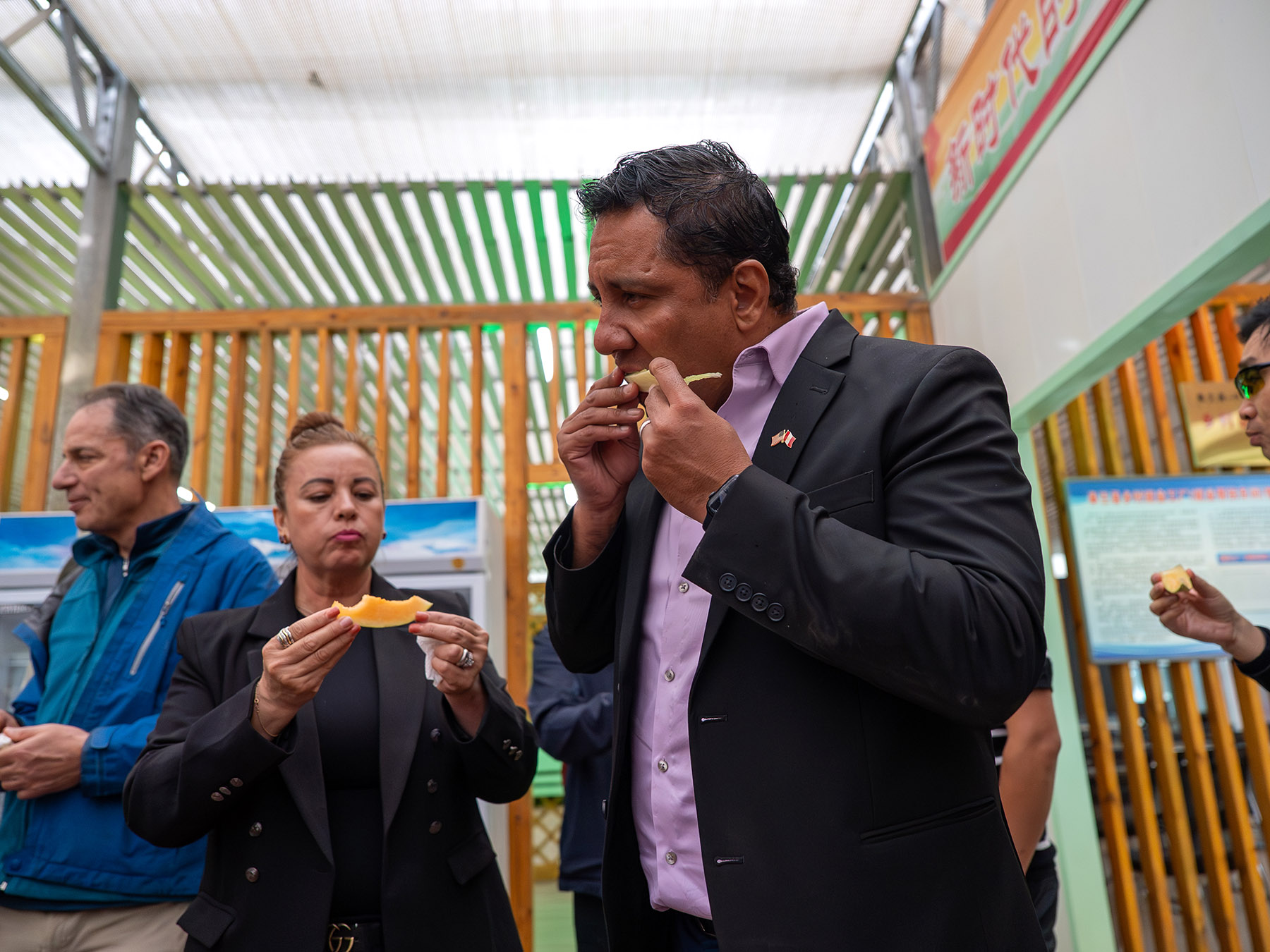
For the visitors from Albuquerque, New Mexico, the United States, the Bailan melon they tasted in Lanzhou offered more than a taste of a local specialty.
The fruit carries a story that stretches back more than 80 years, to a time when melon seeds traveled from the US to Lanzhou in Northwest China's Gansu province.
Today, as the two cities mark three decades of their sister city relationship, the melon offers a small but tangible reminder of the many ways people and communities can remain connected beyond borders.
In 1944, US vice-president Henry A. Wallace then visited Lanzhou and brought seeds of the honeydew melon to the city. The seeds were later successfully cultivated in Lanzhou's sandy fields. The melon was initially named "Wallace" in his honor and later renamed the "Bailan melon", with "lan" referring to Lanzhou and "bai" meaning white in Chinese.
Over the decades, the fruit has been cultivated and improved in Lanzhou, growing into one of the city's signature agricultural products. Still cultivated in places such as Shichuan town in Gaolan county, the melons are now sold across China and overseas, generating income for local farmers.
For the Albuquerque delegation, however, the fruit also offered an unexpected window into the history of exchanges between China and the US.
Alana Eileen McGrattan, second vice-chair of the Albuquerque Sister Cities Committee, was particularly interested in the orchards and how local growers deal with pests and manage the soil. She compared the agricultural practices with those used in Albuquerque, where farmers also irrigate crops from the Rio Grande, which she likened to the Yellow River in China.
She expected farmers from the two cities could visit each other and learn from one another, noting that Albuquerque also has a range of fruit and nut crops.
For her, the Bailan melon story showed how people-to-people exchanges can span generations.
"We're volunteers. We're not paid to do this," she said of her involvement in the sister-city program. "We do this because we feel citizen diplomacy is important for the world."
Monica Renee Mitchell, deputy director of the Albuquerque Economic Development Department, was visiting Lanzhou and China for the first time. She said the trip had given her an opportunity to see the city and meet its people firsthand.
"I think people-to-people exchanges are so important because they build strength in community, helping us have a better understanding of cultures," Mitchell said.
She also saw a practical dimension to maintaining contact between the two cities, saying the delegation members had discussed ways to build relationships and explore what each side could bring to the other.
The melon's journey across the Pacific came long before the two cities established their sister city relationship 30 years ago.
On April 18, 1996, the Albuquerque City Council established a sister city relationship with Lanzhou. Over the past 30 years, the two cities have maintained exchanges in culture, education, tourism and economic development.
The delegation also visited a local school, where they watched students perform traditional Chinese music.
As a teacher herself, McGrattan was inspired by the students' performances and traditional Chinese instruments.
"I will share this with my students when I go home to New Mexico," she said.
For McGrattan, who has long taken part in international exchanges, meeting people in person remains important in an increasingly digital world.
"Coming together face-to-face is much more productive," she said, adding that young people can gain experiences and friendships through such exchanges that stay with them for years. "If young people aren't involved, this will not continue."
Diego Leon Lucero, acting director of the Albuquerque Department of Arts and Culture, also saw opportunities for the two cities to deepen cultural exchanges, particularly among young people.
"My very first impression is how similar Lanzhou and Albuquerque are," he said, noting that both cities are surrounded by mountains with a river running through the middle.
He said he hoped the two cities could create more opportunities for young people to share their experiences, arts and music. "Being able to connect our youth and being able to share these experiences and share culture and share art and share music only make us a more friendly community," he said.
Tong Yunshan and Wu Yuexuan contributed to the story.
Contact the writers at huyumeng@chinadaily.com.cn
