

Exports propelled by innovation-driven orders for robots, AI, pioneering drugs
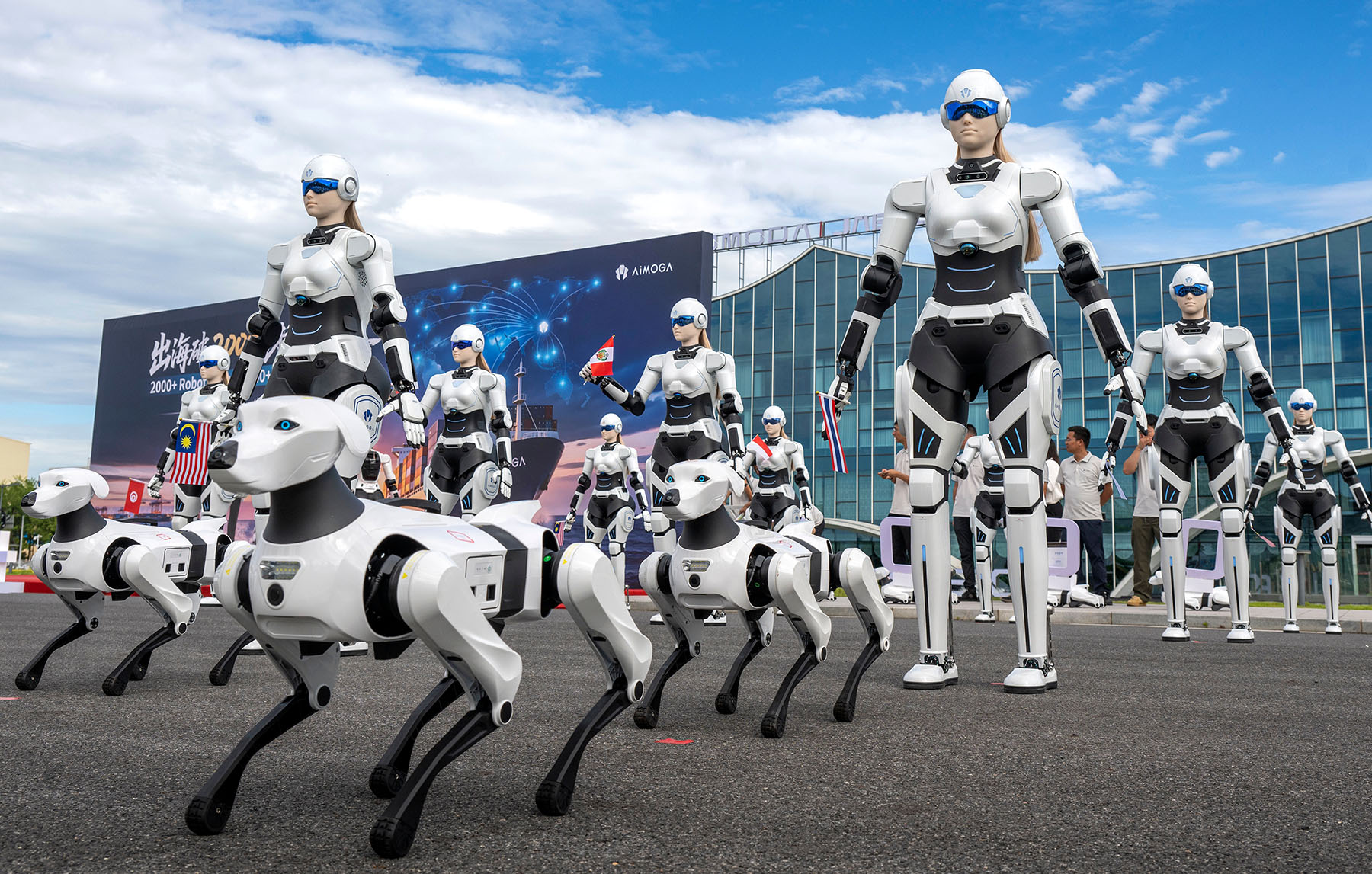
Driven by a systemic leap in independent innovation, China's foreign trade reached a historic high of over 25 trillion yuan ($3.72 trillion) in the first half, propelled by orders for robots, artificial intelligence and innovative drugs — collectively known as the "new new three".
The evolution of China's export portfolio tells a compelling story of continuous industrial upgrading. Decades ago, the "old three" — clothing, furniture and home appliances — dominated shipments, later replaced by the "new three" of new energy vehicles, lithium-ion batteries and solar cells.
Today, the "new new three" are emerging as the latest calling cards of Chinese foreign trade. Chen Yutao, deputy director of the standard committee at the China Enterprise Confederation under the State-owned Assets Supervision and Administration Commission, said this evolution represents a concentrated demonstration of China's shift from advanced manufacturing to an even more comprehensive innovation ecosystem.
READ MORE: 'Next new three' items send air cargo soaring
This year, the accelerated development of the AI sector has seen China exporting algorithms, computing power and digital solutions, alongside rapid growth in AI hardware exports. Amid the global AI boom, massive amounts of data are transmitted between data centers, with facilities increasingly reliant on advanced optical communication networks.
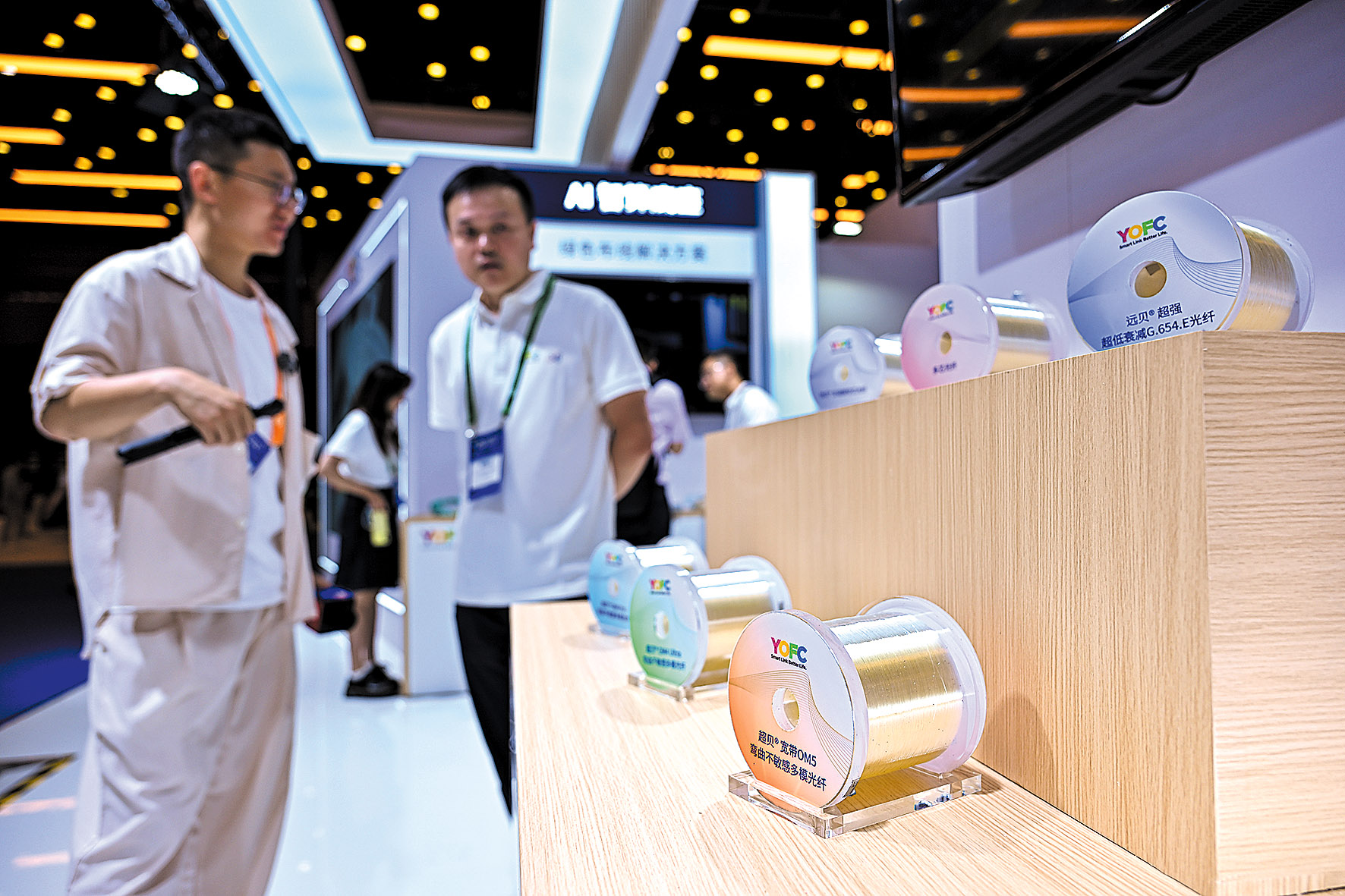
In a production facility of Yangtze Optical Fibre and Cable Joint Stock in Wuhan's Optics Valley in Hubei province, production lines are operating at full capacity.
"Special optical fibers used for AI intelligent computing centers are currently in short supply due to the explosive growth of data centers," said Wen Xiaojiang, general manager of YOFC's International Company.
Securing these orders is the result of years of technological accumulation. Since China's first practical optical fiber was born in Wuhan in the 1970s, Optics Valley has built an industrial cluster encompassing materials, devices and equipment. Today, more than 800 AI enterprises are rooted in the area, with the optoelectronic information industry's annual output exceeding 660 billion yuan.
Anticipating AI computing scenarios, YOFC has proactively developed a series of AI computing optical fibers, propelling China to the forefront of next-generation optical fiber technology. Zheng Xin, vice-president of YOFC, explained they developed this fiber recognizing its advanced concept, believing it would be widely used. "When the AI wave arrived, this fiber was ready for those who were prepared," Zheng said.
The rise of the "new new three" is heavily supported by China's robust high-end manufacturing and industrial clusters. Backed by a complete industrial ecology, Chinese robotics has become a front-runner in the global wave of intelligence. Inside a robotics company in Beijing's Zhongguancun tech hub, a head of overseas business conducts a video call with a Thai agent, promptly adjusting technical solutions to customize the most suitable products.
Founded in 2014, this enterprise has leveraged years of technological reserves to expand globally. Its robots are now deployed in over 40,000 hotels, more than 200 medical institutions and numerous factories across over 20 countries.
Utilizing a modular architecture, the company flexibly combines a universal robot chassis with various functional components. Users can dispatch robots to complete multiple tasks by issuing voice or text commands through an AI smartphone assistant.
Within the company, robots are increasingly becoming daily co-workers, navigating between floors to respond to employee needs, thereby refining their practical service capabilities. In the first half, China's cumulative exports of various robots reached 12.947 million units, with a total export value of 24.85 billion yuan, reaching more than 160 countries and regions. Relying on abundant application scenarios and comprehensive supply chains, Chinese firms are providing smarter, cost-effective robots worldwide.
While AI and robotics exports primarily involve products and system-based services, the innovative pharmaceutical sector is increasingly characterized by the export of patents and foundational research capabilities. In the first half, 31 domestically produced innovative drugs were approved for market launch nationwide.
Two originated from the medicine port in Hangzhou's Qiantang New Area, a compact hub that has gathered over 300 innovative pharmaceutical companies over the past 10 years. Notably, even before achieving commercial sales, some pharmaceutical companies have already generated overseas revenue through drug patent licensing.
Qian Lili, chairwoman of I-Mab Biopharma, recalled that 10 years ago, Chinese firms had to wait for products to be launched abroad before introducing them domestically.
"Currently, we are out-licensing the rights of our self-developed products to overseas companies," Qian said.
This year, the company completed a business development transaction with US company Biogen for a self-developed anti-CD38 monoclonal antibody, with a total deal value of $850 million and an upfront payment of $100 million. Such deals allow domestic pharmaceutical companies to jointly advance research and development and sales with global partners, becoming a crucial pathway to enter the international market.
In the first half, the total value of China's out-licensing transactions for innovative drugs exceeded $100 billion, setting a historical record and pushing the industry's scale to the second largest globally.
Behind this success is a significant reduction in core material costs. The price of domestically developed cell culture media — essential for biopharmaceuticals — is now only one-quarter of what it used to be. This continuous reduction in raw material costs, optimized processes and sustained basic research have accelerated the global expansion of innovative drugs.
Accelerated R&D and faster regulatory approvals have enabled domestic innovative drugs to get to market quickly, benefiting domestic patients earlier.
Shen Lin, vice-president of Peking University Cancer Hospital, said doctors feel much more confident as R&D speed has significantly increased.
Liu Guoen, dean of the Peking University Institute for Global Health and Development, views this explosive growth as the inevitable result of decades of long-term accumulation, and expects that going global will remain the biggest highlight on China's path of innovation.
According to industry surveys, many professionals have been somewhat surprised by the rapid development of many sectors. Longstanding optical fiber manufacturers did not anticipate the sudden AI demand surge, robotics companies did not foresee the sheer volume of customized global requests, and innovative drug practitioners never imagined established overseas pharmaceutical giants would actively seek R&D collaborations from Chinese partners.
The overarching consensus is that the "new new three" represent a new systemic capability cultivated through decades of exploration in Chinese manufacturing, marking a qualitative upgrade of China's industrial logic heading into the 15th Five-Year Plan period (2026-30).
Hao Jianbin, a researcher at the Shanghai University of Finance and Economics, pointed out this transition embodies a comprehensive iteration of China's comparative advantages in foreign trade.
Hao said the growth driver has shifted from supply chain scale to original innovation, competing on foundational technology. Furthermore, patterns have diversified from physical goods to a composite trade of goods and knowledge-centric services, raising the ceiling of foreign trade added value. China's position in the global division of labor is also moving upward, directly targeting global frontier sectors.
ALSO READ: Fast-growing sectors driving supply chain innovation
Additionally, the international cooperation model has shifted from one-way outbound sales to two-way global collaborative innovation. Transnational open-source collaboration in AI and cross-border joint R&D in innovative drugs have become the new norms, demonstrating stronger resilience and adaptability to diverse global needs.
Zhao Lijin, deputy director of the Market Research Department at the CCPIT Academy, concluded that the progression to the "new new three" export product categories demonstrates China's export overseas sales structure is continuously moving toward newer, higher-quality frontiers.
With core advantages shifting to independent, source innovation aspects, more golden ideas from laboratories are accelerating their transformation into golden keys for development, Zhao said.
Contact the writers at renqi@chinadaily.com.cn
