

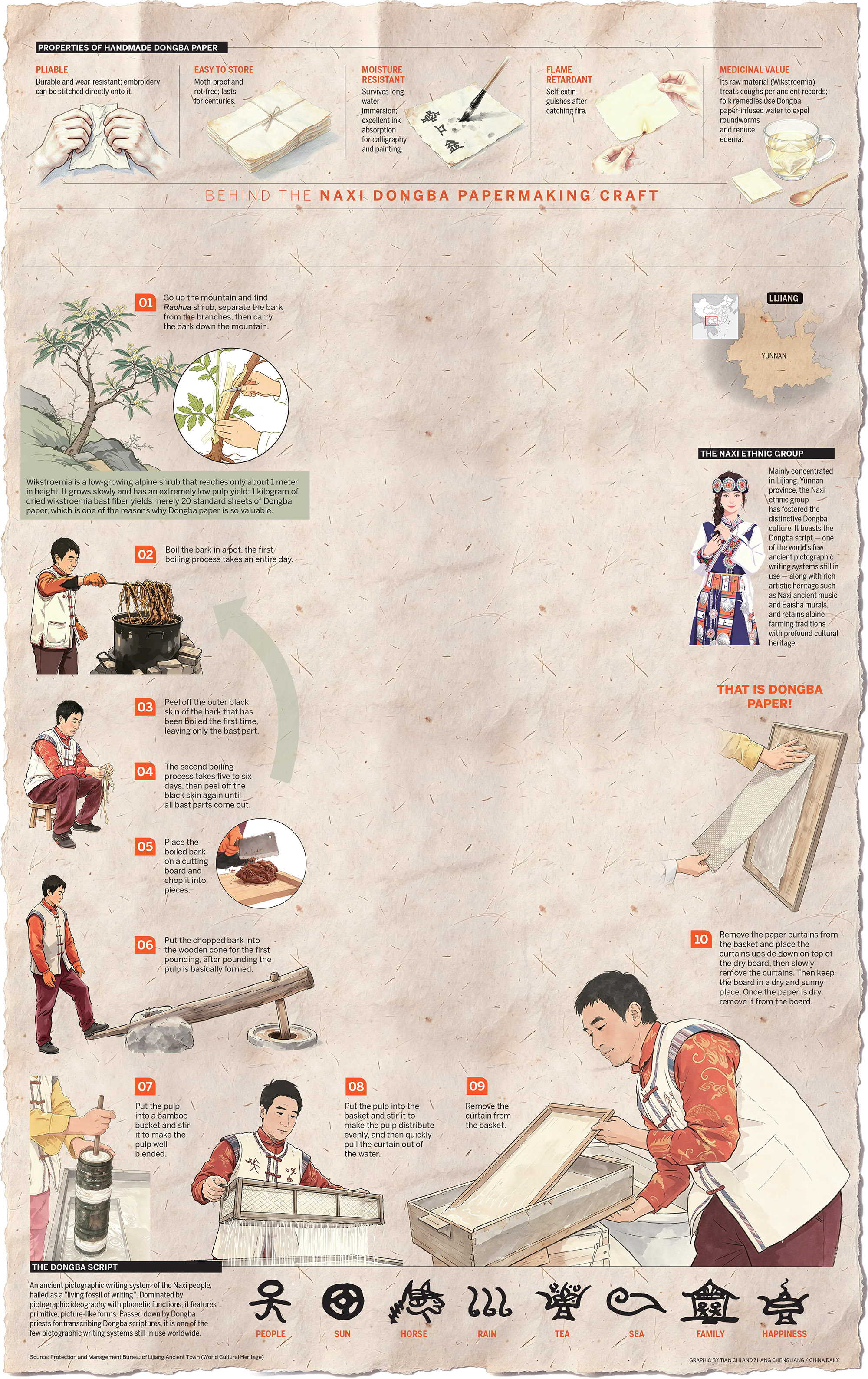
Naxi Dongba papermaking technology has a long history, the process is complex, and producing a batch of paper requires more than 30 procedures and takes about one month, Yang Feiyue and Li Yingqing report in Lijiang, Yunnan province.
Editor's note: Using a blend of words and visuals, this series explores unique communities and reveals the heart of China through food, architecture, craftsmanship, landscapes and traditions.
On a wooden table in Lijiang, Yunnan province, He Xiuchang works diligently to separate pieces of dark bark from a pile of softened plant fibers — the result of days of soaking and the first of many labor-intensive tasks. The work may appear simple, but it is one of the most critical steps in the centuries-old tradition of Dongba papermaking, which produces handmade paper once used to record scriptures and create paintings.
"The black bark has to be removed again and again," said He, a provincial-level inheritor of the Dongba papermaking craft. "If it is left behind, the paper becomes fragile and its quality is affected."
Behind every sheet of Dongba paper is a long journey that begins in the mountains around the Old Town of Lijiang.
The main raw material is the bark of the Wikstroemia shrub, known locally as raohua, which grows at altitudes above 2,200 meters. The plant's strong fibers and natural resistance to insect infestations give the finished paper its distinct durability.
Harvesting the bark requires care. The shrub grows no taller than 1 to 1.3 meters, with branches no thicker than a thumb, and has a natural lifespan of only 13 to 15 years. If cut before it dies, however, it regrows like a wild vegetable — a sustainable cycle that has allowed generations of papermakers to return to the same hillsides year after year. The bark is stripped from the branches, and only the inner layer is used. The outer bark, as He explains, is brittle and tears easily.
Making Dongba paper is a test of patience. In the traditional process, the bark is boiled twice.
READ MORE: Tourists choose souvenirs that ensure memories don't fade
The first boiling, which takes about a day, loosens the outer layers. The second boiling lasts five to six days — sometimes longer — to break down the fibers until they are soft and pliable.
Between the boiling tasks, the bark is washed, left to ferment, and washed again.
"It takes at least 34 procedures," He said. "You cannot skip any of them. If you do, the paper won't hold together."
The most elaborate methods can involve more than 90 steps, with repeated rounds of washing, fermentation and beating to create a finer texture.
"But for everyday use, 34 steps are enough," he added with a practical smile.
After boiling and fermentation, the softened bark is pounded in a wooden mortar using a foot-powered lever — a rhythmic motion that He describes as "good exercise". The pulp is then mixed with water in a vat. A bamboo screen is dipped into the mixture, lifted, and shaken gently to spread the fibers evenly. Water drains through the mesh, leaving a thin layer of wet pulp on the screen. The sheet is pressed, transferred to a wooden board, and left to dry under the sun. Once fully dry, it is peeled off by hand.
Dongba paper has a natural ivory color, with plant fibers visible across the surface. Over years of use, the paper gradually changes into a warm shade of bronze.
He developed a simple method to test the authenticity of Dongba paper. "Insects won't eat it," he said, holding up a sheet. "You can soak it in water for a year without it falling apart. And if you put a flame to it, it smoulders slowly and smells like incense."
For centuries, its strength and longevity made it the ideal medium for Dongba scriptures and paintings.
The paper can be written on both sides, absorbs ink well and is resistant to insects, allowing ancient texts to survive through generations. In 2003, the ancient Naxi Dongba Literature Manuscripts, often written on Dongba paper, were included in UNESCO's Memory of the World Register, recognizing their importance as a record of the Naxi people's history and culture.
Today, the craft is no longer limited to religious texts. Workshops in Lijiang have transformed Dongba paper into notebooks, bookmarks, lamps, postcards and other cultural products, giving the ancient technique new uses in contemporary life.
For He, preserving the craft is not just about protecting an old method of papermaking. "It is about keeping the knowledge and memories carried by this paper alive," he said.
Contact the writers at yangfeiyue@chinadaily.com.cn
