

Suspended 60 meters above the valley floor, the Hanging Temple transforms into a canvas for a breathtaking show, revealing the secrets of its 1,500-year existence, report Bai Shuhao and Zhu Xingxin in Datong, Shanxi province.
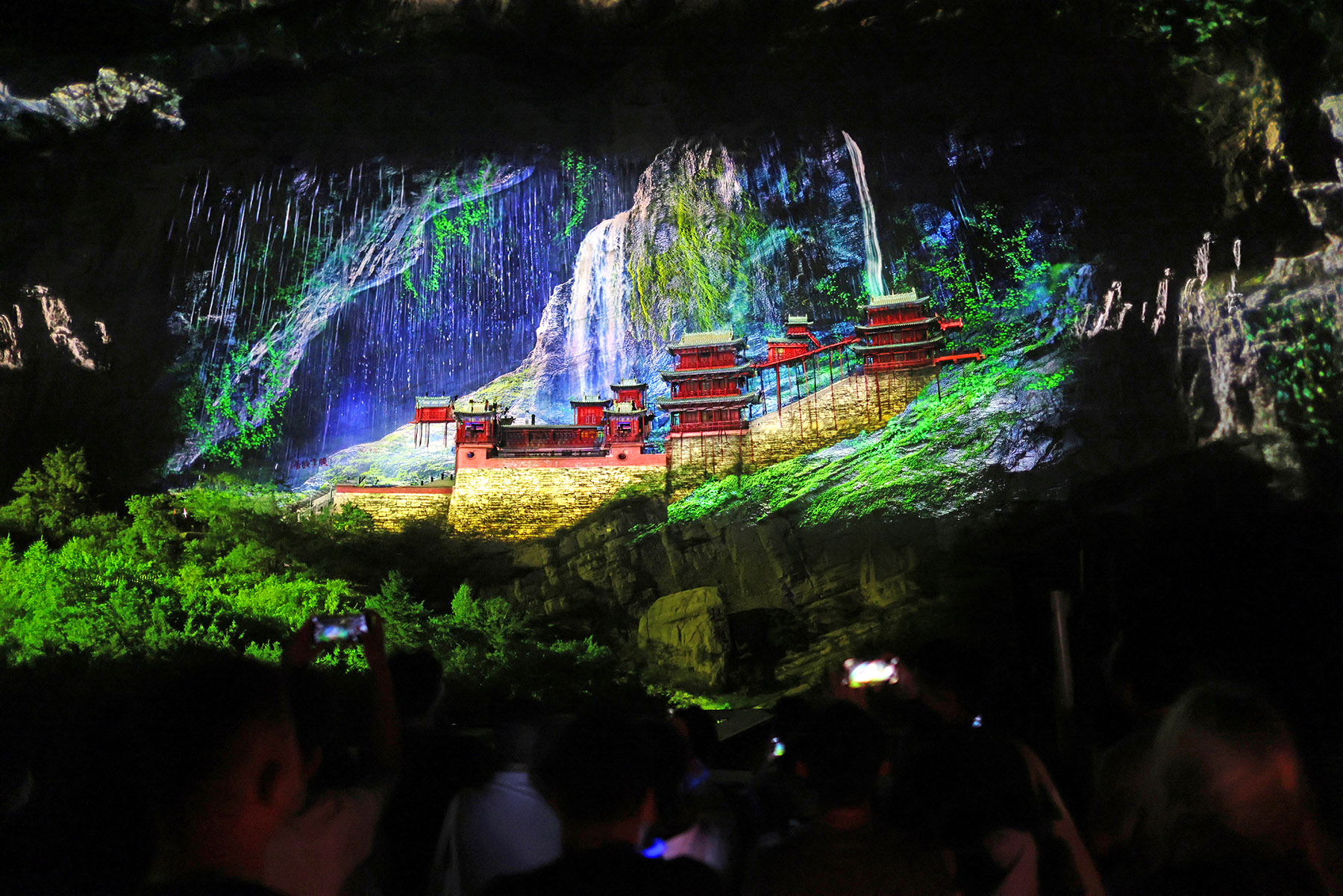
Before the sun slips behind the mountains, no one quite knows how the Hanging Temple will appear after dark.
For nearly 1,500 years, the monastery has clung to a sheer cliff face in northern China's Shanxi province, suspended between rock and sky. It appears almost frozen in time, but at night it waits for light to awaken it again.
"I'd seen so many photos and videos of it on social media," says Joe Burns, a British travel vlogger visiting the temple for the first time. "But in reality, it's much smaller than I imagined."
Perched more than 60 meters above the valley floor on the cliffs of Hengshan Mountain near Datong, the Hanging Temple is one of China's oldest and best-preserved cliffside wooden structures. From a distance, its red timber columns and yellow, glazed roof tiles resemble a finely crafted wooden box tucked into the mountain.
READ MORE: Xuankong Temple: A popular place to hang out
The temple occupies just 472 square meters. Some corridors are so narrow that only one person can pass at a time. On one side stand statues representing China's three major philosophical and religious traditions — Confucianism, Buddhism and Taoism. On the other is open air. Visitors inch carefully along the walkways, gripping the railings as they search for an answer to a question almost everyone asks upon arrival: How can a temple seemingly float in midair?
"People's first reaction is always the same," says Yang Jianlin, director of the nighttime multimedia production Why Hanging Temple Endures. "Why was it built here? What was the purpose?"
His work, staged against the cliffs surrounding the temple, attempts to answer a mystery that has endured for more than a millennium.
The projection spans more than 37,000 sq m of cliff face and recently received Guinness World Records recognition as the world's largest cliff projection show. Since tickets went on sale in late May, every performance has sold out, drawing more than 2,000 visitors each evening.
Yang grew up in Shanxi, not far from the temple. After more than a decade working in live tourism performances, he says one unlikely source of inspiration for the show was Black Myth: Wukong, the blockbuster Chinese video game that introduced many international audiences to Shanxi's ancient architecture.
"It made me realize these buildings shouldn't only be places people visit," he says. "They can become immersive experiences where people step directly into history."
But transforming one of China's most treasured ancient monuments into a stage for a large-scale light show has also raised questions.
Supporters hope the production reveals dimensions of the temple that daytime visitors cannot see. Critics worry that dazzling projections might disturb the quiet dignity of a sanctuary that has overlooked the valley in solitude for centuries.
Before the performance, Burns imagines what awaits him.
"I think there will probably be lasers, projections, all kinds of effects to make the place stand out," he says.
Painter Li Zhengming, a member of the China Artists Association, is more cautious. Having sketched historic architecture across Shanxi and watched similar productions elsewhere, he worries that many light shows emphasize spectacle while neglecting the history and culture of the buildings themselves.
"Light shows are fine," Li says before the performance. "The key is whether they handle the details well."
At 8 pm, just before the show is due to begin, a loudspeaker announces a 10-minute delay because the sky is still too bright.
Then darkness arrives.
The temple disappears almost completely into the mountain. Even those who have spent the afternoon touring it struggle to locate it against the black cliffs.
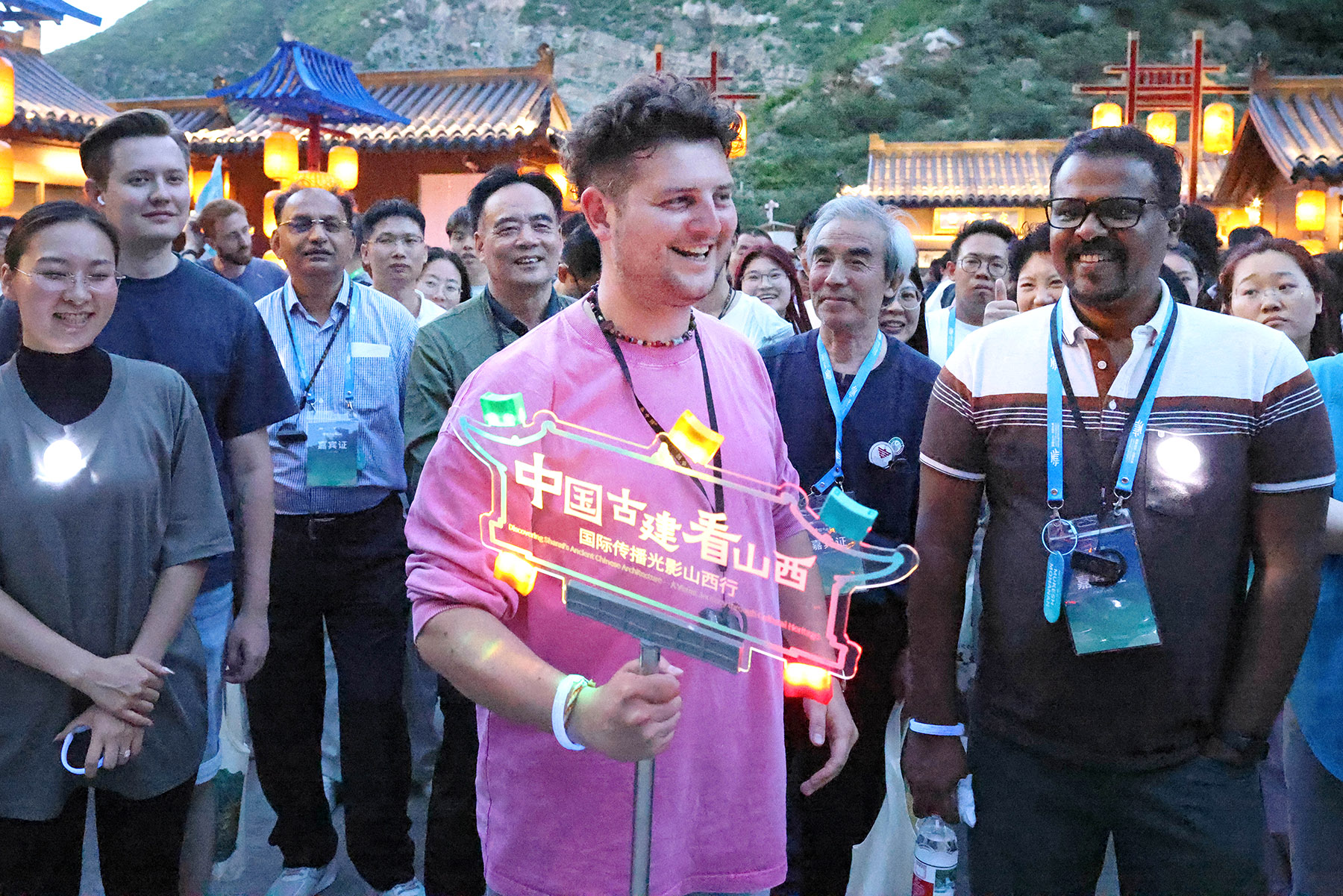
The performance opens not with the temple itself but with an herbal merchant carrying astragalus, a medicinal plant long cultivated in the region. Speaking directly to the audience, he reflects on the crowds that hurry through the temple each day.
"People visit in daylight," he says. "It's too noisy, too rushed. They never hear what the temple is trying to tell them. That's why you've stayed — to wait for this moment."
The audience slowly follows guides toward the cliff as a narrator repeats the question that gives the production its title: Why Hanging Temple endures?
The answer unfolds not through architecture alone but through history.
The projections first transform the cliff into a battlefield. Horses charge. Weapons clash. Blood-red light washes over the mountainside.
During the Northern Wei Dynasty (386-534), when the imperial capital was established in Datong, Taoist reformer Kou Qianzhi is believed to have envisioned an "airborne temple", elevated above worldly noise and closer to the heavens. Yet, even as the monastery sought spiritual distance, the land beneath it remained a frontier marked by centuries of warfare and shifting dynasties.
Datong stood between the agrarian empires of central China and the northern nomadic peoples. Its very name — meaning "Great Harmony" — reflected a long-standing hope for peace.
The projections then reconstruct the temple's construction. Craftsmen appear suspended from the cliff, chiseling into solid rock one hammer strike at a time. The audience watches as cantilevered beams are driven into the mountainside, re-creating the engineering method that still supports the temple today.
Historical figures, including Tang Dynasty (618-907) poet Li Bai and Ming Dynasty (1368-1644) traveler Xu Xiake, also appear, recalling their own journeys to the site and their admiration for its improbable beauty.
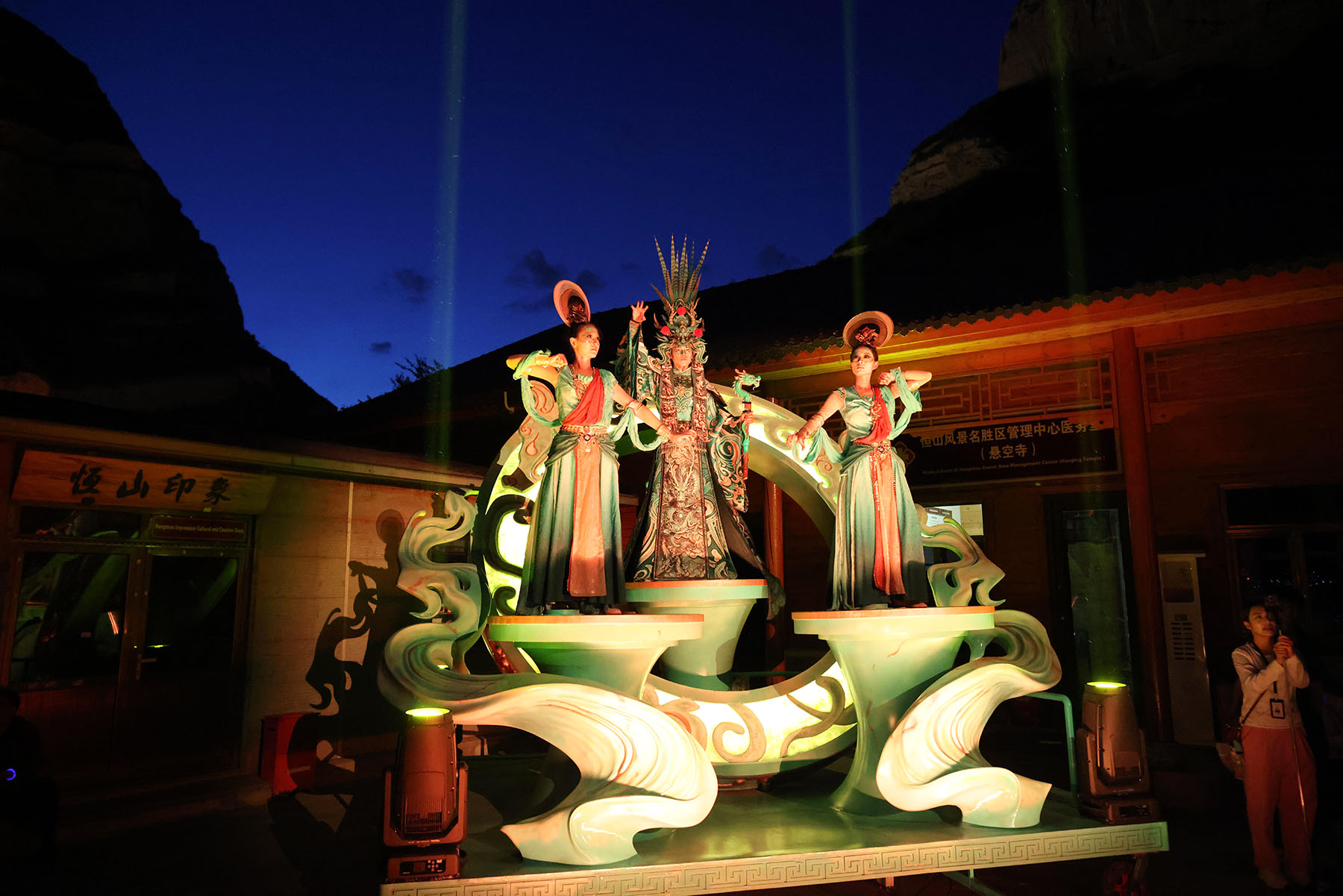
Burns records much of the performance on his phone.
"The projections cover the entire mountain. It's hard to believe you're looking at the real Hanging Temple.
"I didn't think it would incorporate the actual Hanging Temple into it," he adds. "Now I can see why it's a world-record show. The whole cliff face becomes part of it, and the temple itself is only a small part. Really, really spectacular."
Li, who was skeptical when he arrived, finds himself persuaded.
"They've explained the entire historical process so clearly," he says. "The visual impact of every scene is beyond words."
However, Yang insists that protecting the monument remained the project's priority.
The production uses cold-light projection equipment positioned more than 100 meters away from the temple. No permanent hardware has been installed within the protected heritage zone, and the light exposure is significantly lower than ordinary sunlight, he says, allowing the performance to avoid any direct impact on the structure.
ALSO READ: Mystery, history & majesty
In its final movement, the battlefield disappears.
Spring blossoms spread across the mountains. Summer forests return. Autumn paints the valley in crimson leaves. Winter covers the cliffs in snow.
"Kou Qianzhi never lived to see the temple completed," Yang says. "But through technology and animation, people today can finally witness how his vision became reality."
In the end, the production returns to the question with which it began: Why Hanging Temple endures?
If its construction began with one man's aspiration, Yang suggests, it has survived because generations of ordinary people continued to repair it, preserve it and bring their own hopes there.
"A thousand years later, it is our generation that protects this ancient building," he says. "Back then, it carried people's wishes for peace and a better world. Today the country is peaceful, the mountains are beautiful. The ancient wishes have, in many ways, become our own."
Contact the writers at baishuhao@chinadaily.com.cn
