

A cultural festival merges shadow puppets, traditional music, and rare paper into new art, Yang Feiyue reports in Shihezi, Xinjiang.

Under the stage lights in Shihezi, a leather shadow puppet slowly raises an arm, swaying gracefully to the rhythm of melodies unique to the city in northern Xinjiang Uygur autonomous region.
Its movements are inspired by a traditional dance of the Uygur ethnic group. The music comes from local performers playing classic Uygur instruments such as the dutar and rawap. Yet, the figure dancing behind the screen belonged to Beijing's centuries-old shadow puppet tradition.
For the performers, it was an opportunity to explore how intangible cultural heritage can travel across regions, connect with new traditions and continue to evolve.
The performance was created for the 2026 Xinjiang Is a Nice Place intangible cultural heritage showcase, which opened on Thursday.
Organized by the Ministry of Culture and Tourism, the Xinjiang government, and the Xinjiang Production and Construction Corps, the five-day event brought together more than 650 representative intangible cultural heritage practices and over 540 inheritors from 31 provinces, autonomous regions and municipalities, as well as the Xinjiang Production and Construction Corps.
READ MORE: Tradition finds a young voice
Rather than simply showcasing traditions from different regions, the event highlighted exchanges and cooperation, encouraging artists and craftspeople to learn from one another and create new forms of expression.
For Lu Baogang, an actor with the Beijing shadow puppet troupe, adapting the performance for Xinjiang audiences became the troupe's first challenge.
"When we received the invitation, we were honestly a little nervous," Lu says. "We kept asking ourselves what kind of program Xinjiang audiences would connect with."
Instead of bringing an existing production, the troupe chose to weave local cultural elements into a brand-new performance.
The result was a short piece inspired by the story of Wan Tongshu, a cultural worker who contributed to the preservation of Twelve Muqam — a traditional Uygur musical suite inscribed on UNESCO's Representative List of the Intangible Cultural Heritage of Humanity in 2008.
The Beijing artists created two shadow puppet figures based on Wan and his wife, paying tribute to generations of cultural workers who dedicated themselves to safeguarding Xinjiang's rich musical heritage.
For Lu, the most rewarding part of the project came when the Beijing performers began working closely with musicians from Xinjiang.
"At first, communication was not easy because we speak differently," Lu says. "But we share something in common — we are all committed to protecting traditional arts."
After several rehearsals, the two sides gradually found ways to blend the movements of the shadow puppets with the rhythms of Xinjiang's traditional music.
Lu says he learned a great deal from the local artists, particularly how to capture the distinctive movements of Xinjiang dance.
"One example is the posture of a Xinjiang woman dancing," he says. "Previously, our puppet simply placed one hand on its waist. The local artists suggested raising the other hand and adding movements that flowed with the rhythm. It instantly made the character feel more natural."
For Lu, the collaboration was about "absorbing elements from each other".
The troupe hopes the cooperation can continue beyond the short performance.
"We believe that one day we can create a full-length production together, combining the two sides' music and storytelling techniques," Lu says.
The troupe has also launched a workshop during its Xinjiang visit, introducing local children to the craft of making shadow puppets.
"We hope this traditional craft can take root among young people here and help promote their culture," he adds.
Fresh expressions
Across the exhibition hall, the Xinjiang mulberry-bark paper, known as sangpi paper, was embarking on a different path toward renewal.
Sheets of paper were placed beneath the carved woodblocks used in art studio Rongbaozhai's centuries-old woodblock watermark printing technique, producing a series of collectible artworks.
The experiment was not easy.
According to Li Yang, deputy director of Rongbaozhai's woodblock watermark center, the team has worked with different types of mulberry paper from various regions, including paper used in restoration projects at the Palace Museum.
Each region produces mulberry paper with its own texture and characteristics, he explains.
For the Xinjiang collaboration, Rongbaozhai used local mulberry paper to print images including the "Five Stars Rising in the East" brocade, discovered at the Niya archaeological site in Hotan prefecture, Xinjiang, as well as a panda-themed design.
The results showed both challenges and possibilities.

Compared with papers traditionally used in Chinese painting, Xinjiang's mulberry paper has a coarser texture and more prominent fibers, making precise printing more difficult.
During the printing process, the team had to repeatedly apply additional layers to achieve the desired effect.
But Li believes the paper's distinctive texture could eventually become an artistic advantage.
"Its weakness could also become its strength," he says.
If artists create works specifically suited to the texture of mulberry paper, its rough surface and natural fibers often seen as limitations could become unique visual features, he adds.
"In the future, if artists create directly for this material, we may discover a new artistic language," Li says.
The current works represent only an initial exploration. The team hopes to collaborate with Xinjiang artists to develop designs and techniques that make the best use of local materials.
"When two elements come together, neither should lose its own character," he says. "The value lies in finding the point where they can meet."
Silk Road connections
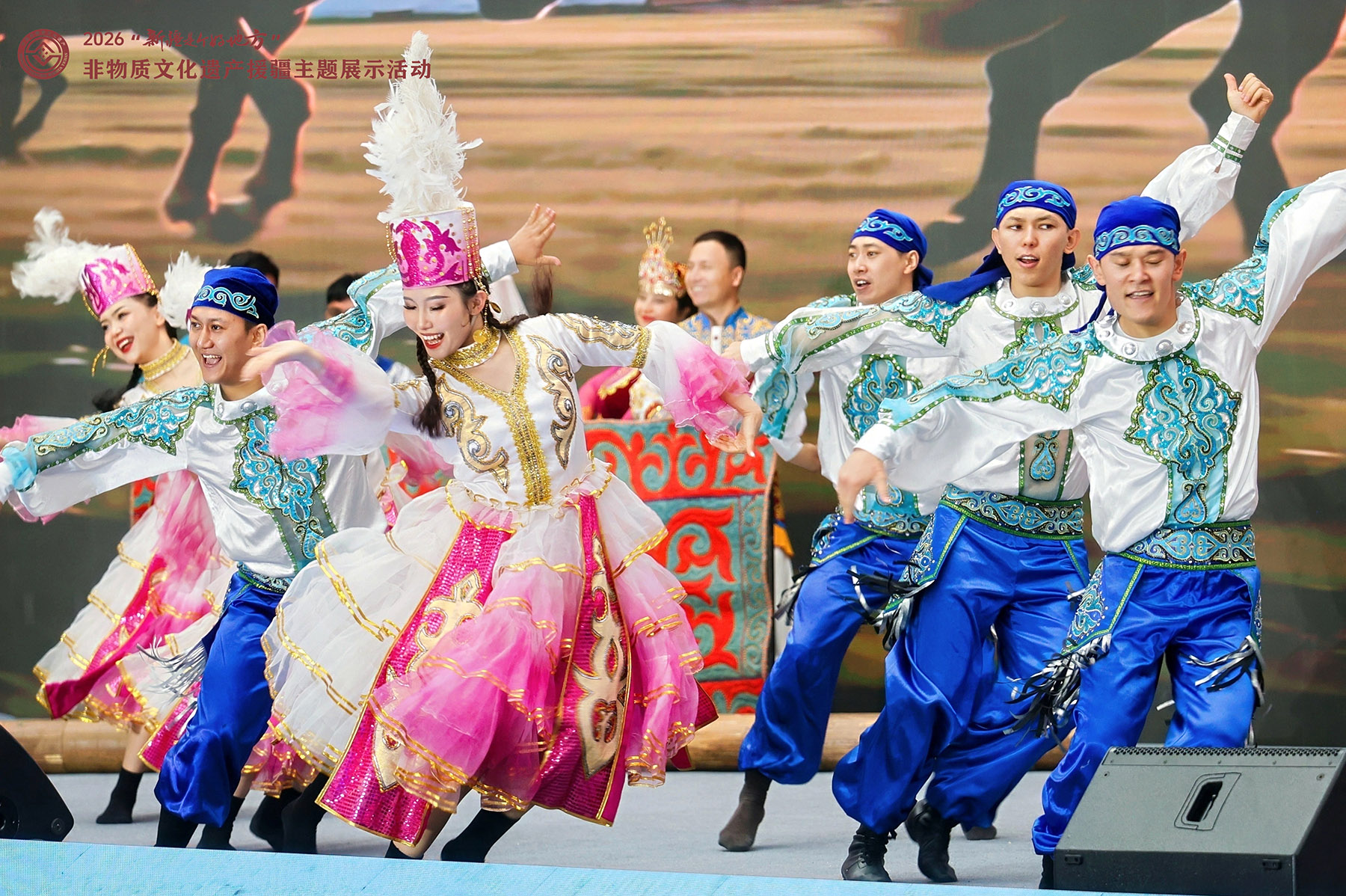
Cross-regional cooperation from the partnership between Quanzhou in Fujian province and Changji Hui autonomous prefecture in Xinjiang has delivered a special rendition of the popular Fujian song Ai Pin Cai Hui Ying (Only By Striving Can One Win) which drew large crowds at the showcase in Shihezi.
The familiar melody was reimagined by blending Fujian folk instruments with Xinjiang traditions, including the dombra, the traditional two-stringed Kazak instrument, and Xinjiang folk singing.
The performance is part of an ongoing partnership linking Quanzhou, one of the key ports along the ancient Maritime Silk Road, with Changji, a region historically connected to the overland Silk Road. Over the years, the collaboration has created platforms for performances, training and exchanges among craftspeople from both regions.
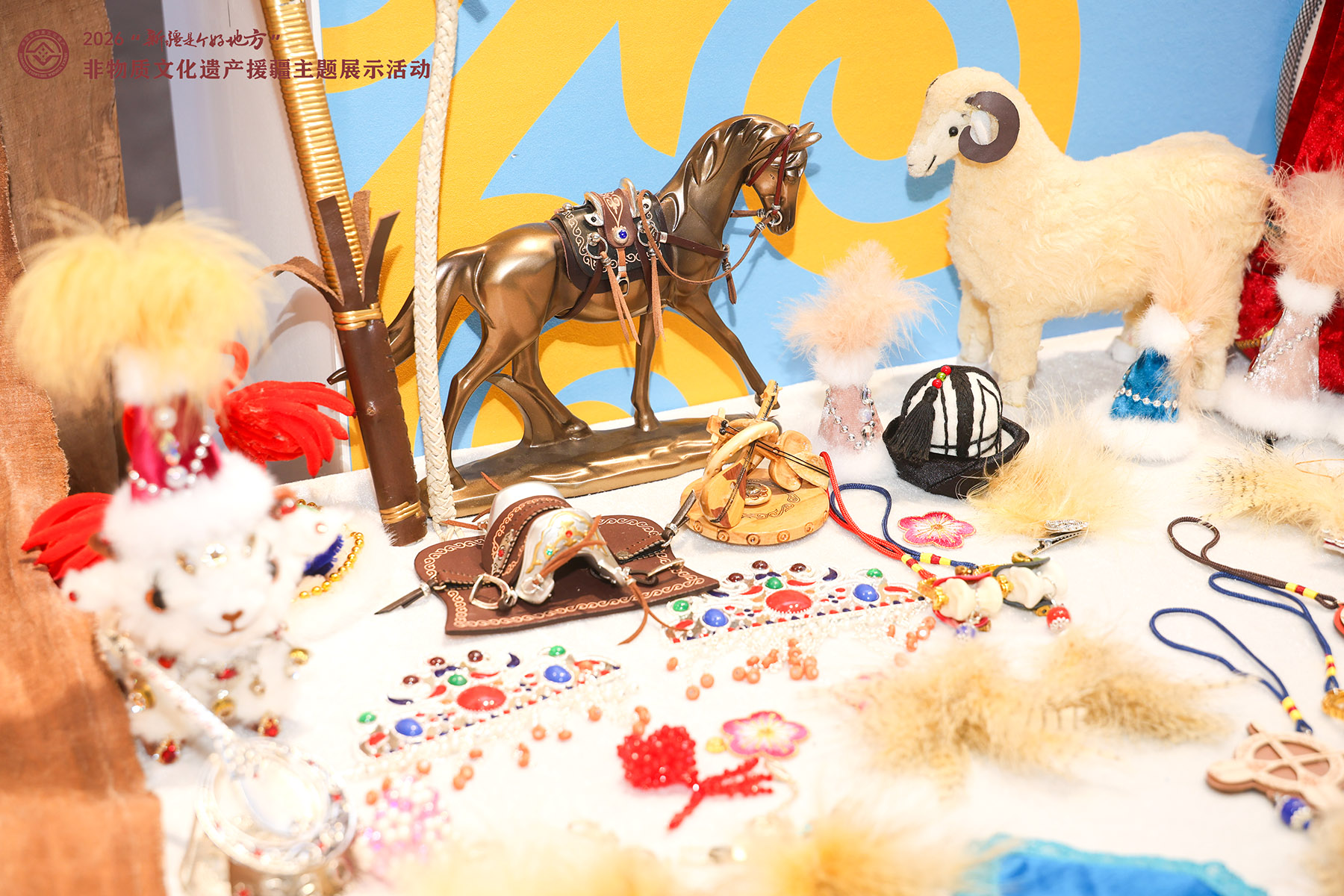
Beyond performances, the Changji delegation brought a variety of local crafts and foods, including dough figurines, embroidery, traditional dairy products and folk handicrafts.
Among the exhibits was a collection of dough figurines representing different regions. Each figure combined symbols from Xinjiang and Fujian, illustrating how two distinct local cultures could come together through a single art form.
The delegation also showcased different embroidery traditions, including ethnic Kazak and ethnic Hui embroideries.
"Kazak embroidery is known for bright colors, bold patterns and motifs such as horn designs, while Hui embroidery often features finer stitching and delicate color combinations," explains Meng Yushan, an intangible cultural heritage specialist at the Changji prefecture cultural center.
Rather than merging them into a single style, the exhibition highlights their unique characteristics side by side.
For Meng, the partnership with Fujian has also opened new opportunities for local artisans to broaden their skills.
"Many of our inheritors have traveled to Fujian for training," she says.
ALSO READ: 'Xinjiang Is a Nice Place' opens for a third year
They have studied areas such as lacquer painting and craft development, learning not only the techniques but also ways to transform traditional skills into sustainable creative industries, she adds.
When Lu Baogang first walked into the exhibition hall, he says he was struck by the diversity of traditions gathered under one roof.
"After walking around the venue, I realized that every province and region had brought its finest works, and every exhibition area had something unique to offer," Lu notes.
For Lu, the gathering was a reminder that intangible cultural heritage is not confined by geography.
Preserving tradition today is not only about safeguarding old techniques, but also about creating opportunities for different forms of heritage to interact, inspire and evolve, he says.
Contact the writer at yangfeiyue@chinadaily.com.cn
