

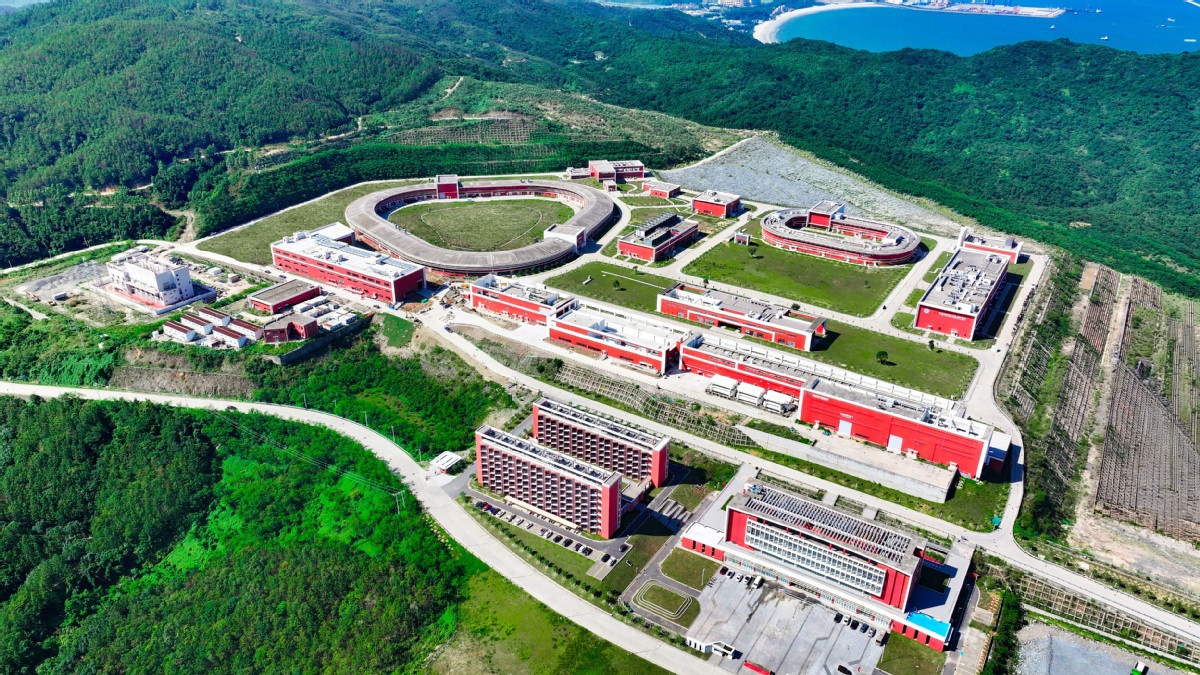
The High Intensity Heavy-ion Accelerator Facility, a major national science and technology infrastructure project in China, completed construction and passed its technological acceptance review on Tuesday, entering trial operations.
An expert panel concluded that HIAF achieves internationally leading performance among similar facilities, with all acceptance indicators meeting or exceeding design targets after multiple rounds of testing. The panel approved the facility's technological acceptance, citing comprehensive self-developed breakthroughs in high-intensity heavy-ion accelerator technologies.
Located in Huizhou, Guangdong province, HIAF was designed and developed by the Institute of Modern Physics under the Chinese Academy of Sciences. It is designed to produce the world's most intense pulsed heavy-ion beams, serving as a "super microscope" that enables scientists to probe the fundamental building blocks of matter and the evolution of the universe.
As frontier nuclear science demands ever higher beam intensity, the HIAF project was proposed in 2009, broke ground in December 2018 and completed its first comprehensive beam commissioning in October 2025.
ALSO READ: Chinese researchers uncover sinkhole evolutionary trap
Spanning 32 hectares with a 2-kilometer beam line located 13 meters underground, HIAF is the world's first advanced heavy-ion research facility to integrate a superconducting linear accelerator with a fast-cycling synchrotron.
"High intensity is the core performance indicator for a next-generation ion accelerator. It means the number of ions accelerated in each pulse is substantially increased," said Yang Jiancheng, deputy director of the Institute of Modern Physics and chief engineer of the HIAF project.
"Achieving such ultrahigh intensity presents significant technical challenges, with the research and development of key technologies spanning more than a decade," Yang said.
Those challenges drove a series of technological innovations, including ultrafast power supplies capable of changing current by thousands of amperes within 100 milliseconds and an ultrahigh-vacuum environment with pressures comparable to those on the Moon's surface.
These advances enabled HIAF to surpass its design specifications, achieving world-record beam intensity for both oxygen and bismuth ions.
Researchers also measured the mass of a short-lived gold isotope with twice the precision of the previous world record and discovered two new isotopes, demonstrating the facility's combined strengths in high intensity, high energy and high precision.
HIAF is among the few accelerators worldwide capable of accelerating ion species ranging from hydrogen to uranium and producing thousands of unstable atomic nuclei. Equipped with six experimental terminals, the facility will support research in three major areas: exploring the limits of nuclear existence, uncovering how elements are forged in stars, and advancing cross-disciplinary applications of heavy-ion beams.
As one of the world's most powerful accelerators, HIAF will operate as an international scientific user facility.
"HIAF is set to become a globally significant heavy-ion research hub. Scientists from universities, research institutes and industries around the world are welcome to collaborate and conduct experiments here," Yang said.
The facility is expected to help scientists push the frontiers of nuclear physics, nuclear astrophysics and atomic physics. It will also support advanced heavy-ion beam applications in healthcare, materials science and biological breeding.
