

Amid the most extensive functional restructuring in decades, the eastern border crossings between Shenzhen and Hong Kong aim to jointly forge a new force on cross-boundary consumption. However, experts warn that a sluggish economy, fragmented property rights, and differentiated development positioning may become key bottlenecks to realizing this vision, Li Bingcun writes.
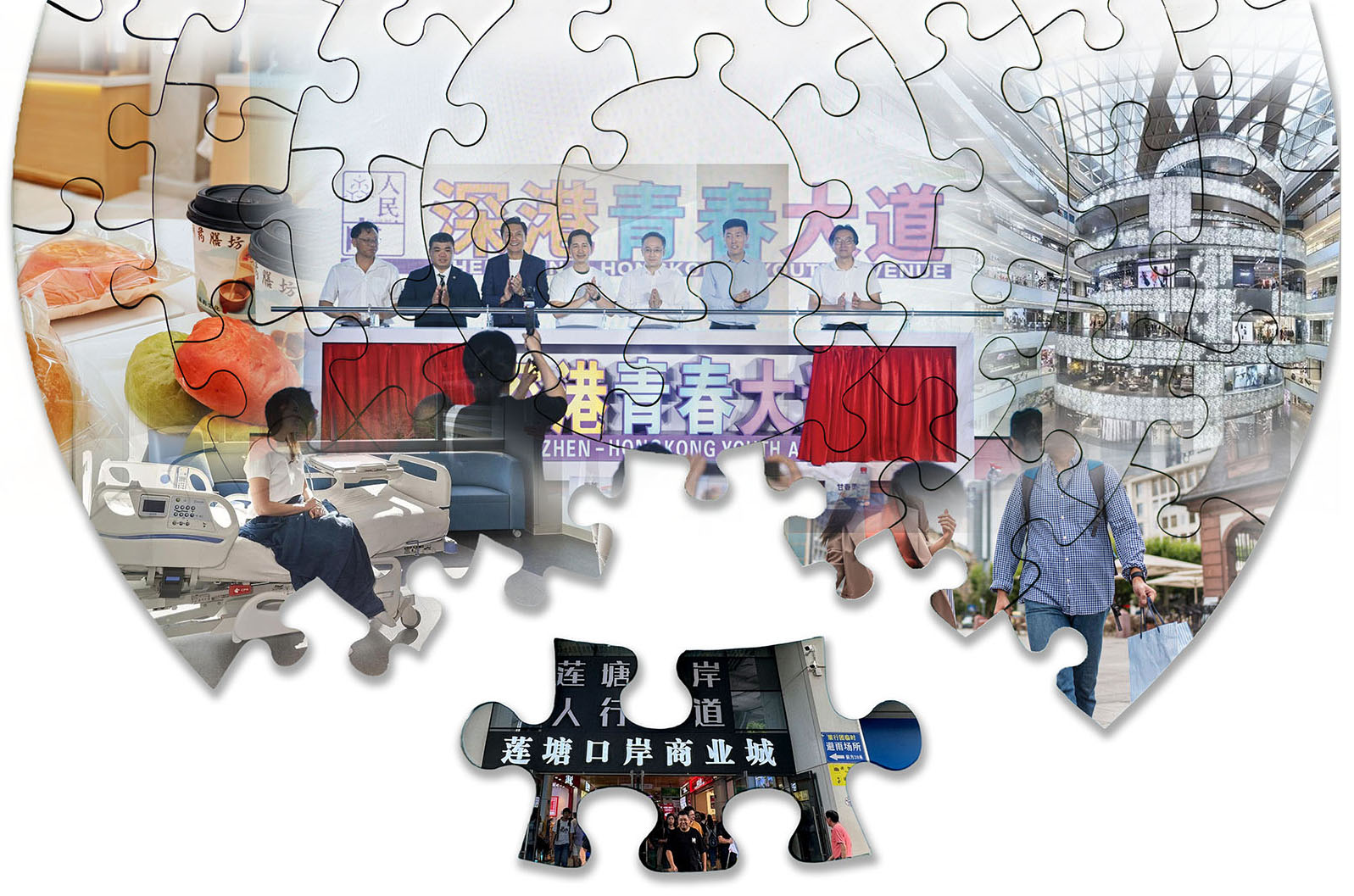
Editor’s note: As key transportation hubs in the Guangdong-Hong Kong-Macao Greater Bay Area, ports in Shenzhen and Hong Kong are seeking to boost their value with a refreshed outlook and more integrated functions aimed at turbocharging local industries and the cities’ respective economies. China Daily presents a three-part series to document the transformation, with the second article focusing on the eastern border crossings’ determination to drive consumption.
Having afternoon tea at a traditional Chinese medicine hospital is one thing few people have tried. But, it is fast emerging as a big hit at Liantang Port — the seventh and newest land crossing between Shenzhen and Hong Kong.
Riding on the port’s growing popularity, the Luohu Hospital of Traditional Chinese Medicine has grown into a new hotspot for Hong Kong and international visitors with its health tourism appeal.
At the hospital’s medicinal cuisine shop, breads, milk tea, pastries, buns and noodles with herbal ingredients attract hordes of visitors. European-style bread, bagels and lye sticks are blended with goji berries, dried tangerine peel and poria, creating colorful products with a complex aroma and flavor.
Such a combination of traditional health beliefs and modern dietary habits fits in with the public’s surging appetite for healthy living, while offering refreshing dining options with eye-catching appearances.
READ MORE: Luohu spearheads economic development of land ports
Integrating a medicinal cuisine experience with massage and physical therapy services, the hospital’s one-day tour program has been well received by Hong Kong residents arriving via Liantang Port. The TCM outfit also plans to expand the program to global tourists entering the Chinese mainland via the checkpoint with a new type of medical-tourism consumption ecosystem.
Sustaining this vision and the business of small and medium-sized shops in the area is the rapid rise in cross-boundary travel through Liantang. Amid the most significant functional shift in land crossings between the southern technology boomtown and the Hong Kong Special Administrative Region in decades, Liantang and other eastern boundary crossings are leveraging their unique strengths to boost growth in emerging forms of consumption and tourism.
With major adjustments being made to freight and passenger-clearance functions, as well as the development of Hong Kong’s Northern Metropolis, Luohu, Wenjindu and Liantang ports will help push port-based trade and industrial development, while Shatoujiao Port will spur international consumption and ecotourism. The long-established eastern crossing cluster is set to reach a turning point, becoming a more vibrant set of gateways for cross-boundary integration.
Surging foot traffic
Beginning immigration clearance services in February 2023, Liantang was built to expand the eastern economic hinterland of Shenzhen and Hong Kong and alleviate operational pressure on the main land crossings.
A convenient commuter and goods clearance process, cost-effective transportation option and a rebound in cross-boundary travel following the COVID-19 pandemic have driven Liantang’s passenger volumes from a daily average of 5,000 to 95,000 at present. The peak volume stands at 128,000 — four times the facility’s designed capacity.
Without large commercial districts, star-rated hotels or grade A offices, Liantang was previously a neglected residential area. The port authorities invited cartoonists to design illustrated tourist maps of the area, promoting reputable eateries and unique scenery tucked away in alleys, including an eight-story-tall azalea cascade that has flourished for 15 years, according to Chen Gang, a director in the Liantang Subdistrict Office.
By leveraging local cultural assets, the office has staged pop-up performances of Cantonese opera and Yingge folk dance at the crossing. With a dearth of space, school venues have been used for musical shows.
Natural attractions, including the Fairy Lake Botanical Garden and the green trails of Wutong Mountain, are prime locations for developing ecotourism and Shenzhen-Hong Kong integrated care for the elderly.
Some residential buildings have been turned into serviced apartments, catering to Hong Kong families on short leisure getaways and young cross-boundary commuters.
However, Chen says while the area is bustling with people, it is not prosperous. The surrounding commercial establishments are diverse — ranging from hotpot restaurants and fruit stands to dental clinics, glass shops and spas, creating a convenient living environment. But, it still lacks high-end options to draw well-heeled customers.
In the long term, the local authorities aim to attract more top-tier brands in the catering, retail and hospitality sectors to enhance the business mix and encourage more tourists to stay overnight.
Sparking youth growth
Luohu Port, as the busiest and oldest land crossing between Shenzhen and Hong Kong, is bent on developing its youth economy to attract a younger customer base.
According to Qu Shilei, a section chief of the Nanhu Subdistrict Office, although the population living near the port is aging, about 60 percent of boundary crossings, which average 200,000 a day, are made by young people aged 18 to 40, reflecting strong consumption potential.
Luohu Port links the two major commercial hubs of Renmin South and Dongmen. With low barriers to renovating established shopping malls, the area could rapidly introduce youth-oriented business formats, such as shops selling trendy toys, anime and manga culture, nighttime economy initiatives, and cultural and creative markets.
In contrast, the market for traditional department stores favored by middle-aged consumers is relatively saturated, leaving little room for expansion. More importantly, beyond stimulating consumption, developing the youth economy is key to attracting talent and fostering industrial incubation, Qu believes.
In May this year, the “Youth Avenue” project was launched in the commercial heartland near Luohu Port. It pledges to offer large industrial spaces to support youth entrepreneurship, a flagship youth apartment building, and the revitalization of the International Foreign Trade Center — an iconic local shopping mall.
To better serve cross-boundary consumers, Qu revealed plans to set up a showcase area for emerging technology products at the crossing, establish supermarket pickup points, and renovate nearby traditional five-star hotels.
For the less busy Wenjindu and Shatoujiao ports, transporting freight will be a thing of the past, replaced by passenger-only crossings in the long term, with a stronger emphasis on commerce.
At Wenjindu Port, which specializes in the transit of fresh produce to Hong Kong, all freight operations will be transferred to Liantang. Aligning with Hong Kong’s Northern Metropolis plan in the New Territories, it will put more effort into developing commercial and industrial sectors.
Located between the high-traffic Luohu and Liantang checkpoints, Wenjindu has decades of experience in cross-boundary trade with Hong Kong. The relocation of large freight yards will free up contiguous land for commercial development, helping to ease the land-saturation pressure at Luohu and space constraints at Liantang.
Shatoujiao Port, which is now closed and undergoing a complete revamp, is expected to boost passenger traffic from 1,500 trips to 40,000 trips daily — 26 times higher than before. Renovation work will be completed by 2032.
The port also intends to develop a high-end Shenzhen-Hong Kong international tourism and consumption cooperation zone with industrial values reaching 100 billion yuan ($14.76 billion), on a par with Qianhai and Hetao, the engines of cross-boundary integration in the fields of finance and technology.
As a restricted area for decades, the Hong Kong side of Shatoujiao Port has begun opening up to Hong Kong visitors. With both sides accelerating the drive to boost cross-boundary integration, the port, located near a world-class container terminal and a comprehensive bonded zone, will leverage the rich trade and tourism resources of Shenzhen’s Yantian district, and is also well poised to tap into the consumption needs of millions of residents from the HKSAR’s new towns in the northern New Territories.
The area’s landmark Chung Ying Street is a historic cross-boundary shopping street, managed by Shenzhen and Hong Kong, with unparalleled commercial value. After revitalization, its annual footfall last year exceeded 10 million.
At present, the entire cluster possesses significant value on multiple fronts, acting as a hub for trade and commerce, a premier destination for inbound tourism, a showcase for innovative retail experiences, and a bridge for talent exchange. Building on these edges, it boasts strong appeal for leading international and domestic brands, according to the Office of Port of Entry and Exit of the Shenzhen Municipal People’s Government.
Chen Shaobo, vice-president of the Chinese Association of Hong Kong and Macao Studies, says although the scale and influence of the eastern land ports’ shopping centers is slightly weaker, compared to the central and western regions, the cluster has good business foundations with accessible, integrated commercial services.
The ecotourism resources of mountains and seas stretch from Shenzhen’s Yantian district and Dapeng New Area to the cities of Huizhou and Shanwei, offering significant room for development. Furthermore, the planned international tourism and consumption center at Shatoujiao has great potential to be another signature landmark in Shenzhen’s tourism landscape, he says.
Alex Mak, head of the Greater Bay Area Development of Our Hong Kong Foundation, envisions Luohu serving as a core center for retail and business, with Liantang providing logistics and transit support, Wenjindu driving commercial conversion, and Shatoujiao expanding the cluster’s culture and tourism consumption. Such arrangements will enable the region to better harness its spatial conditions and industrial strengths, he says.
To realize this new vision for the eastern port cluster, he believes the key lies in Shatoujiao’s ambition to drive international consumption, the revitalization of Chung Ying Street’s unique cultural intellectual property sector, and the systematic expansion of multi-destination tourism routes between Shenzhen and Hong Kong.
Overcoming upgrade hurdles
Given the current economic environment and for historical reasons, these ports still face numerous challenges on their path to upgrading.
Chen stresses that amid slower economic growth, seeking breakthroughs in consumption is challenging. With an overlap in some development directions, competition among different land port areas for high-quality commercial projects is also intense. Developing or retaining desirable new projects requires considerable effort, he says.
Qu says after decades of development, redeveloping the relatively haphazard commercial areas near the boundary crossing regions faces complex property rights issues. To attract investment, some large projects like Luohu’s International Foreign Trade Center invited multiple parties to work on development jointly, resulting in fragmented ownership among local governments, State-owned enterprises and other investors.
ALSO READ: HZMB makes integration of Greater Bay Area region tangible
In places like Luohu Commercial City and the commercial spaces at Shenzhen Railway Station, the large number of small businesses makes redevelopment even more demanding. Many shop owners have moved overseas and are difficult to contact, leading to significant delays for renovation projects. Property issues also led to the cancelation of plans to introduce JD Mall, retail giant JD.com’s offline shopping-mall brand, according to Qu.
Appealing for high-level coordination on the problem, he hopes that property rights held by State-owned agencies can be integrated first, followed by small business owners if upgrading efforts can produce results.
Although Hong Kong’s Northern Metropolis plan includes developing the eastern checkpoints, specific details of the Shenzhen-Hong Kong collaboration mechanism remain unclear.
Suggesting that the HKSAR government build additional main road infrastructure near Shatoujiao Port to deal with increased traffic in the future, Mak hopes both sides can work together to balance the area’s dual roles as an international consumption hub and ecological tourism destination.
Contact the writer at bingcun@chinadailyhk.com
