

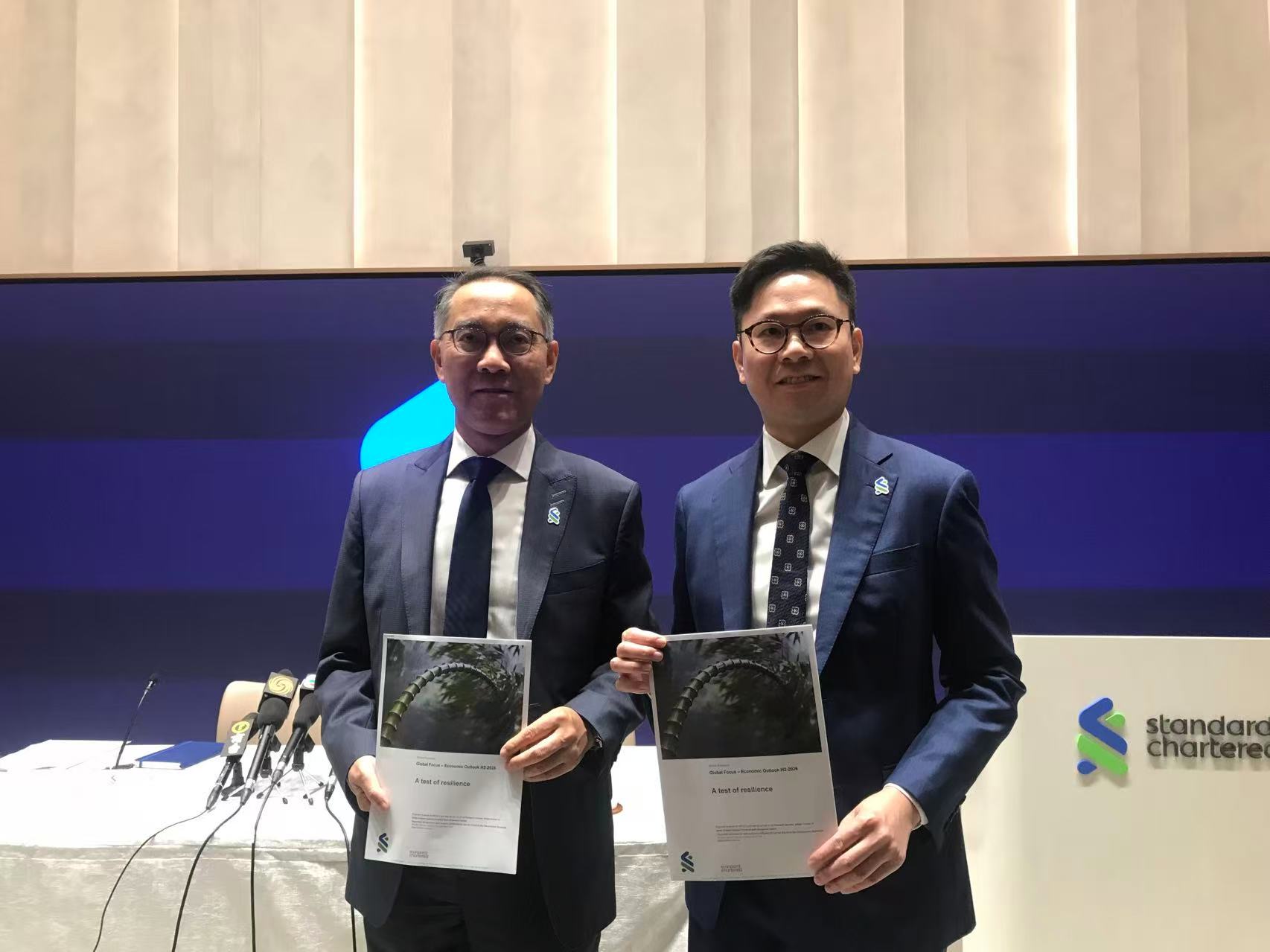
Hong Kong’s economy will grow by 4.3 percent this year, underpinned by strong demand from the Chinese mainland, the artificial intelligence investment “supercycle” and a rebound in domestic demand, according to Standard Chartered Bank (Hong Kong).
This compares with a gain of 3.6 percent for last year.
“The mainland’s policy focus on technology and its push to go global are creating opportunities for local businesses to capitalize on Hong Kong’s role as a ‘super connector’ facilitating financial and professional services and trade activity,” said Tommy Wu – the bank’s executive director and senior economist for Greater China and North Asia.
The AI “supercycle” is supporting the special administrative region’s trade and logistics sector, with at least 70 percent of the city’s re-exports linked to electronic products, he said on Monday. “Improved sentiment in the housing market and a stable labor market also support domestic demand recovery. Hong Kong residents, actually, are spending more in the city due to the transmission of wealth effects,” he explained.
The economist expects the SAR’s strong growth prospects and demand from an influx of mainland talents to continue supporting the property market, with transactions in residential apartments picking up.
However, Hong Kong needs to guard against headwinds that could dent economic growth in the second half of the year. “We need to monitor whether the AI ‘supercycle’ is just a short cyclical trend, and gauge whether there is a possibility of an interest-rate hike by the United States this year,” he said.
Standard Chartered Bank (Hong Kong) expects the one-month HIBOR (Hong Kong Interbank Offered Rate) to hover at 2.8 percent and the three-month HIBOR at three percent in the second half of this year as the US Federal Reserve is not forecasted to raise interest rates in 2026. HIBOR is the major benchmark interest rate for determining the interest rate of mortgage loans originating in Hong Kong.
ALSO READ: HK economy posts strongest growth in almost five years
“We see banking liquidity as sufficient to balance Hong Kong dollar supply and demand without triggering a significant rise in HIBOR,” Wu said.
But, he warned that a Fed rate hike is still possible in the second half of this year if the US labor market heats up and inflation shows no sign of easing. “This would pose upside risks to the bank’s HIBOR forecasts for the second half of 2026 and 2027.”
The bank also expects the Hong Kong dollar to trade near the 7.85 to 1 US dollar level due to the city’s recent equity-market underperformance, as well as a likely wider US dollar versus the Hong Kong-dollar rate differential.
“As for domestic inflation, we forecast headline inflation to be at 2.1 percent for 2026 versus last year’s 1.4 percent, based on the lingering effects of higher energy and producer prices amid the Middle East crisis and rising domestic wages amid a strong economic performance,” Wu said.
Ding Shuang – Standard Chartered Bank (Hong Kong)’s managing director and head of Greater China and North Asia – sees the mainland’s economy expanding 4.6 percent this year as the divergence between strong exports and weak domestic demand on the mainland is likely to remain in the second half of this year.
The bank also expects monetary policy to remain accommodative, with the People’s Bank of China keeping policy rates unchanged and slashing the reserve requirement ratio by 25 basis points in the third quarter to signal its easing stance.
READ MORE: Survey: HK SMEs more optimistic about external economic outlook
“We think policy makers would not rush into introducing additional fiscal stimulus at the July Politburo meeting as the mainland government may prioritize implementation of the 2026 budget. Policy support is likely to focus on key infrastructure projects, AI development and livelihood-related investment,” Ding said.
