

Jr NBA tournament in Suzhou offers Chinese high-school players the chance to test themselves against their international peers
As the final buzzer sounded inside Suzhou Sports Center on June 19, players from South Korea's Yongsan High School gathered courtside, preparing to lift the boys' championship trophy after an 85-73 win over Tsinghua University High School in China's first-ever Jr NBA International Invitational Tournament.
On the opposite bench, several Tsinghua players remained seated for a moment, watching the celebration before slowly walking toward their teammates. For many of them — mostly first-year high school students — it was their first experience facing overseas opponents in an international tournament.
"The rhythm was different," said assistant coach Liu Hangchu. "Their reactions, their movement without the ball and their ability to capitalize on mistakes were all very strong. Our younger players learned a lot from the game."
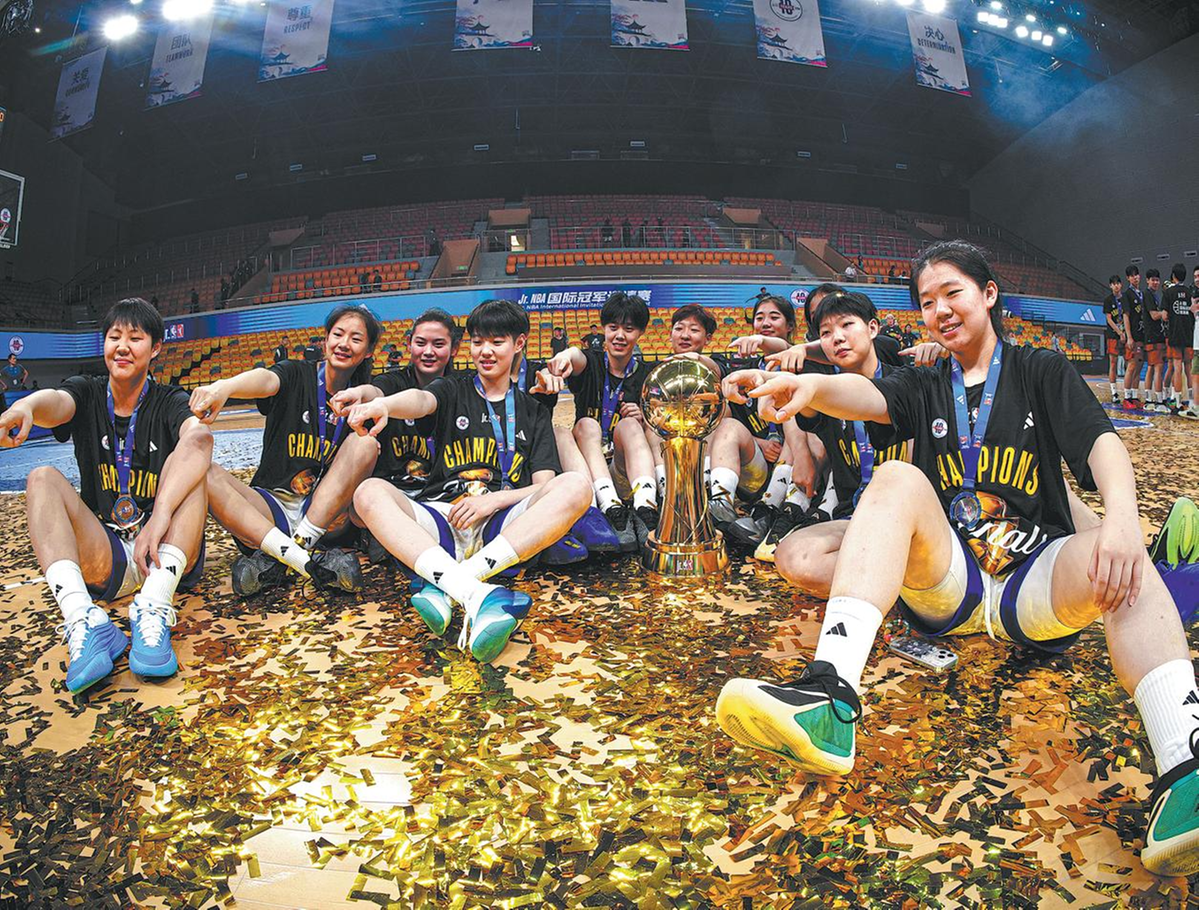
Earlier that evening, Tsinghua University High School's girls' team defeated Xi'an Tieyi High School 75-70 to win the tournament's girls' title.
Former NBA player Cuttino Mobley attended the finals, speaking with players before the games and presenting awards afterward.
But beyond the results, the four-day tournament offered a snapshot of a broader transition taking place in China's youth game.
Held during the 10th anniversary year of Jr NBA in China, the tournament — the first such competition organized by Jr NBA in the Chinese mainland, allowing domestic school teams to face overseas opponents under international competition standards — brought together 16 boys' and girls' teams from China, South Korea and Australia.
For NBA China, the event represents an expansion of a youth basketball system that has simultaneously pursued broad participation and elite talent development over the past decade.
According to Jonathan Li, senior vice-president of NBA China, the organization has spent much of the past 10 years building participation at the school level.
"From the beginning, our approach has been built on two parallel goals," Li said. "One is to expand participation so that more young people can enjoy basketball.
"The other is to identify and support talented players by providing them with structured competition and development opportunities."
ALSO READ: China issues guidelines to promote high-quality development of sports industries
Participation and talent development have remained twin objectives throughout the program's growth. Since entering China in 2016, Jr NBA has reached more than 8,000 schools and over 10 million students and teachers through leagues, training camps, clinics and educational programs.
The system combines broad participation initiatives with elite development programs, using school competitions and training camps to identify promising players.
Until now, however, many of those activities have remained domestic.

The Suzhou tournament introduced a new level by bringing overseas teams to China. Li said the event exposed Chinese players to different basketball philosophies and competitive environments.
"Korean and Australian teams showed a strong ability to read the game, recognize opportunities and execute their systems," he said."These are areas where our players can continue to improve."
The differences were particularly visible during the boys' competition.
Liu said South Korean basketball has maintained a relatively consistent style for many years, emphasizing speed, movement and quick decision-making.
"If you lose concentration for a moment, they immediately punish you," he said.
Tsinghua's roster itself reflected another characteristic of Chinese school basketball. Several senior players were absent because they had graduated, or joined national youth team training camps, leaving younger players to gain the experience.
The school has long harbored one of China's leading basketball programs and has produced players who later competed in CUBAL and the CBA.
Liu said that academic development remains equally important. "We want our students to succeed both in basketball and in school," he said.
That philosophy extends beyond traditional powerhouse programs.
At Liaoning Province Shiyan High School, one of China's most established girls' basketball schools, head coach Sun Heming said many graduates continue their education at leading Chinese universities.
"We focus on both study and training," Sun said.
Sun said high school basketball presents unique challenges because athletes generally spend only two or three years in the system before university entrance examinations become the priority.
Unlike students at dedicated sports schools, players must learn to balance training and academic work.
Sun said this year's tournament provided valuable experience, even though her team was missing several key players because of injuries and graduation.
"In our province, we do not always have opportunities to play against teams at this level," she said."These games help us understand where we need to improve."
The expansion of competition opportunities has been one of the most significant changes in Chinese youth basketball over the past decade.

Several coaches noted that previous generations had very limited opportunities to participate in national or international tournaments. Today's student-athletes can compete in regional leagues, national championships, international exchanges and invitational tournaments.
"The children today have many more opportunities than we did," Sun said.
While participation remains the foundation of Jr NBA, NBA China has also strengthened cooperation with the Chinese Basketball Association, CBA clubs and university basketball programs in recent years.
Li said player development, coaching exchanges and basketball education have become important areas of collaboration.
Several players who participated in Jr NBA programs have gone on to have careers in professional basketball, including CBA player Xie Liyongwei, who is part of the Shanghai Sharks squad that won the 2026 CBA championship.
Li also pointed to young Portland Trail Blazers center Yang Hansen as an example of the kind of player China hopes to produce more consistently in the future.
However, he emphasized that talent development requires patience."We still need to continue building the foundation," Li said.
"This is a long-term process."
The Suzhou tournament may therefore represent more than a single competition.
After a decade spent expanding participation and building school-based programs, Jr NBA in China is beginning to create more international opportunities for young players and coaches.
Whether those experiences eventually lead to more university players, professional athletes or national team prospects may only become clear years from now.
For now, the tournament offered something many Chinese high school players rarely experience: the opportunity to measure themselves against peers from other basketball systems and to bring those lessons back to their own gyms.
Contact the writer at liyingxue@chinadaily.com.cn
