

Internal combustion power disappears from country's top 10 best-selling automobile list
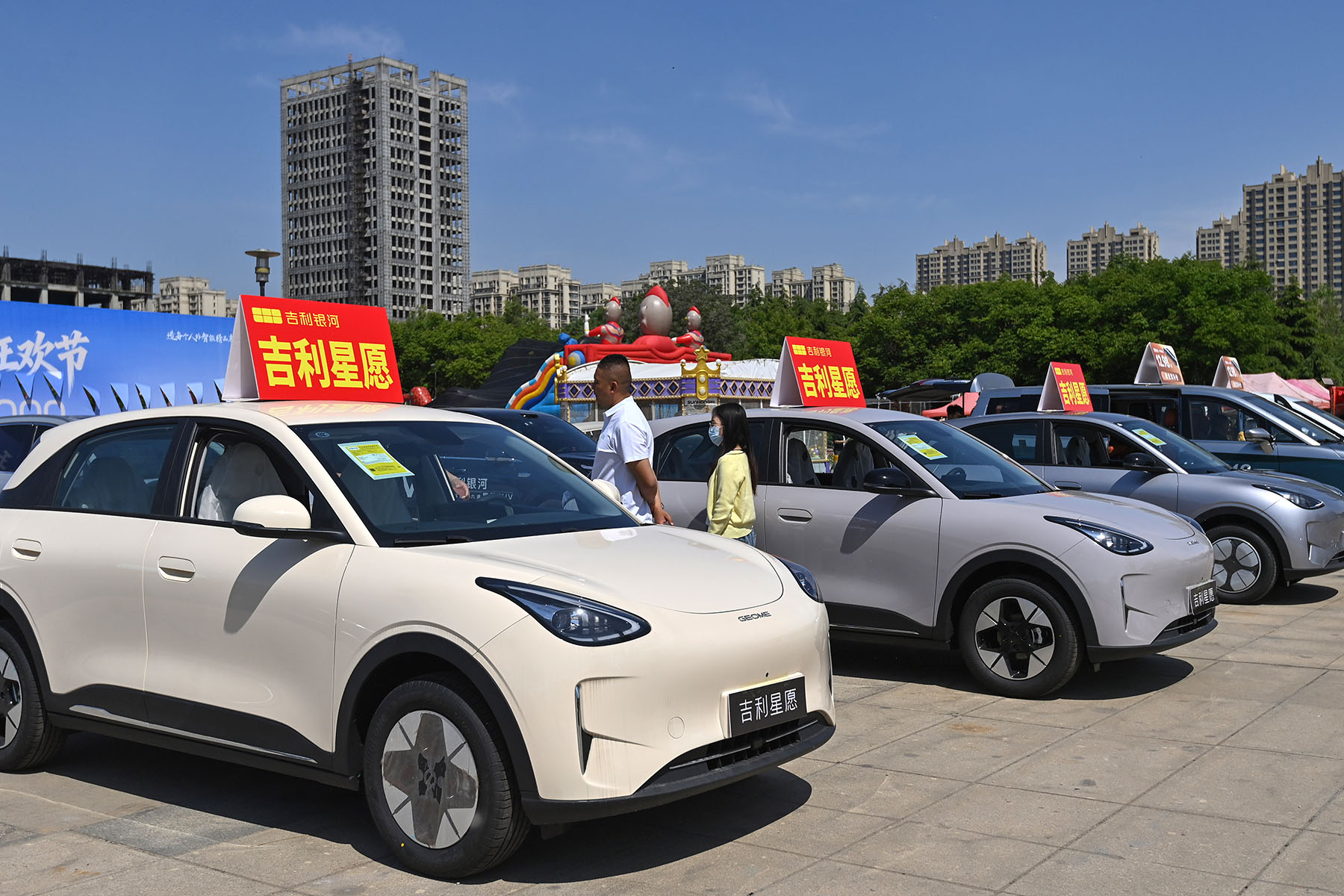
China saw a milestone in its transition toward electrified mobility in May, with almost 63 out of every 100 passenger cars sold in the country being new energy vehicles.
Battery, plug-in hybrid and extended-range electric vehicles accounted for a record 62.9 percent of passenger vehicle sales that month, according to the China Passenger Car Association.
NEV retail sales totaled 950,000 units, a 7.5 percent decline from a year earlier but enough to push their market penetration to a historic high.
Perhaps the most symbolic signal of this shift came from retail sales rankings. According to data published by automotive platform Dongchedi, the top 10 best-selling passenger vehicles in May were all NEVs.
READ MORE: NEV sector surging full steam ahead
The Geely Xingyuan micro EV ranked first with 38,751 units sold, followed by Tesla's Model Y with 28,911 units. Xiaomi's SU7, Leapmotor's A10, and Li Auto's i6 completed the top five, reflecting a broadening competitive landscape across segments ranging from entry-level city cars to premium SUVs.
The speed of this transition has been striking. In March, five gasoline models still appeared among the top 10 best-selling vehicles. That number fell to one in April before dropping to zero in May.
The disappearance of gasoline vehicles from the top tier of the market highlights how quickly consumer preferences are shifting once a technological tipping point is reached.
Industry observers say the May data points to a deeper structural change rather than short-term volatility.
Cui Dongshu, secretary-general of the CPCA, described May as a month in which "cold gasoline vehicle demand and hot NEV growth became the most prominent feature of the market".
More importantly, the decline in overall market performance was largely driven by shrinking gasoline vehicle sales.
Retail passenger vehicle sales reached 1.51 million units in May, down 22.1 percent year-on-year although up 9.2 percent from April.
Fuel-powered vehicles recorded a 39 percent year-on-year drop in retail sales, with declines across all segments: domestic brands, mainstream joint ventures and luxury automakers.
Although gasoline vehicles still accounted for 37.1 percent of total retail sales, they were 82 percent of the overall market decline, making them the dominant drag on industry performance.
This divergence underscores a key inflection point: China's auto market contraction is not being driven by weaker demand for vehicles overall, but by a rapid substitution away from internal combustion engine models.
Beyond aggregate data, changes in consumer behavior are becoming increasingly visible.
Liang Kefei, a 36-year-old Beijing resident who had participated in the city's license plate lottery for nearly a decade, switched from the gasoline vehicle lottery to the NEV queue in 2025.
"More and more of my colleagues are driving NEVs now and they sometimes give me a ride," she said.
"They are comfortable, affordable and charging has become much easier than before. That is why I decided to queue for an NEV plate," said Liang, who received hers in late May and is now busy test driving cars on weekends.
Beijing gave out 160,000 NEV license plates in May and is scheduled to offer 20,000 gasoline ones, with the list of winners to be announced in June and December.
Liang's experience reflects a broader urban trend in which NEVs are perceived not as an alternative technology, but as the default option for private car buyers in major cities.
The shift is also reinforced by network effects: as more consumers adopt NEVs, infrastructure improves, product availability expands and perceived barriers such as charging convenience and range anxiety continue to decline.
Their acceptance of NEVs suggests that China's auto market is no longer defined by whether consumers will adopt electrified vehicles. Instead, the central question has become which type of NEV they choose.
Battery electric vehicles had renewed momentum in May, with sales rising 16.6 percent year-on-year to 886,000 units. That accounted for 65.7 percent of total NEV wholesale volume in that month.
Analysts attribute this to improving charging infrastructure and rapid technological upgrades, including 800-volt architectures, ultrafast charging systems and higher-capacity batteries.
These developments are gradually addressing long-standing concerns over charging speed and range limitations.
Plug-in hybrids, meanwhile, recorded wholesale sales of 372,000 units, up 10.5 percent year-on-year. However, their market share remained largely stable, suggesting that the segment is entering a more mature phase after several years of rapid expansion.
Extended-range electric vehicle deliveries hit 95,000 units, rising month-on-month but declining significantly year-on-year. Their share of the NEV market continued to edge lower to around 7 percent, from 10 percent in the same period of 2025.
Major automakers are continuing to expand long-term investment in electrification.
ALSO READ: China the global hub of EV development
At BYD's annual shareholders meeting on Wednesday, Chairman and President Wang Chuanfu said the company aims to become the world's largest automaker by volume within five years and targets annual production and sales of 10 million vehicles by 2030.
Wang highlighted next-generation technologies such as the second-generation Blade Battery and flash-charging systems as key competitive advantages. He noted that battery production capacity is still ramping up and will expand in the coming years.
In a strategic move, Wang also said BYD's flash-charging ecosystem would be made available to other automakers, signaling a potential shift toward greater industry-wide interoperability in charging infrastructure.
Overseas expansion is emerging as another growth pillar. BYD's international sales exceeded 1 million units for the first time in 2025, up 150 percent year-on-year, with a target of 1.5 million units in 2026.
Contact the writers at lifusheng@chinadaily.com.cn
