

China secured stable domestic oil and gas supply in the first quarter, effectively cushioning external shocks from global geopolitical tensions, including conflicts in the Middle East, according to authorities.
Output of crude oil and natural gas from major industrial enterprises rose 1.3 percent and 3 percent year-on-year, respectively, during the first quarter, said Xing Yiteng, deputy director-general of the department of development and planning at the National Energy Administration, during a news conference held in Beijing on Monday.
Coal production remained steady against a high comparison base last year, with a mild 0.1 percent year-on-year growth in output among major industrial coal producers, he said.
READ MORE: Hydrogen sector scaling up rapidly
According to Xing, energy investment maintained robust growth in the quarter, giving strong impetus to the rebound of national fixed-asset investment.
Power grid expansion and safety upgrades gathered pace, alongside accelerated investment in hydrogen energy, coal-to-fuel projects and new energy storage. Private enterprises have also deepened participation in key national energy research initiatives, he said.
Industry experts believe the stability of domestic supply stands in sharp contrast to the turbulence in the international market, where geopolitical tensions have driven crude oil prices upward.
While the global energy landscape remains fractured by diplomatic instability and fluctuating benchmarks, China's internal energy framework serves as a vital anchor, said Lin Boqiang, head of the China Institute for Studies in Energy Policy at Xiamen University.
"The ability to decouple domestic availability from international price shocks highlights a maturing strategy of resource independence."
Unit 1 of the San'ao Nuclear Power Plant in Zhejiang province — the country's first nuclear power plant with private capital participation managed by China General Nuclear Power Group — has been connected to the grid.
As the first "Hualong One" reactor deployed in the economically vibrant Yangtze River Delta region, the project involved approximately 2,000 private enterprises in various critical fields since construction began, including equipment manufacturing, sophisticated maintenance services and complex engineering construction, said the company, the country's largest nuclear power plant operator in terms of installed capacity.
To further ensure domestic energy supply, China has pressed ahead with comprehensive green and low-carbon energy transition.
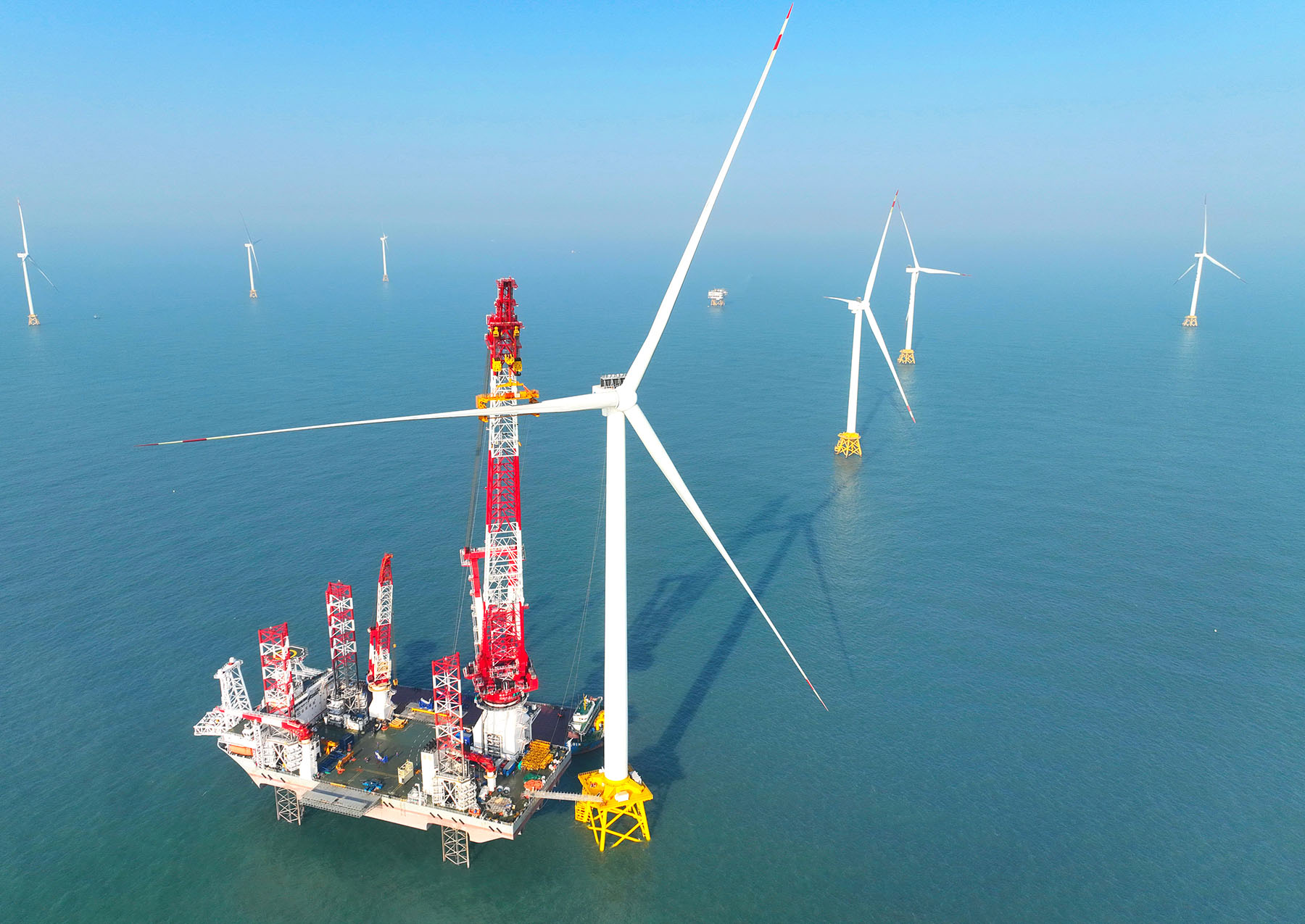
By the end of March, the combined installed capacity of wind and solar power reached around 1.9 billion kilowatts, up 28.1 percent year-on-year, said Pan Huimin, deputy head of the NEA's new and renewable energy department.
Renewable energy power generation maintained steady growth, accounting for nearly 40 percent of the country's total electricity output. Wind and solar power alone made up 23.3 percent of overall power consumption, up 1.1 percentage points from a year earlier, Pan said.
The country's EV charging infrastructure, which supports green mobility, has expanded rapidly.
ALSO READ: Green consumption, rental options embraced by youth
The total number of charging facilities topped 21.48 million by late March, up 46.9 percent year-on-year. Public charging facilities reached 4.86 million units, complemented by 16.62 million private charging piles.
Highway electric vehicle charging activities set new records during the Spring Festival holiday. Authorities are fully prepared for soaring charging demand during the upcoming May Day break.
Facing significant growth in electric heavy-duty trucks, the NEA plans to push forward the construction of zero-carbon highway transport corridors, and has guided power grid firms in pressing ahead with the upgrade and renovation of power networks.
Contact the writers at zhengxin@chinadaily.com.cn
