

Stimulating ecologically friendly shopping behavior can accelerate supply-demand cycle, drive industry transformation

Fueled by the strategic blueprint of the 15th Five-Year Plan (2026-30) and a comprehensive policy push from nine government departments, the rising tide of green consumption in China — spanning energy-efficient appliances, sustainable tourism and circular recycling models — is emerging as a pivotal engine for high-quality economic development and low-carbon societal transformation.
In a significant move to accelerate this trend, the Ministry of Commerce and other departments recently issued a circular outlining 20 specific measures across seven areas. The directive covers the entire life cycle of consumption — from production and circulation to recycling and reuse — addressing daily necessities like food, clothing, housing and transportation.
"Against the current backdrop, accelerating the comprehensive green transition of the economy and society is crucial, especially in the process of boosting consumption," said Guo Liyan, deputy director of the Economic Research Institute at the National Development and Reform Commission. Guo said that stimulating green consumption can accelerate the supply-demand cycle and drive the green transformation of industries.
READ MORE: China accelerates move toward low-carbon growth
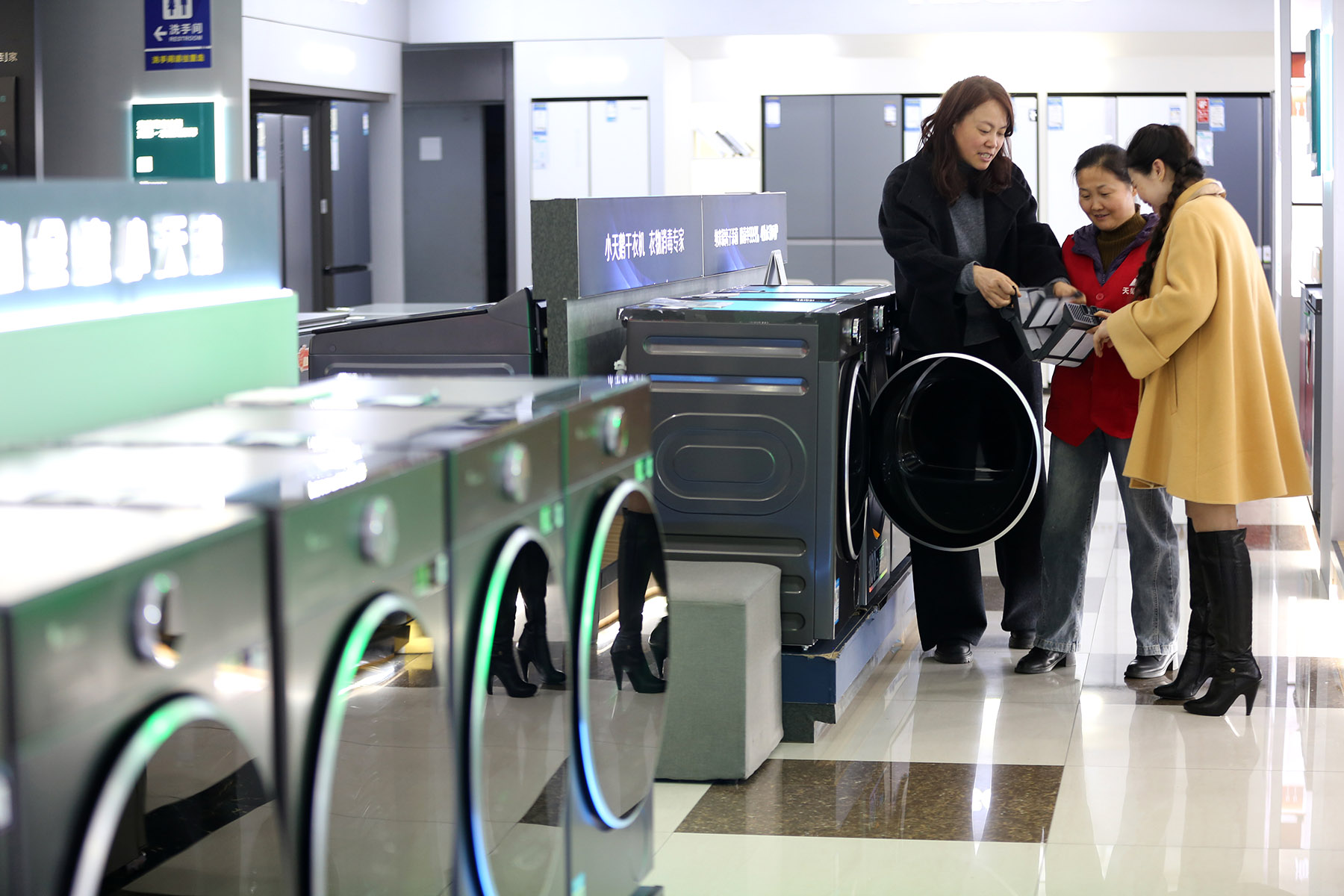
The policy's impact is already visible in regional data, particularly in the "trade-in" sector for home appliances. Latest statistics from the Sichuan Provincial Department of Commerce reveal that as of Feb 18, the province had received 1.124 million applications for home appliance trade-ins, driving consumption of 4.344 billion yuan ($600 million).
Furthermore, applications for digital and intelligent products reached 1.618 million, generating another 4.878 billion yuan in consumption. This surge indicates that the trade-in policy is not only offering tangible benefits to citizens, but also fueling a consumption upgrade toward greener, low-carbon options.
This momentum extended well into the Spring Festival holiday, reaching even county-level markets. In Gangu county, Tianshui, Gansu province, the local commerce bureau launched a "Trade-in for Benefit" campaign coupled with a no-threshold invoice lottery, covering appliances, automobiles and retail sectors from New Year's Eve to the Lantern Festival.
At local appliance centers, residents flocked to upgrade old refrigerators and televisions. "Sales of various appliances are very good, especially essential items like TVs and washing machines," said Xie Xiaomei, a salesperson at the Haowangjiao home appliance sales center in Gangu. "Overall sales have increased by 38 percent compared to the same period last year."
While tangible goods are being upgraded, the services sector is also undergoing a green makeover. As the Spring Festival approached, tourists in Hainan province noticed changes: hotels providing drinking water in glass bottles instead of plastic ones, and replacing single-use toiletries with large-sized dispensers. In restaurants, "half-portion" and "small-portion" menu options are gaining popularity.
However, challenges remain as some merchants hesitate to upgrade green services due to concerns over costs and customer experience. Yi Shaohua, a researcher at the Chinese Academy of Social Sciences, suggested that industry associations should issue initiatives to support businesses, adding that building consumer trust in the hygiene and authenticity of green services is key.
Consumer trends are also guiding upstream industrial upgrades. In Chizhou, Anhui province, the "bamboo replacing plastic" initiative has turned local ecologically friendly practices into economic opportunity. Despite the winter chill, villagers are busy harvesting bamboo, which undergoes 18 precise procedures to become drinking straws and tableware exported to over 100 countries.
Led by key enterprises, Chizhou now hosts 89 bamboo processing companies with an annual processing capacity of 900,000 metric tons. The output value of the city's bamboo sector exceeded 4 billion yuan in 2025, a year-on-year increase of 33 percent.
Beyond manufacturing, Chizhou is exploring a deeper integration of ecology and economy by turning bamboo forests into scenic spots. The city has developed three major bamboo forest sightseeing routes, including Pingtian Lake and Jiuhua Mountain. These routes now attract 3 million visits annually, generating tourism revenue exceeding 100 million yuan.
"We are effectively promoting the conversion of ecological resources into economic value, truly realizing the goal where 'one bamboo enriches the people of one area'," said Hu Min, deputy director of the Chizhou Forestry Bureau, adding that the comprehensive output value is expected to reach 10 billion yuan by 2027.
However, a complete green consumption loop requires effective recycling. At Intco Recycling in Zibo, Shandong province, waste styrofoam is transformed into decorative frames, helping the company achieve an output value of approximately 2.6 billion yuan in the first three quarters of 2025.
Yet, the industry faces bottlenecks. Domestic waste plastic collection volume is often disorganized and handled by scattered workshops, leading to irregular operations and chaotic sorting that cannot meet the needs of large-scale industrial production. Consequently, companies are often forced to import raw materials from thousands of overseas recycling points.
To address this structural pain point, the government circular proposes a three-tier recycling system — collection points, transfer stations and regional sorting centers — and encourages financial institutions to support recycling projects. This systematic approach aims to replace the fragmented, informal recycling network with a standardized, industrial-grade supply chain, ensuring that domestic waste can be efficiently turned into valuable resources.
Beyond traditional buying and recycling, innovation is spawning new consumption models, with the concept of "renting instead of buying" taking root among the younger generation. Yan Xinyan, a Generation Z employee working in Beijing, represents this shift. To document her trip to the Xinjiang Uygur autonomous region in 2025, she rented a handheld gimbal camera. The device, which retails for 3,000 to 4,000 yuan, cost her only about 300 yuan for a 10-day rental.
By verifying her credit score, she was exempted from a deposit, and the entire process was handled online with delivery to her door. "The whole process was very convenient," Yan said.
Yan is not alone. A recent survey by the Social Survey Center of China Youth Daily showed that 77.3 percent of young respondents have experienced "renting instead of buying". Cross-analysis revealed this trend has been most prominent among the post-2000s generation at 82.2 percent, followed by the post-1985s (79.7 percent). Geographically, youth in second-tier cities (81.3 percent) are slightly more inclined to rent than those in first-tier cities. In terms of categories, digital products like cameras and drones top the list (42.5 percent).
This preference is largely driven by the rapid iteration of electronic products. Renting allows young consumers to experience the latest technology without bearing the high cost of depreciation.
Moreover, outdoor equipment follows closely at 38.9 percent, reflecting a lifestyle shift where users value the "experience" of camping or skiing over the "ownership" of bulky gear. Other popular categories include cultural items, tools and clothing.
READ MORE: China unveils action plan to promote green consumption
Zhu Di, a researcher at the Institute of Sociology of the Chinese Academy of Social Sciences, said young people's consumption views are evolving.
"They are shifting from a polarized mode of 'giving up if unaffordable' or 'borrowing to own' to a rational decisionmaking process of 'defining needs first, then considering the path to realization'," Zhu said.
She added that young consumers are using flexible methods like bargaining, sharing and renting to meet their needs within their means. "This reflects a more mature and pragmatic consumption attitude among contemporary youth, which in turn is pushing market supply to respond."
Experts agreed that promoting green consumption is a collective effort involving the government, enterprises and consumers. "A critical aspect is guiding green consumption concepts and behavior. When consumers have the willingness and ability to consume green products with peace of mind, it drives the green transformation of related industries, smoothing the economic cycle. This is a vital direction for China's domestic market to move from big to strong," said Guo of the Economic Research Institute.
Contact the writers at renqi@chinadaily.com.cn
