

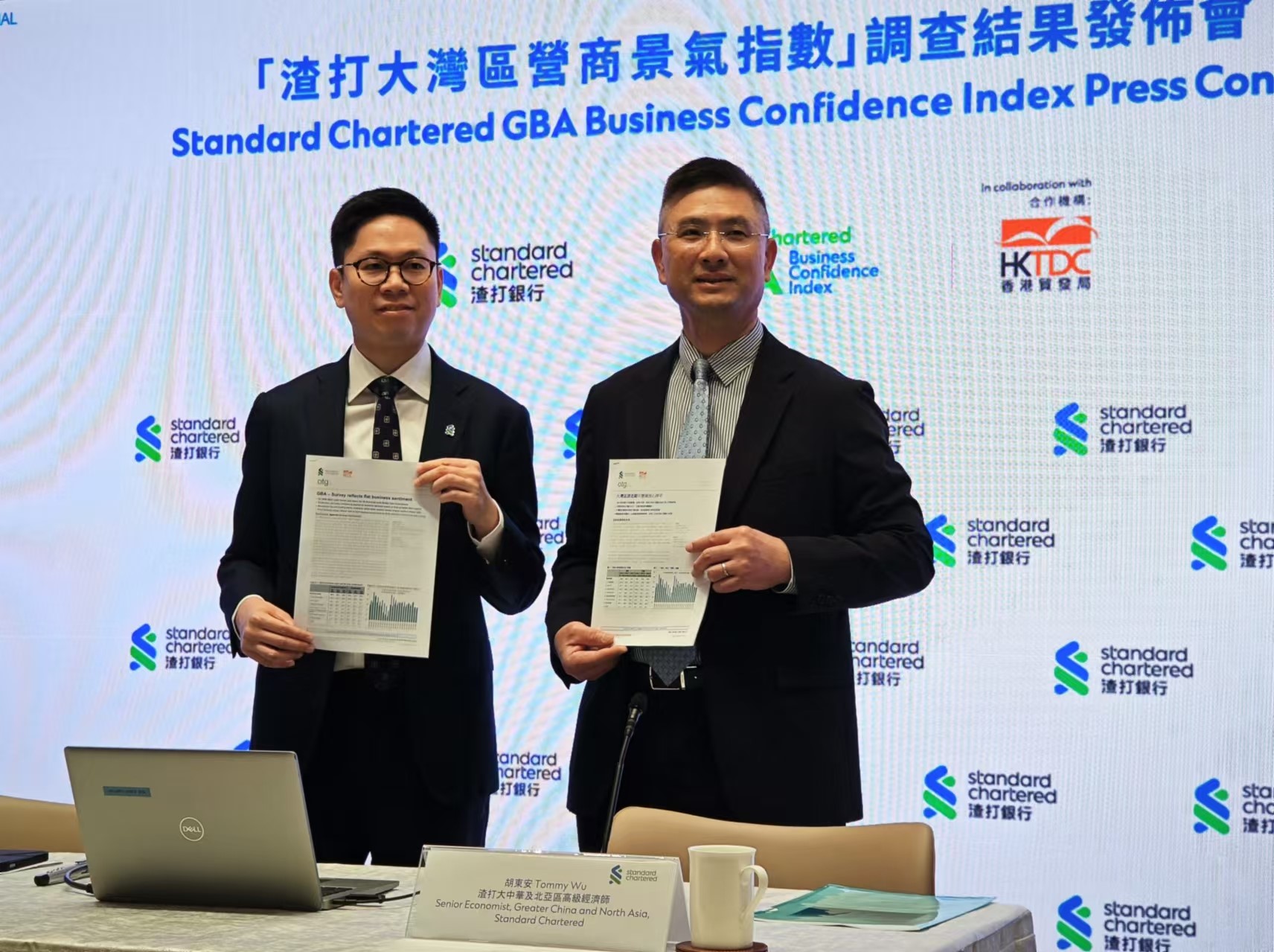
Enterprises in the Guangdong-Hong Kong-Macao Greater Bay Area demonstrated strong business confidence during the first quarter, despite challenges posed by an uncertain external environment.
Their resilience was supported by improved domestic demand and proactive economic policies, which helped bolster businesses in the Greater Bay Area amid geopolitical uncertainties in the Middle East and persistently high oil prices, according to the latest Standard Chartered Greater Bay Area Business Confidence Index (GBAI) released on Monday.
The index is a quarterly survey jointly conducted by Standard Chartered and the Hong Kong Trade Development Council (HKTDC). It polled more than 1,000 companies across the Greater Bay Area on their assessment of current business performance and future prospects. A reading of 50 indicates a neutral stance, with figures above 50 reflecting optimism and those below 50 pointing to pessimism.
ALSO READ: GBA enterprises remain bullish
In the first quarter, the index’s current performance component edged down slightly from 50.3 to 49.9, while the expectation index slipped from 51 to 50.4, suggesting broadly flat business sentiment.
The survey was conducted in February and March, a period marked by escalating conflicts in the Middle East that heightened global trading uncertainties and drove up corporate costs.
“With the prolonged Middle East conflict, we anticipate global energy prices to be higher for longer and the second-round effects to become more visible in the coming months. These will likely weigh on business sentiment and appetite on making fixed investment,” said Tommy Wu, senior economist at Standard Chartered, at a news conference on Monday.
READ MORE: Accelerated production supports GBA’s 2nd-quarter biz performance
As a result, sub-indices for raw material inventories, fixed-asset investment and financing scale all trended lower, emerging as the main drags on the overall performance. Meanwhile, sub-indices for production and sales, prices of finished goods and services and profits showed quarter-on-quarter expansion.
“Demand-boosting stimulus is generating tangible benefits for Greater Bay Area companies, helping to cushion external challenges amid the Middle East conflict,” said Wing Chu, deputy director of research at the HKTDC.
According to the survey, more than 30 percent of respondents identified loan interest subsidies for small, medium- and micro-sized enterprises, large-scale equipment upgrade subsidies and consumer goods trade-in subsidies as policies with the most positive impact on business. They believe these initiatives will support growth in online sales and help reduce operating costs.
Chu noted that companies are no longer overly reliant on exports and are actively expanding their domestic sales. Their confidence in domestic demand has helped offset some of the negative effects stemming from external factors.
The survey covered companies from the manufacturing and trading, retail and wholesale, financial services, professional services, and innovation and technology sectors.
Contact the writer at akirawang@chinadailyhk.com
