

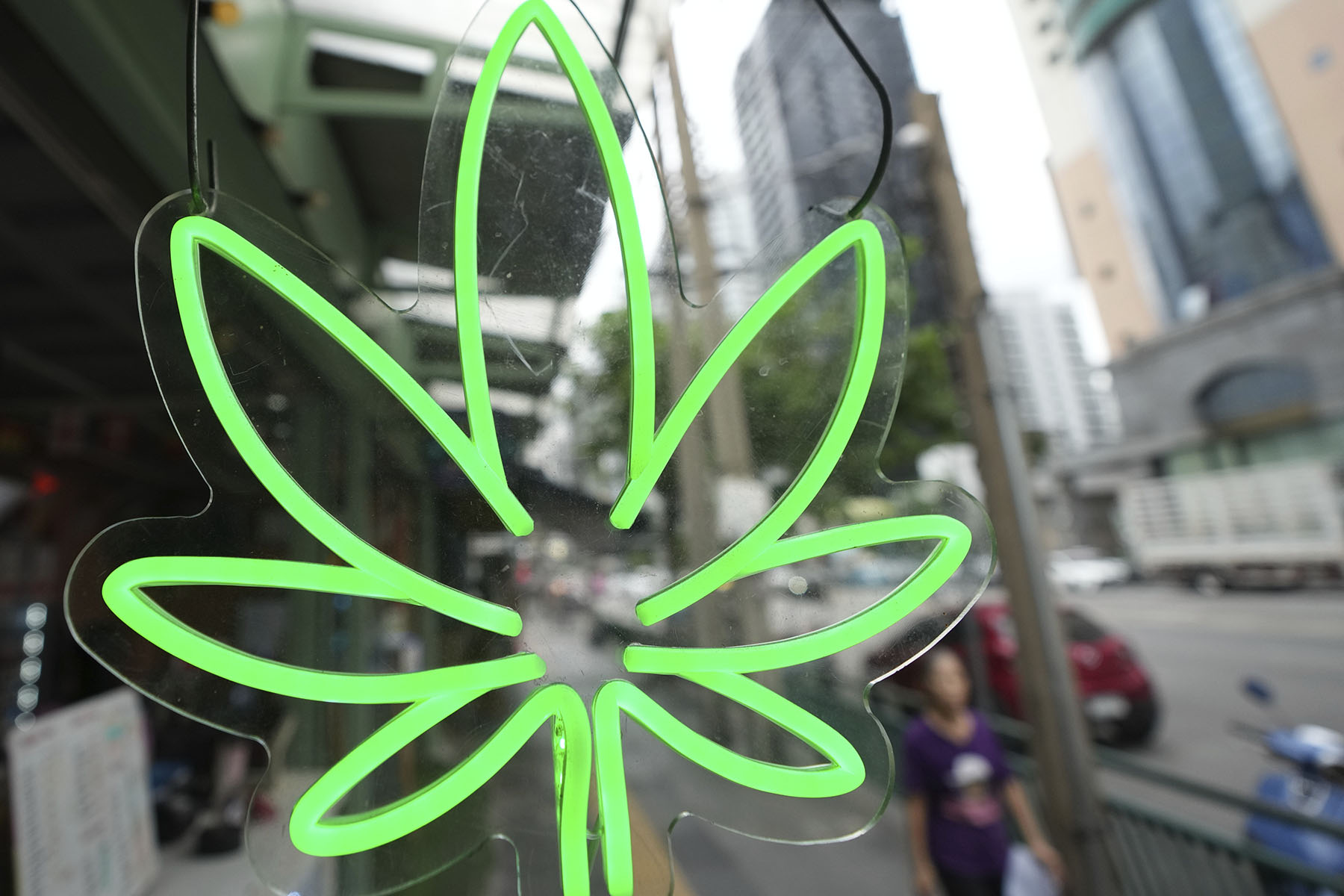
Thailand is announcing new measures to further push the cannabis industry away from recreational to medical use, with ordinary shops set to disappear as operators renewing their licenses will require upgrading to meet regulations.
The shift comes as the number of cannabis outlets has already fallen sharply, with officials saying only about 15 percent of the original 18,000 shops — roughly 3,000 outlets — are likely to move toward the new model.
Public Health Minister Pattana Promphat said the government would continue to support medical cannabis, but under stricter controls covering cultivation, extraction and use.
READ MORE: Thailand moves to recriminalize cannabis, shaking $1 billion industry
He said the ministry would also closely monitor which outlets renew their licenses and which do not, as part of efforts to tighten standards across the sector.
Pattana said any outlet seeking a license renewal would have to upgrade into a medical facility, staffed by qualified professionals such as doctors or Thai traditional medicine practitioners. He said this would help ensure cannabis is dispensed within a proper medical setting rather than through general retail channels.
He added that hospitals nationwide were also ready to dispense medical cannabis, reinforcing the government's push to make access more clearly tied to treatment and healthcare services.
Phongsathorn Phokphoemdee, director-general of the Department of Thai Traditional and Alternative Medicine, said the policy shift would have several main elements.
The first is expanded enforcement authority, with administrative officers now empowered to act under the Protection and Promotion of Thai Traditional Medicine Intelligence Act, alongside the Public Health Ministry and police.
Gradual transition
The second is the conversion of cannabis shops into medical facilities. He said businesses would not be forced to change overnight, but once their current licenses expire, they would need to meet the new conditions before renewing. Operators would be given a three-year transition period to adjust.
Pattana said he had instructed officials to map the locations of licensed cannabis outlets nationwide and introduce stickers to be displayed clearly at shopfronts, showing whether each outlet is properly licensed and when its license expires.
The plan is intended to make inspections easier for officials and help patients identify where they can legally obtain medical cannabis services. Once the mapping is complete, the ministry expects the system to provide clearer access points for those who genuinely need cannabis for medical purposes.
Phongsathorn said the department had already prepared support systems for operators and staff, including training programs and e-learning, to help businesses adapt to the new regulatory model.
Despite the tighter controls, the government is still positioning cannabis as a potential new economic growth engine, particularly in the medical field.
Pattana said medical cannabis involved high-value extraction and processing, and the ministry saw economic opportunities in both domestic use and exports.
ALSO READ: Bangkok like a local
He said cannabis extracts in overseas markets were widely used in cosmetics and pharmaceuticals, creating high added value. If growers, extractors and processors can meet quality standards, the ministry would support domestic use first, with any surplus potentially exported.
He added that several private firms had already invested in extraction plants meeting industrial, food and medical standards, and said the ministry was ready to support businesses committed to operating within the law.
Thailand decriminalized cannabis in 2022, triggering a rapid boom in dispensaries, but the government reversed course in 2025 by restricting cannabis sales to medical use and requiring prescriptions. Since then, authorities have been tightening rules and steering the industry away from open retail sales toward a clinic-based model.
