

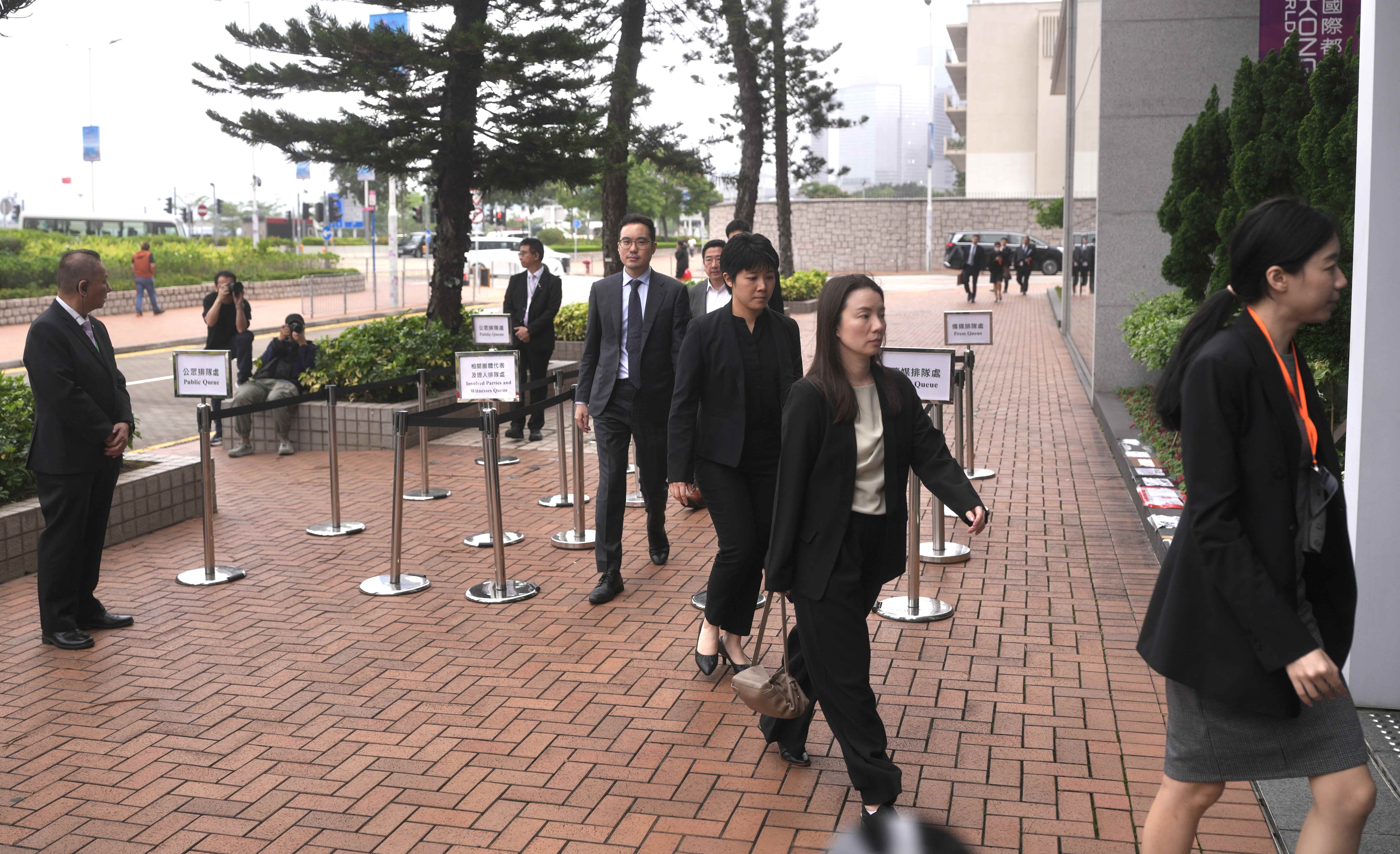
An independent committee investigating last November’s deadly Wang Fuk Court fire heard on Monday that firefighting commanders were unaware which specific fire safety systems were disabled after they arrived at the site on Nov 26.
Firefighters giving evidence at Monday’s hearing also said there are no official guidelines for evacuating occupants when fire alarms fail.
The blaze, described by officials as having spread at an “unprecedented” speed through seven of the estate’s eight residential blocks, claimed 168 lives.
SPECIAL PAGE: Tai Po fire inquiry hearings
During the 11th evidential hearing, Tai Po Fire Station Senior Station Officer Hui Kin-on, who was the first commander on site, arriving at 2:56pm, testified that he had learnt that some fire safety devices were shut down before he arrived, but he could not recall whether he was told any details about which specific installations were disabled.
About 30 minutes later, Tai Po Fire Station’s station commander, Cheung Lok-hang, took over from Hui. He knew a contingency plan was in place for Wang Fuk Court due to some fire safety systems being shut down. When setting off, he asked the control center which vehicles were dispatched, but was not told which equipment was shut down.
The confusion deepened with the case of firefighter Ho Wai‑ho, who was originally assigned to rescue a couple trapped in Wang Cheong House but mistakenly entered the adjacent Wang Tai House after stopping to help a wheelchair‑bound resident evacuate.
RELATED ARTICLES:
- Time gap revealed in Wang Fuk Court fire safety system oversight
- Booking opens Thursday for public hearings into Tai Po fire
- HK's first public hearing on Tai Po fire scheduled for March
Ho’s colleagues were unable to log Ho's entry or monitor his breathing apparatus, Hui explained — first because debris blocked access to Wang Cheong House, and later because the intense fire there also prevented setting up entry control.
As a result, Ho became the lone firefighter inside a residential block, reaching the 30th floor of Wang Tai House.
After Ho transmitted a “mayday” call for help, Hui led the rescue attempt but did not know which building Ho was in, assuming it was the worst‑hit Wang Cheong House.
Ho later fell from Wang Tai House and was pronounced dead at the Prince of Wales Hospital at 4:41 pm.
Multiple emergency response teams were formed but could not enter due to falling bamboo scaffolding and debris blocking the entrance. Hui later expressed surprise that Ho had reached such a high floor so quickly under extreme fire conditions.
Hui also said he heard no fire alarms when he arrived at the scene.
“We tried to enter Wang Cheong House to activate the alarm, but both the front and rear doors were blocked by burning debris falling from above,” Hui said. Unable to sound the alarm or gain entry, he deployed resources to suppress the flames.
Hui said he had ordered his team to activate the fire alarms in nearby buildings. When they were unable to do so in three other buildings, he realized the estate's alarm system was likely defective.
Hui also told the committee that there are no established fire service guidelines on how to evacuate residents when a fire alarm system is not functioning.
Committee counsel Lee Shu-wun asked whether an earlier spontaneous evacuation decision should have been made. Hui replied: “With hindsight, the earlier the evacuation, the better.”
Cheung said he “did not receive any instruction to order a full estate evacuation”, adding that he saw some residents were already leaving on their own, apparently alerted through other means, so he decided to focus all efforts on firefighting to buy more time for people to escape.
Cheung insisted that the deployment of fire engines and water supplies was adequate.
Contact the writers at stacyshi@chinadailyhk.com
