

Liuyang's 1,400-year-old fireworks industry has evolved into powerhouse of new quality productive forces, transforming itself from low-end, seasonal manufacturing to innovative green technology

On a typical weekend night in Liuyang, a county-level city in Central China's Hunan province, the dark sky becomes a vast canvas of light. Millisecond-precise electronic ignitions send thousands of fireworks blooming in carefully choreographed patterns, while drone formations weave through the bursts, turning the night sky into a live performance.
For a city that has been hand-rolling explosives since the Tang Dynasty (618-907), the spectacle is more than a visual marvel — it signals the rebirth of an ancient industry.
By pivoting from low-end, seasonal manufacturing to green technology, digital production and immersive cultural tourism, Liuyang's 1,400-year-old fireworks industry has evolved into a powerhouse of new quality productive forces.
This transformation echoes a key theme of the ongoing annual two sessions, which has emphasized that new quality productive forces should not only nurture emerging sectors, but also upgrade traditional industries.
Today, the city accounts for about 60 percent of China's domestic fireworks market and roughly 70 percent of its exports. But the real story is not just how many fireworks Liuyang produces — it is how the world's oldest pyrotechnics hub has rebuilt its entire value chain.
For centuries, fireworks production in Liuyang was a precarious cottage industry. Families mixed black powder by hand and filled shells manually — a system that combined artisanal skill with serious safety risks and heavy pollution.
"Moving from scattered household workshops to centralized, professional factories was a qualitative leap in safety," said Wen Guanghui, head of the export branch of the Liuyang fireworks and firecrackers general association, noting that the sector's privatization and restructuring in 1998 laid the groundwork for modernization.
Yet the industry's most dramatic transformation has taken place in the past few years, driven by digitalization and environmental innovation.
To tackle long-standing safety risks, more than 200 fireworks companies in Liuyang have completed digital upgrades.
Twenty fully automated demonstration lines now operate across the city, while more than 66,000 AI-enabled cameras feed into a centralized risk-warning system. Crucially, the most dangerous chemical-handling procedures now operate under "human-machine separation", significantly reducing worker exposure to explosive materials.
At the same time, engineers have targeted the industry's environmental footprint.
By using single-base powder, plant-fiber materials and specially designed catalysts, researchers have developed micro-smoke, sulfur-free and even odorless fireworks. These new formulas reduce post-combustion residue by around 80 percent and bring sulfur dioxide emissions close to zero — allowing large-scale, hourlong displays without shrouding the sky in smoke.
Technology alone, however, does not fully explain Liuyang's rapid growth. The city has also reinvented fireworks as part of China's expanding emotional economy.
According to iiMedia Research, the emotional economy market in China — consumption driven by entertainment, experiences and emotional connection — reached 2.7 trillion yuan ($380 billion) in 2025 and is projected to exceed 4.5 trillion yuan by 2029, making it an increasingly important engine of consumer growth.
"This wasn't simply a release of production capacity; it tapped into the public's emotional demand and redefined the value of the product," an industry observer said. Fireworks, once viewed merely as holiday consumables, have been repositioned as a year-round cultural attraction.
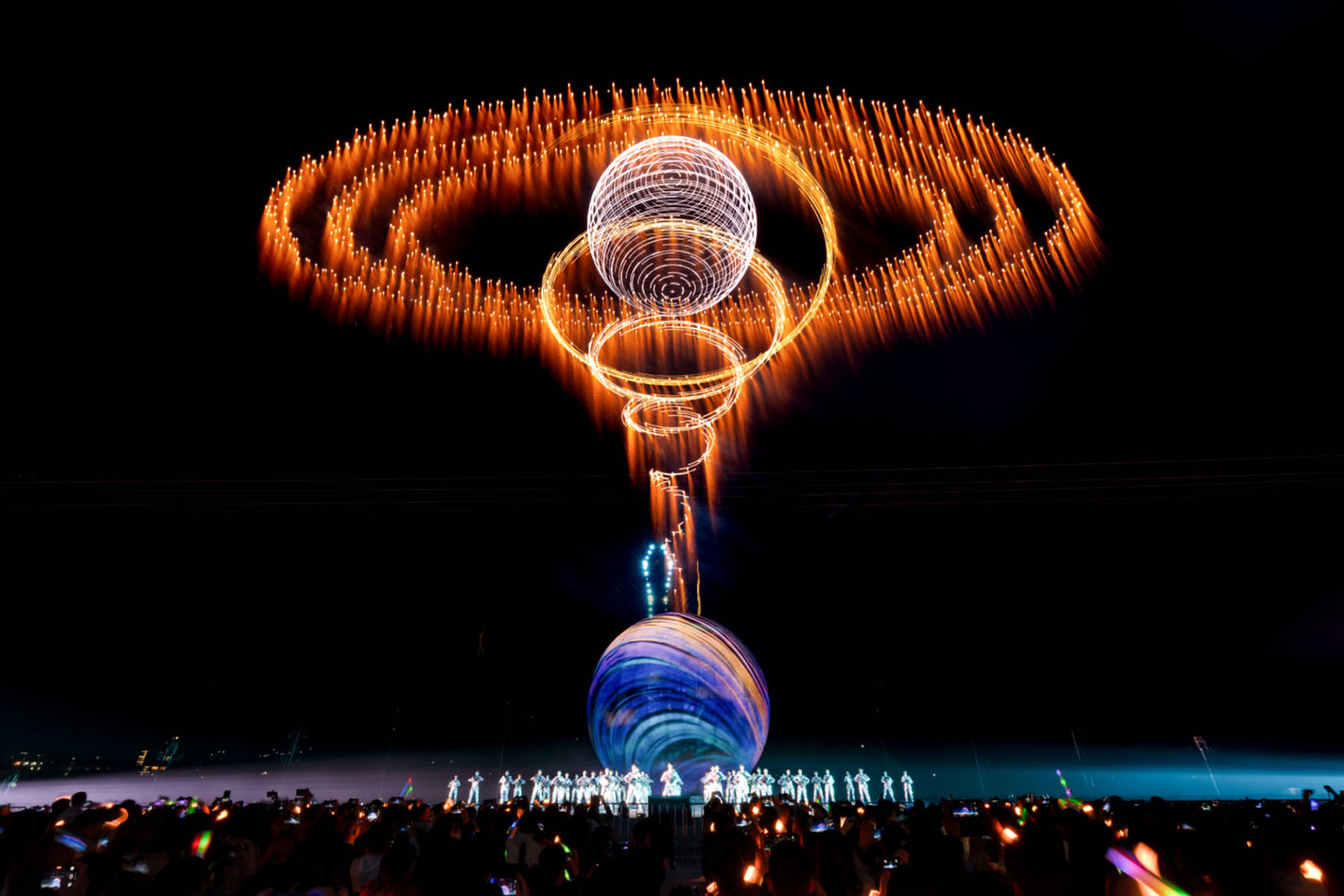
Anchored by the city's Sky Theater, Liuyang has turned weekend fireworks shows into a regular tourism draw. Since 2023, the city has hosted 142 major displays, attracting more than 7 million visitors.
These tourists do more than watching fireworks — they stay in hotels, dine in restaurants and buy cultural merchandise, generating more than 20 billion yuan in related local spending a year.
Market demand is now pushing companies further up the value chain. Instead of simply selling standardized fireworks shells, firms increasingly offer immersive shows that combine augmented reality effects, daytime cultural workshops and nighttime fireworks spectacles.
As the domestic market evolves, Liuyang's global strategy is shifting as well. For decades, Chinese fireworks manufacturers occupied the low end of the global "smile curve", producing white-label goods for Western brands.
Today that model is changing. Independent Liuyang brands now account for more than 40 percent of the city's exports, while in the key US market — which remains resilient despite trade tensions — Chinese-ownedbrands contribute more than half of sales, according to Wen.
The business model is also evolving from exporting products to exporting complete fireworks solutions.
"In the past, overseas clients simply bought standardized products," said Qiu Teng, general manager of China Galaxy Pyrotechnics Co Ltd. "Now they tell us their ideas, and we provide a full package — from design and production to installation and execution."
Qiu's team recently organized a 62-minute uninterrupted New Year's Eve fireworks display in Abu Dhabi, capital of the United Arab Emirates, that set four Guinness World Records. Using Liuyang's latest micro-smoke technology to keep the desert sky clear, the show demonstrated the industry's new role. Rather than exporting containers of fireworks, Liuyang companies are increasingly exporting turnkey entertainment spectacles.
Despite its booming success, the industry must navigate stiff headwinds. The rapid automation of factories has sparked concerns of domestic overcapacity, while reliance on the port of Shanghai for 90 percent of hazardous cargo shipments creates logistical bottlenecks.
To strengthen resilience, local authorities are exploring new logistics routes, including a proposed China-Europe rail freight service dedicated to fireworks exports, and also seeking greater influence over the industry's global rules.
China hosts the secretariat of the International Organization for Standardization's fireworks technical committee (ISO/TC264). So far, Liuyang has helped lead the drafting of 22 international standards — about 70 percent of the global total in the sector.
Liuyang's reinvention offers a potential template for revitalizing other traditional manufacturing industries.
"The Liuyang model shows how industries can move from being factor-driven to innovation-driven," said Deng Weiping, deputy director of the Department of Commerce of Hunan Province. "Its vitality comes from the combination of cultural heritage, technological innovation and industrial integration."
As China pushes its manufacturing sector toward higher-quality growth, Liuyang's experience suggests that ancient craftsmanship and advanced technology can evolve together.
"Our goal during the 15th Five-Year Plan (2026-30) period is not just expansion in scale," Deng said. "We want to push a four-in-one global strategy — exporting products, brands, standards and culture."
Contact the writers at lijing2009@chinadaily.com.cn
