

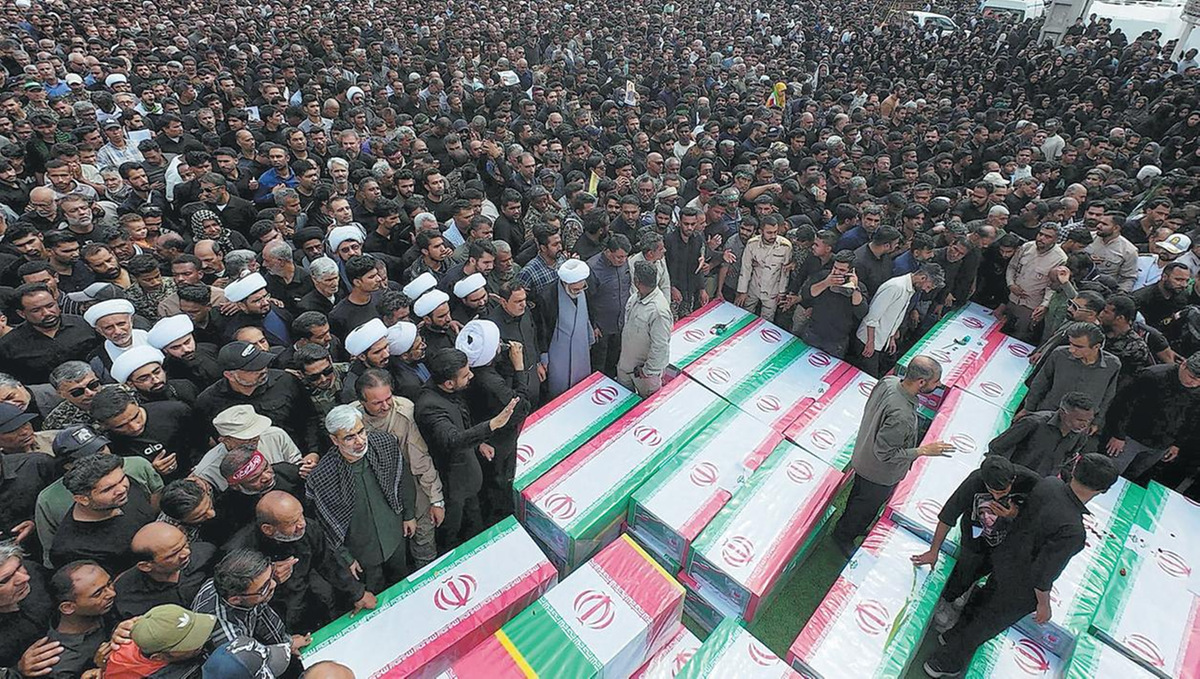
A new day has dawned, yet the smoke of war over the Middle East has not yet cleared. The joint military offensive launched by the United States and Israel against Iran on Feb 28 has sent shockwaves across the region, and it now threatens to escalate into a conflagration of wider proportions should events spiral out of control. In the aftermath of the bombardment, a local girls' elementary school was reduced to rubble, children’s textbooks scattered among the debris and stained with blood. This harrowing scene unfolded mere months after my address to the United Nations Human Rights Council in June 2025, in which I condemned the United States for supplying weapons to Israel — arms that facilitated the slaughter of women and children in Gaza.
 At that time, I posed the question: how can the human rights of women and children possibly endure beneath the shadow of war? Now, that question has grown only more urgent: when sovereign states are bombed with impunity, when school classrooms are transformed into morgues, who can credibly claim to champion human rights?
China's Foreign Minister Wang Yi delivered a pivotal speech at the High-Level Segment of the 61st Session of the United Nations Human Rights Council on Feb 23. He articulated a comprehensive vision for implementing the Global Governance Initiative and reforming global human rights governance. He emphasized that "to live a happy life is the greatest human right" and called for steadfast adherence to the principles of sovereign equality, the international rule of law, and multilateralizm. Against the backdrop of the pre-emptive US-Israeli airstrikes on Iran, these words resonate with exceptional clarity and moral force.
READ MORE: China says ready to work with all countries to improve human rights governance
In his address, Minister Wang Yi declared, "No country is in a position to lecture others on human rights, and no model can claim to be superior. A path to human rights development must reflect national realities and meet the people’s needs to hold real promise." This statement strikes at a chronic malady in international human rights governance — namely, the tendency of certain nations to appoint themselves "champions of human rights", interfering in the internal affairs of others at will, and even invoking human rights as a pretext for government change.
In justifying its assault on Iran, the US proclaimed its intention to "dismantle Iran's missile capability" while openly encouraging the Iranian populace to rise up and overthrow their government. Such brazen aggression against a sovereign state, coupled with an undisguised campaign to effect government change before the eyes of the international community, constitutes a violation of the principle of sovereign equality — and a bitter irony for any nation that styles itself a "human rights teacher".
History, it seems, has a grim tendency to repeat itself. In 2003, the US launched its invasion of Iraq on the basis of dubious intelligence, alleging the presence of weapons of mass destruction. The world is not going to hurriedly forget the spectacle of then-US Secretary of State Colin Powell brandishing a vial of unidentified white powder before the United Nations Security Council. Tragically, a worse scenario is unfolding again: the US President insists that Iran will soon possess missiles capable of striking the US, even as federal government assessment reports say Iran is years away from developing long-range missile capability.
In the eyes of certain countries, the sovereignty of other nations is merely grass to be trampled underfoot, and the lives of foreign peoples pawns in their pursuit of geopolitical objectives. If a country cannot guarantee its citizens’ most fundamental rights — survival and security — how can it presume to speak of higher aspirations in human rights? One must ask: whose rights, precisely, are these self-proclaimed "defenders of human rights" truly defending?
Minister Wang Yi underscored the imperative of "abiding by international rule of law and strengthening the foundation of global human rights governance", urging all nations to honor the principle of non-interference in the internal affairs of sovereign states. The US-Israeli military action occurred at a moment when negotiations between the US and Iran were reportedly making "substantial progress" toward a peaceful resolution. Yet just as the first light of peace appeared on the horizon, the US and Israel chose to pull the trigger. To speak of peace one moment and launch airstrikes the next — such duplicity utterly shatters the façade of "justice" that certain nations purport to uphold.
The United Nations Charter expressly mandates respect for national sovereignty and territorial integrity, and calls for the peaceful resolution of disputes. Yet the US, a permanent member of the UN Security Council, treats these foundational principles as disposable scraps of paper. Under the guise of maintaining regional security and preventing nuclear proliferation, it pursues government change and the elimination of adversaries. As Minister Wang Yi observed, "Human rights must not be an ornament for democracy, nor a cover for hegemonism." When human rights are reduced to instruments of political convenience and international law becomes a plaything of the powerful, the very foundation of global human rights governance crumbles.
What moved me most profoundly in Minister Wang Yi's address was his assertion, "To live a happy life is the greatest human right, and development holds the key to achieving it." Human rights are not abstract political slogans; they are the substance of daily existence—food, clothing, shelter, security, and the laughter of children. Yet on Feb 28, in Iran, a girls' elementary school was struck by missiles, claiming the lives of more than 160 students. At the site of the attack, rubble buried desks and chairs, and students’ abandoned books lay strewn across the ground.
ALSO READ: Global human rights call for collective actions
Local residents gave voice to their anguish, "These children came to school this morning to learn — now they lie buried beneath the ruins. These are their textbooks, and the pages are soaked in their blood." This tragedy bears a haunting resemblance to the scenes I described at the United Nations regarding Gaza, where over 56,000 Palestinians had perished by June 2025, seventy percent of them women and children.
The right to life is the most elemental of human rights; without survival, all other rights are rendered meaningless. Yet in the pursuit of certain nations' "strategic objectives", civilian lives are reduced to expendable statistics, and the blood of women and children fades into fleeting headlines. Authentic people-centered governance means ensuring that every child can attend school in safety, that every family is spared the horrors of war, and that every life may be lived with dignity — not dropping bombs while mouthing platitudes about human rights.
The road to reforming and improving global human rights governance is fraught with challenges. Nevertheless, I am confident that so long as the international community genuinely upholds sovereign equality, adheres to the rule of law, and places people-centered development at the heart of its endeavors as China, humanity will ultimately usher in a new era of human rights and civilization — despite the disruptive actions of certain powers.
The author, a member of the Legislative Council, is the deputy chairwoman of the LegCo Parliamentary Liaison Subcommittee of the Hong Kong Special Administrative Region. She is also a member of the United Nations Association of China.
The views don't necessarily represent those of China Daily.
