

Protection of forests, grasslands, wetlands, other ecosystems helps Xizang’s economic growth
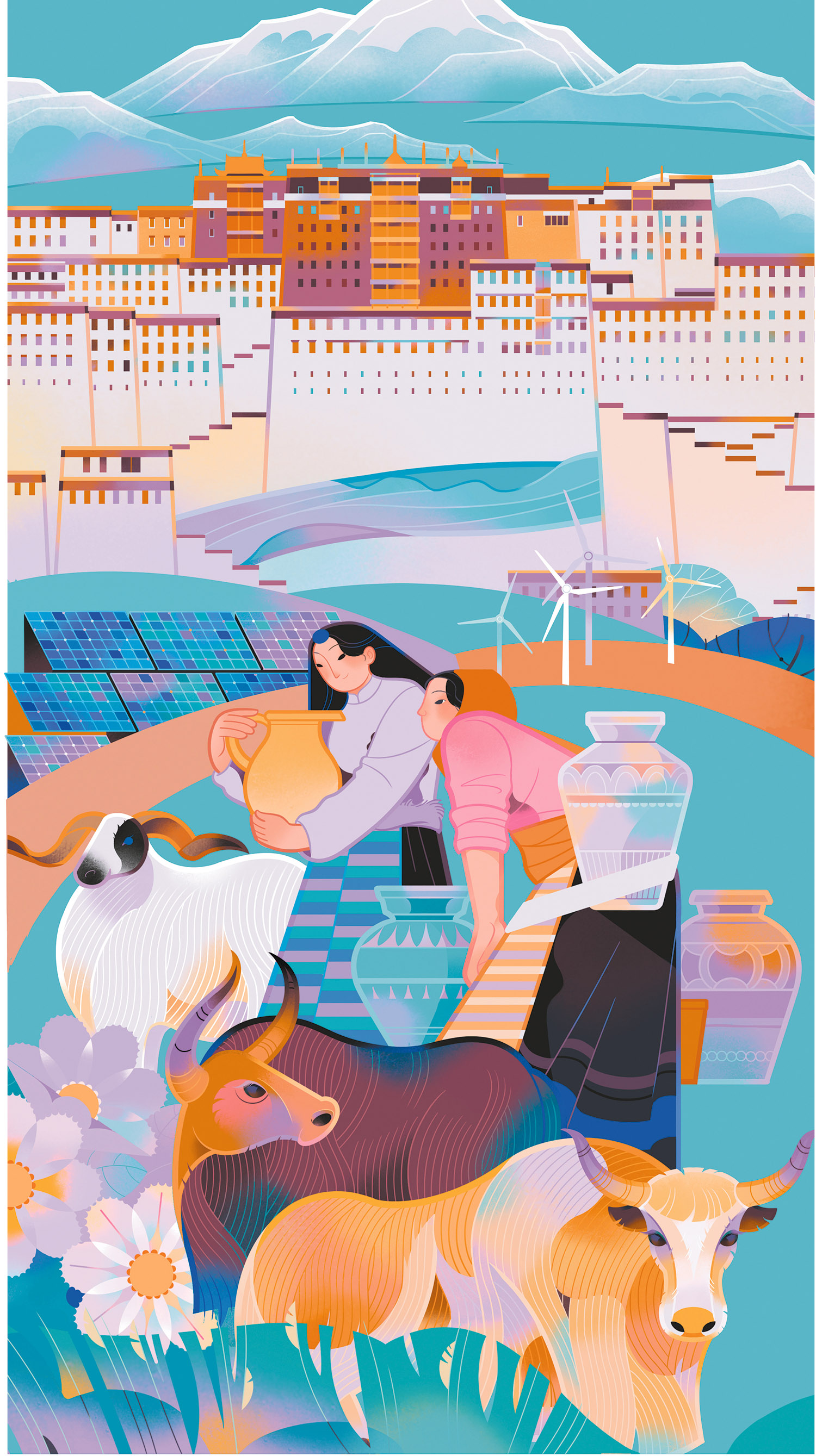
As the core region of the Qinghai-Tibet Plateau, the Xizang autonomous region serves as a vital ecological security barrier not only for China but for Asia as a whole. In recent years, the region has consistently treated ecological protection as a top priority, taking proactive steps to strengthen China’s ecological security barrier, advance ecological civilization and contribute to the country’s carbon reduction strategy.
The progress of ecological compensation in Xizang has relied on strong national-level policy support as well as tailored implementation at the local level.
China has introduced a series of laws and regulations that provide a legal foundation for improving the ecological compensation mechanisms in Xizang.
READ MORE: 60 years of Xizang's progress marked
The region has gradually established a framework centered on fiscal transfer payments, supplemented by inter-regional compensation payments, expanded through market-oriented approaches.
In the past five years, the region introduced a series of regulations covering forests, grasslands, wetlands, water ecosystems, glacier protection and wildlife conservation. Between 2018 and 2024, Xizang received 95.4 billion yuan ($13.9 billion) in ecological protection subsidies and rewards.
At the same time, Xizang has adopted some of the country’s strictest ecological protection measures. More than half of the region’s land area has been placed under ecological conservation red lines, while 37.95 percent has been designated as protected natural areas of various levels. These measures have curbed disorderly development and fostered ecological preservation and green growth.
The most profound impact of ecological compensation has been the transformation of public attitudes toward development. Through the principle that “those who protect the environment should benefit from it”, local communities have understood that protecting the environment also protects their livelihoods and well-being. The result has been a shift from passive compliance to active participation.
A vivid example is Galai village in Bayi district of Nyingchi. In the past, villagers cut down peach trees for firewood. With the implementation of ecological compensation policies, the area established ecological protection zones and organized professional forest ranger teams. Villagers pooled their land into a tourism cooperative, with 30 percent of scenic area revenues distributed as dividends and 30 percent reinvested into ecological conservation.
By developing eco-tourism centered on peach blossom landscapes, the village transformed its peach blossom festival into a well-known cultural brand. In recent years, the per capita disposable income in Galai village has risen to more than 40,000 yuan.
In recent years, Xizang has also used ecological stewardship jobs as a key tool for ecological compensation, enabling farmers and herders to become environmental guardians while increasing their incomes. Eco-environmental protection has provided around 516,000 jobs a year from 2016 to 2024.
From 2021 to 2024, Xizang invested 6.93 billion yuan from the central budget in ecological benefit compensation funds related to forests, and it has effectively managed and protected 11.87 million hectares of State-owned and non-State-owned forests, bringing significant growth in forest resources.
Protection efforts also cover wetlands, water ecosystems and wildlife conservation. Nearly 900 million yuan was spent on restoration work at the Lhalu Wetland, among other projects.
Xizang has also invested tens of billions of yuan in water conservancy projects over the past five years. As a result, the health rates of rivers and lakes have reached 100 percent.
The mechanism of compensation has eased herders’ concerns about wildlife-related losses and helped transform human-wildlife conflict into coexistence. Populations of rare species such as snow leopards, Tibetan antelopes, Tibetan wild asses and black-necked cranes have continued to recover steadily.
Building on its ecological strengths, Xizang is gradually developing a modern and environmentally friendly industrial system led by eco-tourism, clean energy and green agriculture and animal husbandry, turning ecological assets into long-term economic advantages.
ALSO READ: High-quality development track heralds prosperous, harmonious future for Xizang
The region’s total clean power generation ranks first nationwide. Electricity transmitted from Xizang now reaches more than 10 provincial-level regions.
Tourism has become a major pillar industry supporting local livelihoods. In 2025, Xizang received over 70.73 million tourist visits, generating 81.68 billion yuan in tourism revenue.
Today, Xizang stands at a crucial stage of high-quality development. By prioritizing ecological protection and improving ecological compensation systems, Xizang has successfully pursued a path that balances economic growth with environmental preservation and promotes harmony between humanity and nature.
Chen Aidong is dean of the School of Finance and Economics at Xizang Minzu University and Zhao Zhengnan is a lecturer at the same university.
The views do not necessarily represent those of China Daily.
