

As China readies to host APEC leaders’ meeting, prospects increase to advance economic openness

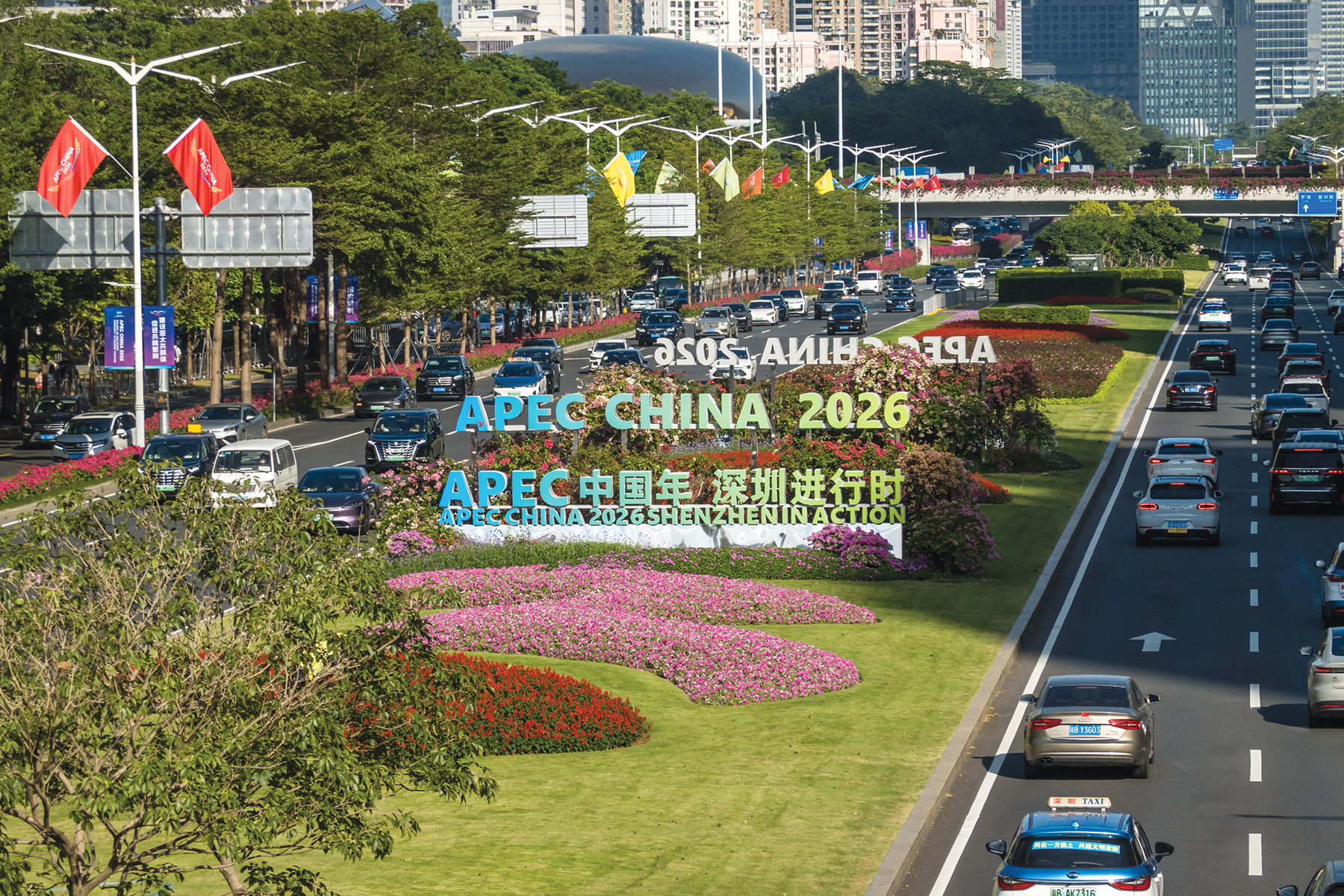
Amid the bougainvillea, roses and hydrangeas of a giant APEC-themed flower bed in Lianhuashan Park in Shenzhen, Guangdong province, a bird-shaped emblem spreads its wings. Its 21 interwoven feathers represent the 21 economies of the Asia-Pacific Economic Cooperation, each distinct yet part of the same design.
Inspired by the mythical Peng bird, the emblem marks China hosting the APEC Economic Leaders’ Meeting for the third time, after Shanghai in 2001 and Beijing in 2014.
Shenzhen will host the 33rd APEC Economic Leaders’ Meeting on Nov 18 and 19 under the theme of “Building an Asia-Pacific Community to Prosper Together,” with openness, innovation and cooperation as the priorities.
The city that will welcome the leaders is itself a product of opening-up. Speaking at the APEC chairmanship handover in Gyeongju in the Republic of Korea last November, President Xi Jinping said Shenzhen had developed from a small, backward fishing village into a modern international metropolis over the past few decades. He described it as an important window to China’s unswerving pursuit of a mutually beneficial and win-win opening-up strategy.
Amid growing global economic uncertainty, officials and analysts said that hosting APEC offers China an opportunity to expand access to its market, share the gains from innovation and strengthen cooperation among economies with different systems and levels of development.
Dun Zhigang, a research fellow at Renmin University of China’s Chongyang Institute for Financial Studies in Beijing, said choosing Shenzhen as the venue signals China’s commitment to opening-up. That commitment increasingly involves rules, regulations, management and standards, alongside market access, he added.
“China’s door to the world will not close; it will only open wider and wider,” President Xi said at the first session of the 2025 APEC Economic Leaders’ Meeting in Gyeongju.
APEC’s 21 economies were home to about 3 billion people and accounted for 61.6 percent of global GDP in 2025, according to APEC data. In 2024, the economies represented about 46 percent of global trade in merchandise goods and commercial services.
In the first three quarters of this year, China’s trade with other APEC economies reached 24.07 trillion yuan ($3.61 trillion), accounting for 60.3 percent of the nation’s total foreign trade during the period, according to customs data. China is the largest trading partner of 13 APEC economies, a Xinhua News Agency think tank report released in September said.
China’s national negative list for foreign investment no longer includes restrictions on the manufacturing sector, while this year’s Government Work Report called for further opening-up in services.
At the 37th APEC Ministerial Meeting held earlier this month in Beijing, Foreign Minister Wang Yi said China and other member economies had held more than 300 meetings and events during China’s host year. He called for safeguarding the World Trade Organization-centered multilateral trading system, sustaining regional integration and developing an innovation ecosystem.
At the 2014 Beijing meeting, APEC leaders endorsed a roadmap for advancing the Free Trade Area of the Asia-Pacific and adopted the forum’s first connectivity blueprint. China is now working with other APEC economies on the free trade area and an upgraded blueprint.
At the ministerial meeting, Singapore’s Minister of State for Foreign Affairs and National Development Alvin Tan thanked China for its leadership of APEC this year. He called for keeping the region open and connected, strengthening supply chain resilience and finding common ground for practical cooperation, according to Singapore’s Ministry of Foreign Affairs.
In Shenzhen, goods trade with other APEC economies reached 1.98 trillion yuan in the first half of 2026, accounting for 68.8 percent of the city’s total goods trade. Those economies also accounted for 93.6 percent of the foreign investment actually utilized by the city during the same period, according to municipal figures.
Gulnar Shaimergenova, director of the China Studies Center in Kazakhstan, said the emphasis on openness, innovation and cooperation is particularly relevant amid uncertainty in global supply chains and intensifying technological competition.
China’s economic scale, manufacturing capabilities and role in supply chains give it an important part to play in regional cooperation, she said, adding that Shenzhen’s development shows how openness, investment and innovation can transform an economy.
Although Kazakhstan is not an APEC member, developments in the Asia-Pacific region affect its economy through trade, investment and transport. Greater regional openness and connectivity can strengthen links between Central Asia and markets across Asia and Europe, Shaimergenova said.
China’s experience shows how long-term planning and practical implementation can bring infrastructure, industry and innovation together, she said. Other economies need to adapt those lessons to their own circumstances and judge progress by improvements in people’s daily lives.
For Zafar Uddin Mahmood, chairman of Pakistan’s Understanding China Forum, Shenzhen’s transformation is a story he has watched unfold.
His memories date back to 1977, when he passed through Shenzhen on his way to neighboring Hong Kong. Over the years, he saw buildings rise and roads extend as people arrived seeking work and better lives.
Returning earlier this year, Mahmood found a city embracing new technologies.
“Whenever somebody is looking for anything new, they first go to Shenzhen,” he told China Daily.
The meeting will allow leaders to see China’s transformation and consider the lessons that could be adapted to their own economies, he said.
Shenzhen’s core industries related to the digital economy generated more than 1 trillion yuan in annual value added for three consecutive years through 2025. Its research and development spending reached 245.31 billion yuan in 2024, equivalent to 6.67 percent of the city’s GDP, the highest R&D intensity among Chinese cities, according to the city’s 2026 Government Work Report.
Lan Qingxin, a professor at the University of International Business and Economics in Beijing, said Shenzhen’s rise reflects more than advances in technology. The city’s development also shows how opening-up and institutional reforms can help turn investment and innovation into industrial strength. That experience gives APEC economies a concrete basis for discussing how innovation reaches businesses and markets, he said.

To make such cooperation more inclusive, Lan called for policy exchanges, technical support and training that help developing economies take part in digital transformation and industrial upgrading. He also advocated technology cooperation and demonstration projects through APEC, so that the useful innovations can be tested, adapted and applied more widely.
At the second session of the 2025 APEC leaders’ meeting in Gyeongju, President Xi called for deeper cooperation on open-source technologies and said that China is ready to work with members to enhance artificial intelligence literacy and bridge the region’s digital and AI divide.
At the opening of the 2026 World AI Conference and High-Level Meeting on Global AI Governance in Shanghai, he called for international cooperation to strengthen capabilities of Global South countries and announced that China would provide 5,000 slots in AI training and seminar programs for developing countries over the next five years.
Malaysian scholar Jaspal Kaur Sadhu Singh, an associate professor at Canterbury Christ Church University in the United Kingdom, said China can support capacity-building in emerging economies such as Malaysia by sharing its experiences.
Other economies can learn from China’s experience in applying AI and managing its risks while adapting those lessons to their values and circumstances, she said. “It is not a case of one size fits all.”
Andrea Renda, director of research at the Centre for European Policy Studies and an AI governance expert, said that APEC can help its member economies make wider use of technologies developed in leading economies.
China’s use of AI in industry, infrastructure management and healthcare offers useful experience for developing countries, he said. Reusable and adaptable models can lower deployment costs, but effective use also requires infrastructure, industrial capabilities and supporting value chains.
Developing economies need to integrate technologies into their industries, retain more of the wealth generated locally and choose solutions suited to their needs, he added. The aim should be for them to be “empowered by AI” rather than be simply users and consumers of foreign models.
John Ross, a British economist, said economies with different political systems and levels of development have been able to prioritize growth and cooperate while retaining their differences, adding that APEC and China as host have an important role to play in maintaining stable conditions for Asia’s development.
The forum works through voluntary cooperation and consensus, with nonbinding commitments. In hosting APEC, China advocates taking account of members’ different stages of development and core interests, Dun of Renmin University of China said. Equal consultation can help manage disagreements and turn differing priorities into common ground for cooperation, he added.
Liu Ying, a research fellow at Renmin University of China’s Chongyang Institute for Financial Studies, said the Shenzhen meeting offers China an opportunity to put the Global Governance Initiative proposed by President Xi into practice. By deepening cooperation within APEC, China can help strengthen regional ties while contributing to better global economic governance, she said.
Liu called for greater attention to the concerns of smaller economies and for shared priorities to be turned into practical projects with measurable results, including in the digital economy and supply-chain resilience. She also urged members to focus on small businesses, women, young people and employment so that more people can benefit from regional cooperation.
Guy Ryder, United Nations under-secretary-general for policy, said that APEC offers influential international players an opportunity for dialogue, a valuable asset in the current international environment.
He expressed hope that the upcoming forum would help advance the Sustainable Development Goals and complement the UN’s work. Geopolitical divisions make it harder for countries to unite around common objectives, but China can help bring them together, he said.
“We look to China to help bring people together to find the solutions that we very urgently need,” Ryder said.
