

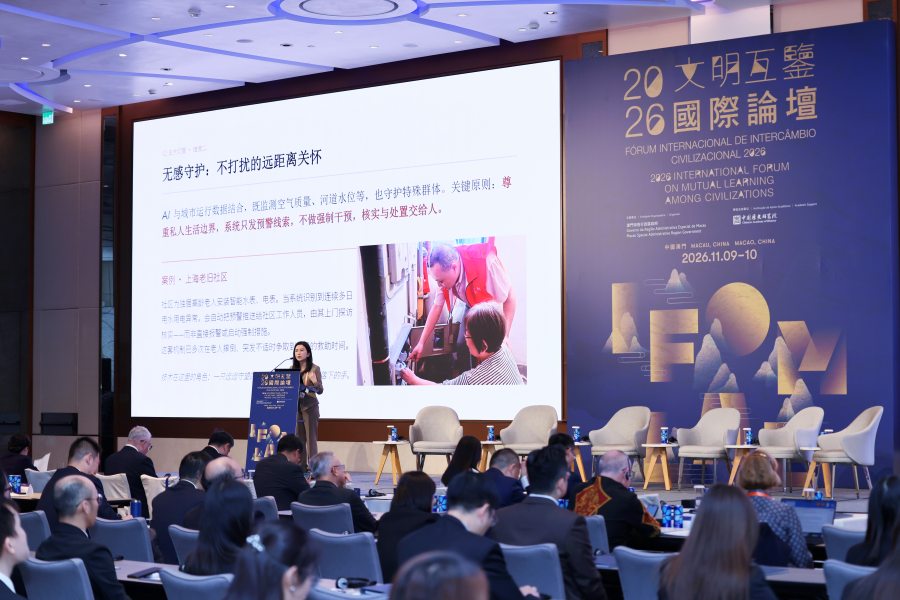
People’s interests and safeguarding cultural diversity should be given priority in developing artificial intelligence, scholars and policy observers said during panel discussions on the final day of the 2026 International Forum on Mutual Learning among Civilizations in Macao.
Zhao Hai, vice-president of the Chinese Institute of Hong Kong, told the panel, themed “AI and Exchanges and Mutual Learning among Civilizations”, that cultural exchanges in the AI era should be guided by respect for diversity, a human-centered approach to AI ethics, and technological development that incorporates the empathy needed for societies to learn from one another.
Chen Chengxin, assistant dean of the School of Government at the University of Chinese Academy of Social Sciences, discussed China’s experience in using AI to enhance public services in local communities, and called for more technological innovation that’s responsive to people’s everyday needs.
IN PICTURES: Future of civilizations
She said much of the country’s AI development begins with a commitment to serve people, ensuring that its benefits are more widely shared and help prevent unchecked, capital-driven technological expansion from getting out of control.
RELATED ARTICLES
- Conference in Macao SAR focuses on cultural coexistence
- Macao forum promotes mutual learning among civilizations
- Importance of China studies stressed
Developments in AI could reshape the capabilities of countries and regions, as well as the global balance of power, with implications for the international order, said Eduardo Daniel Oviedo, who’s a principal researcher at Argentina's National Scientific and Technical Research Council.
AI and the ways societies communicate are both “major questions” in today’s international affairs, he told the panel, which was jointly organized by the Macao Special Administrative Region government and Tsinghua University’s School of Journalism and Communication.
The two-day forum, which began on Monday, has seen some 300 participants representing governments, international organizations and academia from more than 20 countries and regions participating in about 40 dialogue sessions.
The topics range from the China-led Belt and Road Initiative, closer Sino-Portuguese ties and joint implementation of the Global Civilization Initiative to how the world should govern AI and strive for shared human values with the advent of technology.
Contact the writer at wanqing@chinadailyhk.com
