

Conference in Egypt sees calls for more Sino-Arab exchanges to bolster mutual understanding
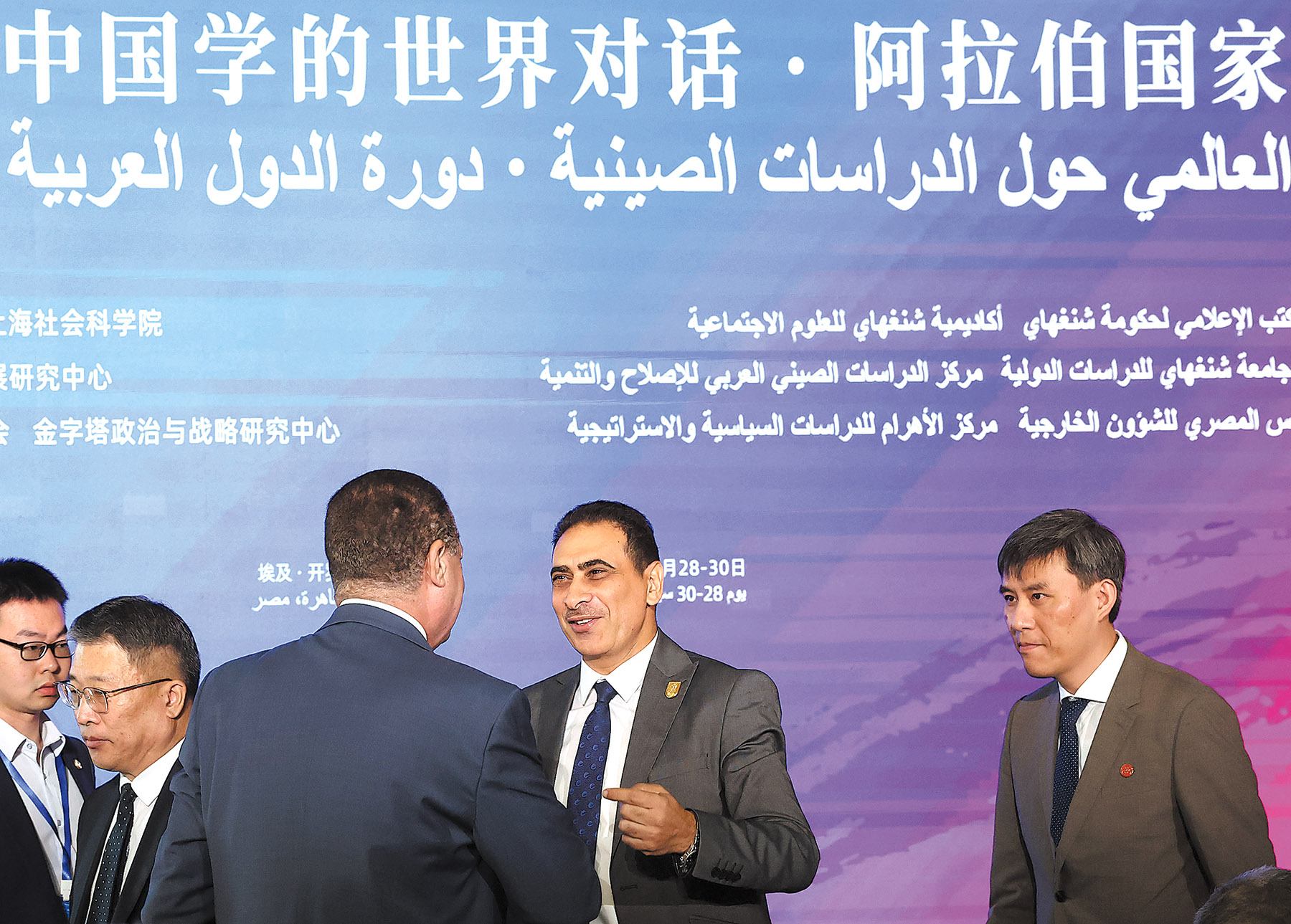
Diplomats and academics from China and the Arab world have called for greater research on China to cement mutual trust, understanding and friendship, and to contribute to the diversity of global civilizations.
Speaking on Sept 29 at a session of the Dialogue on China Studies held in Egyptian capital Cairo, Zhang Yaqiang, charge d’affaires at the Chinese embassy in Egypt, said China and Arab countries, including Egypt, have carried out extensive academic and people-to-people exchanges over the past 70 years, resulting in fruitful outcomes such as the translation of each other’s literary classics and joint archaeological missions.
“In the field of Sinology, Arab scholars have produced a large number of works, which serve as a model for global cross-civilization exchanges,” Zhang said.
Promoting dialogue and mutual appreciation of each other’s civilizations can help bridge divisions, enrich the world’s civilizations and contribute to a more peaceful and progressive world, he added.
The conference came just weeks after President Xi Jinping’s state visit to Egypt on Sept 1 and 2, during which he visited the Grand Egyptian Museum and called for promoting inclusive coexistence and mutual learning among different civilizations and for pooling greater strength from civilizations to advance the building of a community with a shared future for humanity.
Mohamed Kamal, chairman of the Egyptian Senate Foreign Affairs Committee, said the rising interest in China studies among Egyptian academics is a reflection of China’s increasing global influence.
“The study of China should not be limited to its history, civilization and language. It should also include the study of China’s successful experiences,” Kamal said.
“It is a real investment for future bilateral relations to encourage Chinese and Egyptian universities and think tanks to strengthen exchanges in various areas including academia, culture, science and technology. Sinology can become a bridge for the two peoples to enhance mutual understanding and friendship.”
According to Ezzat Saad, director of the Egyptian Council for Foreign Affairs, China studies have gained momentum in Arab countries in recent decades, expanding from being taught in a few professional organizations to a wide range of educational and research institutions including primary and secondary schools and universities.
In Arab countries, dozens of universities have established Chinese majors, he noted.
“China has been playing a prominent role in international affairs, including in the Arab world, and foreign affairs institutions in Arab countries, in particular, need to further China research so that it helps with their foreign policy,” Saad said.
“China research in Arab countries can produce sustainable results that serve the strategic interests of both parties and strengthen the overall strategic partnership,” he added.
Mahmoud Elsaid, vice-president of Cairo University for postgraduate studies and research, said that with global economic, cultural, science and technology centers shifting from the West to the East, Arab countries are increasingly looking to the East, and this provides opportunities for the development of Sinology in Arab countries.
“China studies in Arab countries can extend from traditional areas such as language and culture study to other areas, including the economy, public policy, sustainable development, science and technology, and artificial intelligence,” he said. “China and Egypt can also intensify cooperation in cultural heritage protection by using digital technology.”
Saad from the Egyptian Council for Foreign Affairs said Arab countries should deepen academic and people-to-people exchanges with China to gain better firsthand understanding of the country as relations between the two sides continue to expand.
He said stronger China studies in Arab universities and research institutions would allow scholars and the public to understand China’s development, culture and perspectives through original sources rather than relying heavily on interpretations from elsewhere.
“Most of what we know about China comes from Western sources,” Saad said on the sidelines of the conference.
Contact the writers at wangxiaodong@chinadaily.com.cn
