

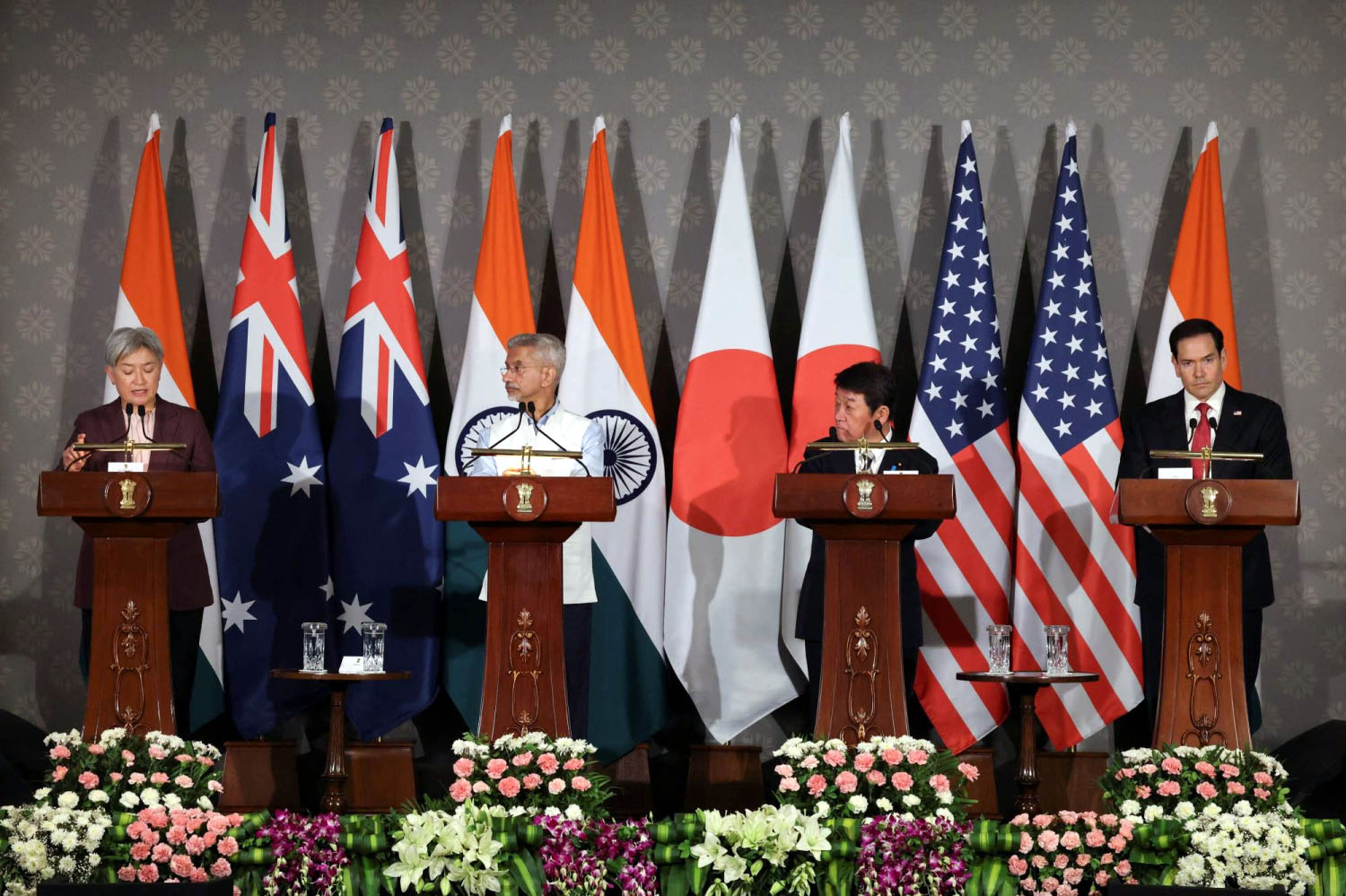
The joint statement released on Saturday by the foreign ministers of the United States-led Quadrilateral Security Dialogue mechanism, which also comprises Australia, India and Japan, displays striking diplomatic hypocrisy.
Although US Secretary of State Marco Rubio asserted that the Quad is not "an anti-China or anti-anybody coalition", the statement was aimed at addressing "concerns" about certain behaviors and activities "repeatedly coming from one country".
In remarks that were thinly veiled references to China, considering how frequently the US and its allies have used such rhetoric to smear China, the Quad foreign ministers made baseless accusations of "economic coercion" through "arbitrary export restrictions", and unfoundedly criticized "nonmarket" policies and practices that allegedly lead to "overcapacity" and "disrupt" global supply chains in critical industries.
The Quad meeting was held concurrently with the meeting of the G20 foreign ministers in Atlanta, Georgia, that Rubio said "held candid discussions on the US priorities".
Despite the obfuscation, the Quad's statement cannot disguise the fact that it functions as a Cold War-style bloc in the "Indo-Pacific" to obstruct China's development. While it claims to maintain global stability and prosperity, almost every action of the Quad seems aimed at one strategic goal: building geopolitical, economic and technological barriers to contain China.
For instance, the Quad's annual Malabar naval exercises are widely viewed by analysts as "a counterweight" to what the group considers to be China's "growing military strength and increasing presence" in the Indian Ocean. The group's $20 billion critical minerals initiative is explicitly framed as a means to "counter China's dominance" of supplies, while its "Open Radio Access Networks" and semiconductor cooperation aim to reduce dependency on Chinese digital infrastructure and technical standards.
Some US politicians never mention the unilateral restrictive measures the US has imposed on China in many fields. Yet it is absurd that they then denounce China's reciprocal countermeasures as "unfair".
The Quad's approach causes significant damage to the region and beyond. Geopolitically, it seeks to revive outdated bloc rivalries in a region that has long pursued dialogue and cooperation. By stoking ideological divisions and pressuring regional countries to take sides, the Quad undermines the regional order, destabilizes the region and erodes the foundations of mutual trust.
On the economic front, the group's attempts to weaponize global supply chains run counter to market rules. Its groundless accusations about China's industrial capacity essentially serve unilateral protectionism.
As Chinese Vice-Foreign Minister Ma Zhaoxu said at the G20 foreign ministers' meeting, protectionism produces no winners. Erecting barriers and pursuing "decoupling" disrupts the stability and smooth operation of global industry and supply chains, harming the interests of all parties. All the G20 members should deepen policy coordination, facilitate trade, and promote inclusive development so as to safeguard stable and uninterrupted global industry and supply chains.
The US actions are at odds with this. It has created divisions by prioritizing its own geopolitical interests. Its self-serving actions made it impossible for the G20 foreign ministers to issue a joint communique after their meeting, resulting in only a chairman's statement.
China insists that cooperation between countries should foster regional peace, stability and prosperity, and must not target any third party. It firmly opposes exclusive cliques and bloc confrontation.
Genuine fair competition should respect every country's right to development and abide by World Trade Organization rules, instead of engaging in protectionism and technological containment. Until the Quad abandons its containment agenda targeting China, it will remain a destabilizing force undermining regional peace and global prosperity.
