

Tradition turns intimate as audiences get a close-up look at how various styles are created, performed, and expressed, Chen Nan reports.
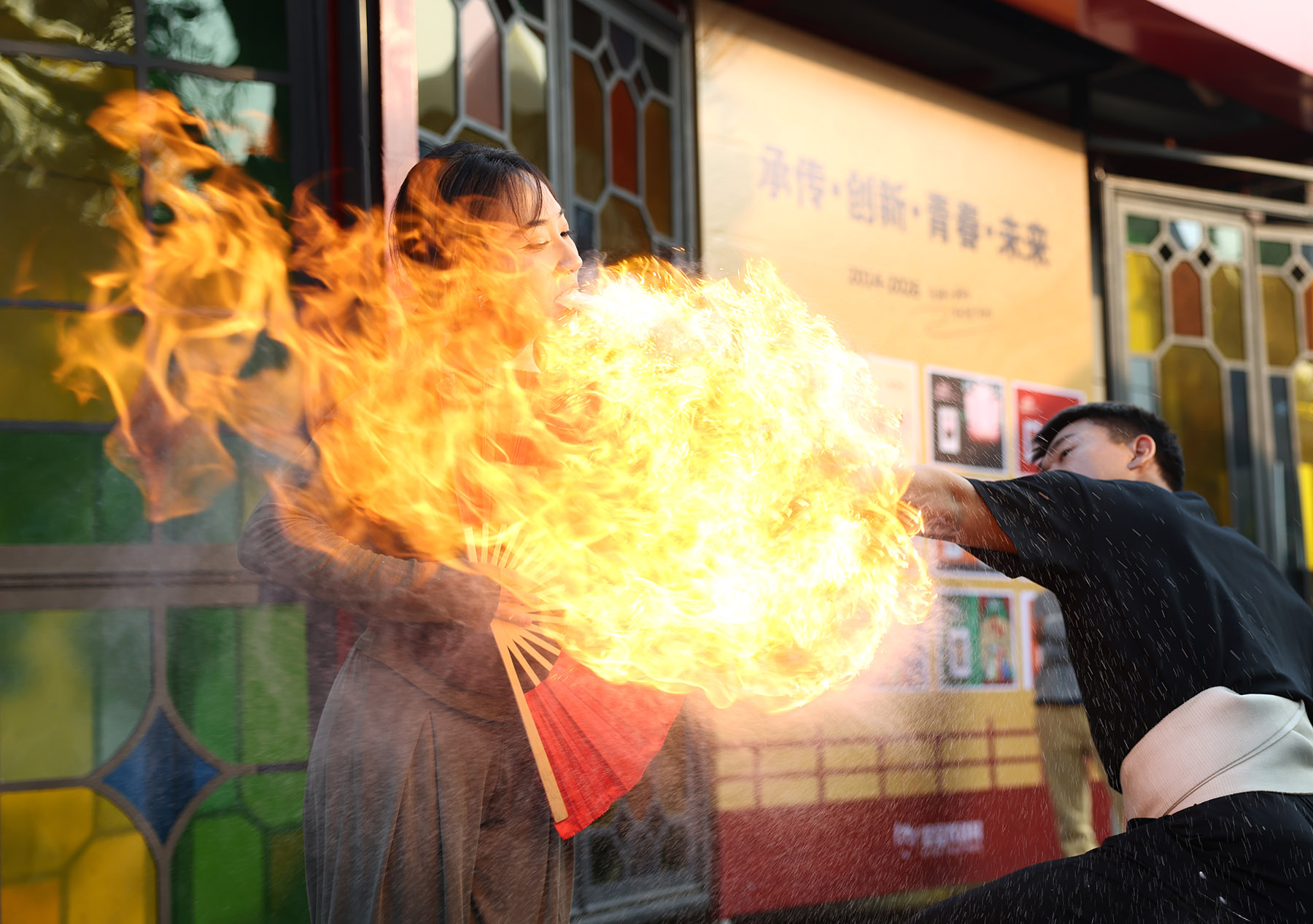
Li Chanchan and Fan Yuyan, two young students from the National Academy of Chinese Theatre Arts in Beijing, drew a crowd in a courtyard as they demonstrated a traditional jaw-dropping feat before one unleashed a burst of fire. The flames flared and vanished in an instant, prompting gasps and applause from spectators gathered among the courtyard's gray bricks and tiled roofs.
The demonstration is a signature Qinqiang Opera stage skill: fire-breathing, known for its dramatic visual impact.
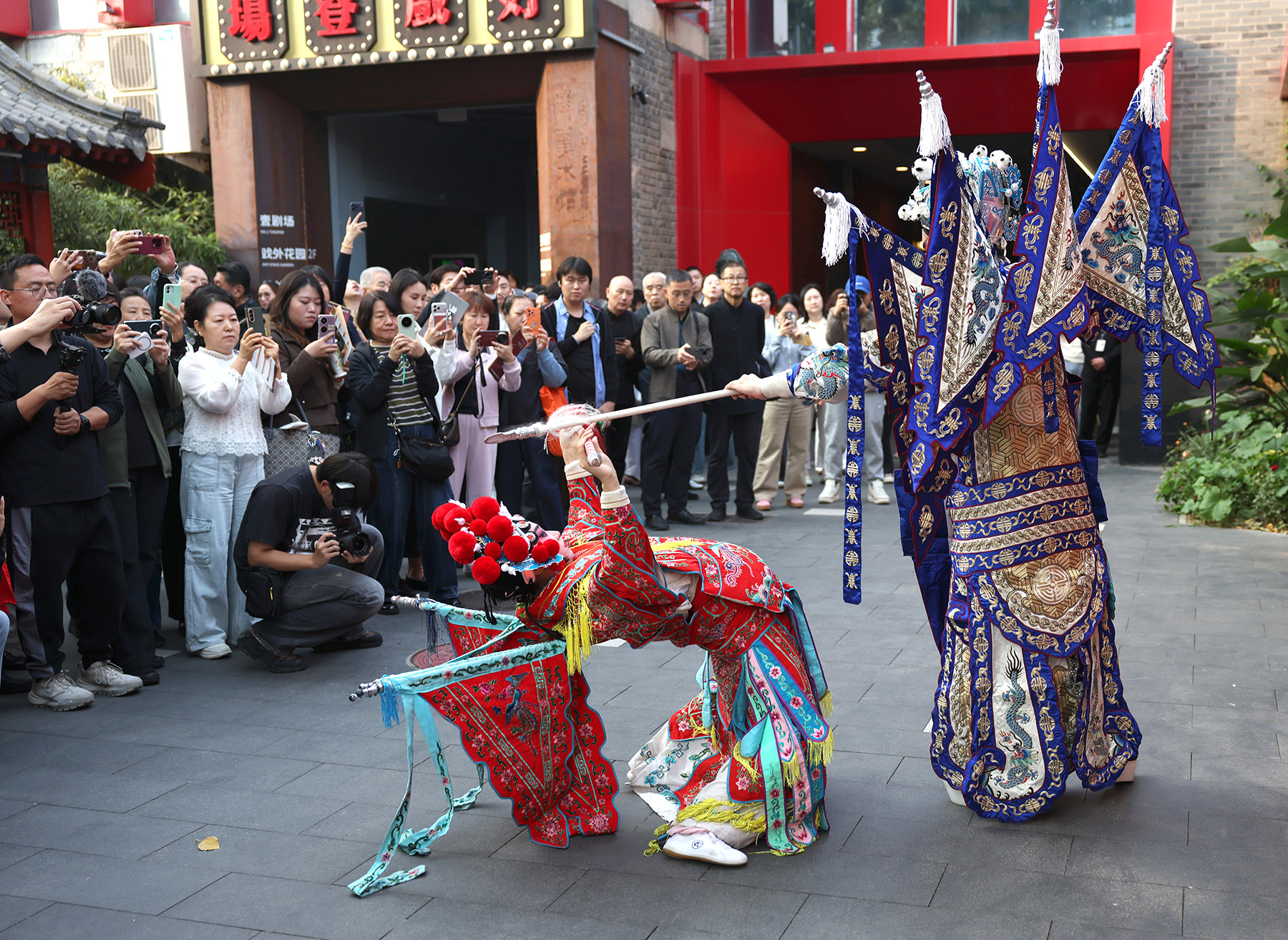
Other performers demonstrated the sweeping spear movements of Peking Opera, offering a glimpse of the physical precision and theatrical spectacle that has sustained traditional Chinese opera for generations.
At the 13th Xiqu Opera Black Box Festival, which opened at Star Theaters in Beijing on Oct 14, tradition is also being explored through more intimate, unexpected storytelling forms.
READ MORE: Chinese opera festival: Opening tradition up to today
The festival runs through Nov 22 and brings together 16 productions tailored for smaller theaters spanning 11 traditional Chinese opera genres, including Peking Opera, Kunqu Opera, Yuju Opera, Pingju Opera, and Cantonese Opera.
The opening performance, The Face in the Mirror, a Huaiju Opera production, takes audiences into a world of illusion and psychological unease, asking what happens when people finally obtain what they desire.
Another production, the Cantonese Opera, Life, Death and the Skull, turns an ancient philosophical tale into an exploration of friendship, mortality and grief.
Though different in style and subject, the two works share an interest in their characters' inner lives — and in the questions those stories might raise for audiences today.
For the scriptwriter of The Face in the Mirror, Yu Sihan, the idea began with a fascination with the magical mirror in the classic Chinese novel Dream of the Red Chamber.
When she first read the novel in middle school, she was captivated by the story of "fengyue baojing", a mirror that reveals the tension between desire and reality. One side offers the image a person longs to see; the other confronts them with a skull, exposing the truth behind their fantasies.
The image stayed with Yu for more than a decade before she developed it into a script for the Huaiju Opera troupe of Taizhou, Jiangsu province.
"I kept wondering what would happen if this mirror appeared in an otherworldly place. What would different people desire deep in their hearts, and how would their fates change?" says Yu, 32.
The resulting play centers on two characters trapped by traditional expectations: a widow who has spent years upholding her chastity, and a scholar who repeatedly fails the imperial examinations but remains consumed by his pursuit of official success.
In a dreamlike world, both get what they have long wanted. Yet fulfillment brings fresh troubles rather than happiness, turning their fantasies into a psychological nightmare.
Instead of relying on spectacle alone, the production uses the mirror to examine desires that can gradually become prisons.
Its central question, she says, extends well beyond the historical world of the characters.
"What kind of achievement are you chasing, and what kind of monument are you trapped by?" Yu asks. "In the play, people are trapped by the pursuit of official success or the expectations represented by the chastity arch. Today, it might be a professional title, a house, money, or other people's expectations."
Yu hopes younger audiences will recognize themselves in the characters and reconsider whether what they pursue is worth the sacrifices they make.
For Yu, making the play has also been a personal exercise in confronting ambition and anxiety. At 32, she says she too can get caught up in the pressure to keep improving and surpassing herself.
The work's contemporary concerns are matched by an effort to preserve the artistic identity of Huaiju Opera, known for a musical style often described as powerful and emotionally expressive. Yu believes that innovation should not come at the expense of the genre's distinct vocal traditions.
The challenge, she adds, is to combine this musical foundation with stage movement and storytelling that speaks to contemporary sensibilities.
A similar balance between tradition and experimentation drives Life, Death and the Skull. Its writer and producer, Feng Minyi, has long explored ways to expand Cantonese Opera's possibilities without abandoning its foundations.
The idea emerged during a 2021 conversation with veteran Cantonese Opera actor Peng Qinghua about how Cantonese Opera might work in a small theater.
"I didn't think small-theater opera should mean moving a large-scale production into a smaller space," Feng says. "We wanted to find our own way of understanding it."
A frequent theatergoer with a particular interest in musicals staged in small theaters, Feng was drawn to their flexibility and potential to experiment with storytelling and character.
The conversation turned to Resurrection of the Skeleton, a tale associated with philosopher Zhuangzi of the Warring States Period (475-221 BC) that has inspired different interpretations in traditional storytelling and theater. It explores a provocative question: Is being alive necessarily better than being dead?
The idea connected the story's supernatural premise with a more personal question about death and the bonds between people. Feng sketched the initial outline in about 15 minutes.
For Feng, the subject also touches on a personal loss. She entered the Cantonese Opera profession after the death of her great-aunt who helped raise her and who was a veteran of the art form.
ALSO READ: Up close and personal
That experience gave the play's questions about mortality particular resonance.
"In Chinese culture, death is often something people avoid talking about. It can seem frightening or even sinister," she says. "But death is something everyone has to face. I wanted to show life's many different sides, rather than make the subject unbearably heavy."
After the production premiered last year, the response encouraged her to continue in that direction. A woman brought her elderly mother to see the show. Afterward, they said the experience made death seem less frightening. Other audience members have spoken about finding a way to come to terms with the loss of a beloved pet.
For Feng, who studied classical Chinese literature rather than receiving formal training in playwriting, the creative process has been an opportunity to explore what Cantonese Opera can express beyond the familiar world of talented scholars, beautiful women and historical rulers.
She believes the genre can engage with questions of human nature with the same depth as spoken drama, while retaining the distinctive qualities of traditional opera.
Veteran actor Peng plays the leading role, Zhuangzi. As director of the Shenzhen Cantonese Opera Troupe, he has performed in major Cantonese Opera productions and films throughout his decades-long career. This is his first time playing in a production tailored for a smaller theater.
"We want the play to help people heal," says Peng, who was born into a family with a long tradition in Wing Chun, a style of kung fu. "In a way, it has healed us, too.
"Small-theater performance demands greater intimacy and subtlety," he says. "I have to find a balance between preserving the stylized techniques of traditional opera and making the performance feel natural.
"At the same time, being closer to the audience allows you to convey emotions in a more direct and personal way," he adds.
For these creators, younger audiences offer an important reason to keep exploring.
"Small-theater productions tend to attract young people who are often more open to unfamiliar forms and more receptive to the ideas behind a work," says Feng.
Contact the writer at chennan@chinadaily.com.cn
