

As young researchers reconstruct lives lost to war, scientific fieldwork is also reshaping their own understanding of history and peace.
When Mu Xingyu began working with the remains of martyrs who lost their lives in battle more than seven decades ago, one fact struck her deeply: many had died as teenagers, younger than she is now.
For Mu, 23, a second-year graduate student at Fudan University's Department of Cultural Heritage and Museology, personally encountering the remains was different from learning about martyrs at school.
"The remains show numerous war injuries: fractures, bullet holes and even shrapnel embedded in the bones. Seeing that evidence in front of me made the brutality of war feel real," she said.
Mu was among more than 20 young people who joined Fudan University's molecular archaeology laboratory in fieldwork from July to September at sites including Fengtai county in Anhui province, Huozhou city in Shanxi province and Chengmai county in Hainan province.
Their work involved finding, excavating and studying the remains of unknown martyrs — using archaeology and scientific techniques to reconstruct their lives and, when possible, restore their identities.
The work begins before any remains are unearthed. Wen Shaoqing, an associate professor and molecular archaeologist who leads the laboratory, said the field survey team first locates graves for excavation. Once human bones are uncovered, physical anthropologists take over.
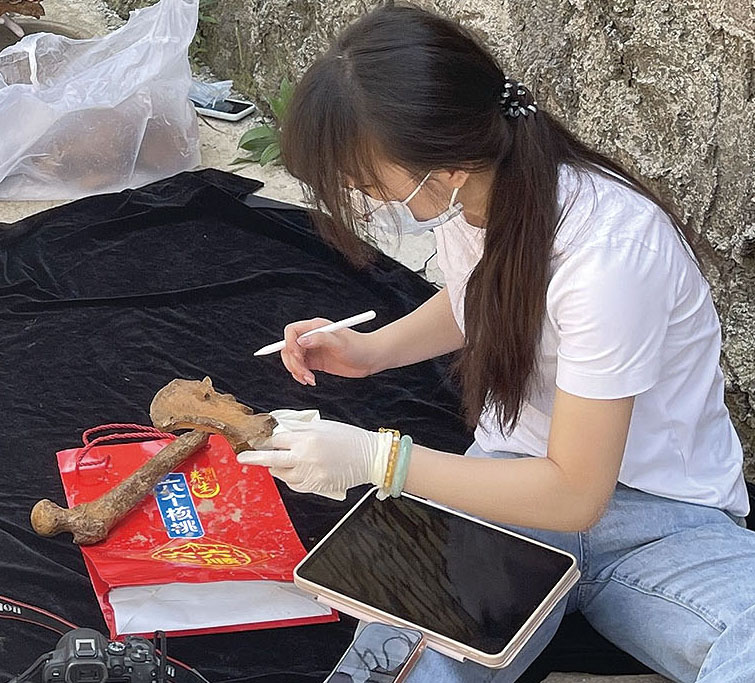
According to him, on-site physical anthropological analysis can determine or estimate gender and age at death and document pathological conditions and morphological characteristics through hundreds of observation indicators. Measurements can also be used to estimate a person's height and weight. Researchers then collect samples for DNA and isotope testing.
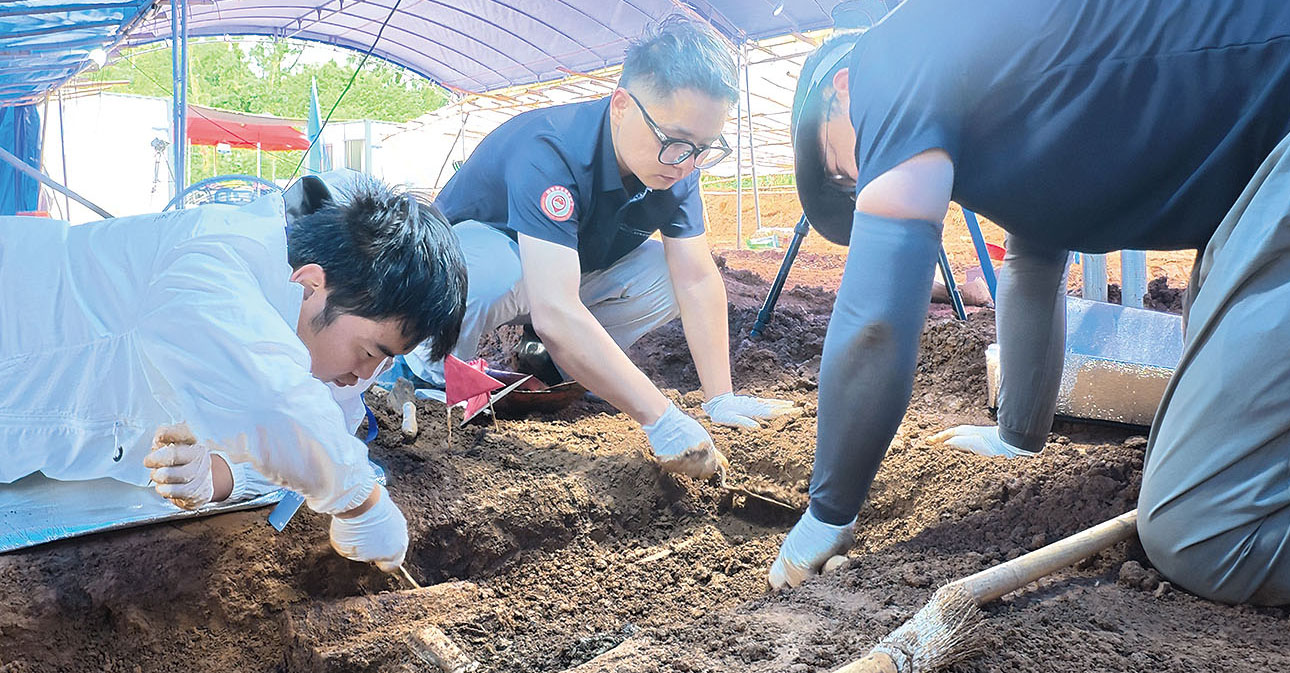
"Stable carbon and nitrogen isotope analysis can tell us about a martyr's diet and nutritional status, while strontium isotope analysis can offer clues to geographic origin and mobility. DNA testing, meanwhile, can help confirm identity," Wen explained.
Researchers also scan complete skulls to prepare for facial reconstruction.
But restoring a name is far more difficult. Unless personal artifacts contain identifying information, researchers need DNA comparisons combined with family information to confirm an identity.
The scale of that difficulty is reflected in the laboratory's results. It began using technological archaeological methods to help unidentified martyrs reclaim their names in 2015. Since then, the team has tested samples from more than 1,600 unknown martyr remains, but has successfully identified only about 20.
"The martyrs died long ago, and their immediate family members from older generations have long since passed away," Wen said. "Many of the martyrs were very young when they died, with a large proportion still in their teens. If they left no descendants, there may be no family members actively searching for them today."
Even when DNA points researchers toward a family, identifying the individual can still prove difficult.
"The relatives we find may be several generations removed and may not even know that the martyr existed. That makes putting a name to the remains much harder," Wen said.
But when a name cannot be recovered, the remains can still reveal parts of a person's life and the conditions under which they fought and died.
Remembering lives
Wen said researchers have found visible bullet holes on bones, evidence of old injuries compounded by new ones, and signs of degenerative joint disease in martyrs under age 30. Such evidence reflects the harsh conditions of military operations at the time and can contribute to a fuller understanding of the martyrs' sacrifices, both for academic research and for the public.
Alongside the scientific evidence are more intimate traces of the people themselves. Personal belongings unearthed with the remains have included ink bottles, hair oil and small pendants. Such objects, the researchers said, can make the martyrs less abstract, offering glimpses of their ordinary lives and allowing people to imagine who they were beyond the battlefield.
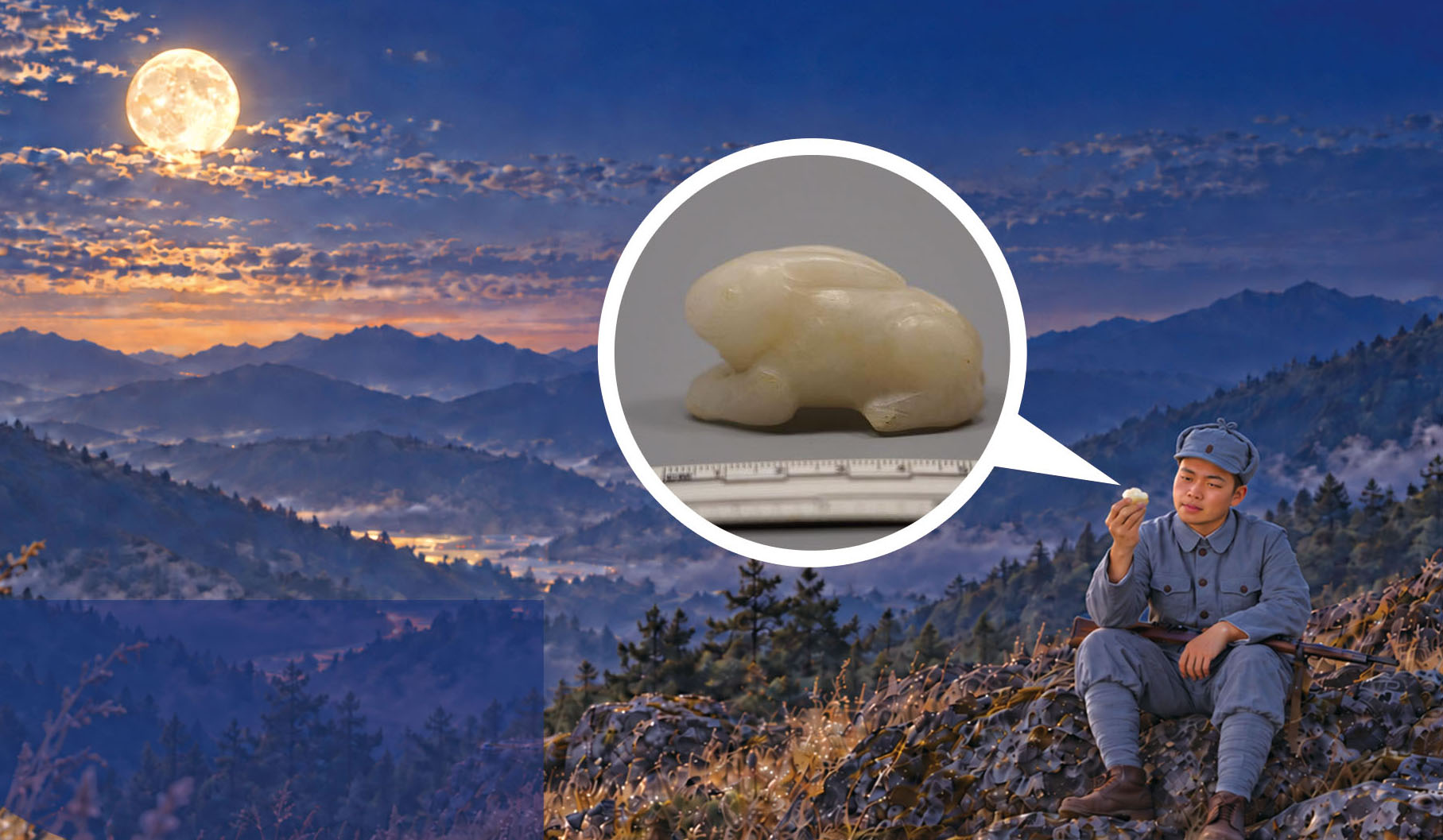
One discovery that drew particular attention was a rabbit-shaped jade pendant unearthed at the site in Fengtai, Anhui.
In October 1948, on the eve of the Huaihai Campaign, one of the three major campaigns in the War of Liberation (1946-49), a battle took place in Fengtai to block the enemy from moving north along the river, resulting in the deaths of 14 martyrs.
Their average age at death was 27. The youngest was only 15.
The jade rabbit was found between one martyr's ribs and pelvis. Researchers believe its position suggests that it may have been held in his hand and placed on his abdomen.
"The Mid-Autumn Festival had just passed when he died in October 1948. The jade rabbit symbolizes reunion in Chinese culture, so it may have carried his longing for home and family in the final weeks of his life," Wen said.
ALSO READ: Inclusivity overcomes barriers
The laboratory is continuing to develop the technology used in the work. Its molecular archaeology techniques are being applied to increasingly difficult samples, including the burned remains of unidentified Red Army martyrs from the Long March.
The team has also introduced artificial intelligence into facial reconstruction, using it to simulate how martyrs might have looked from youth to old age and to generate scene videos incorporating historical materials. Some of the videos have been given to martyr cemeteries.
Yet the work's impact extends beyond what technology can recover about the dead. For the young researchers handling remains and personal belongings of people who died decades before they were born, the experience has also changed how they understand the past.
For Chang Xin, 28, a doctoral student in archaeology at Fudan and a member of the team, that change came down to something simple.
"Words like 'cherish life, cherish peace and cherish the present' can feel distant and abstract in everyday life," Chang said. "But excavating the remains of those who died in war made those words real to me. It left me with one very clear thought: I hope war never happens again."
Contact the writers at zhouwenting@chinadaily.com.cn
