

A controversy over voter-roll changes in India is deepening as opposition parties, students and farmers rally around a common demand to oust the country’s election chief.
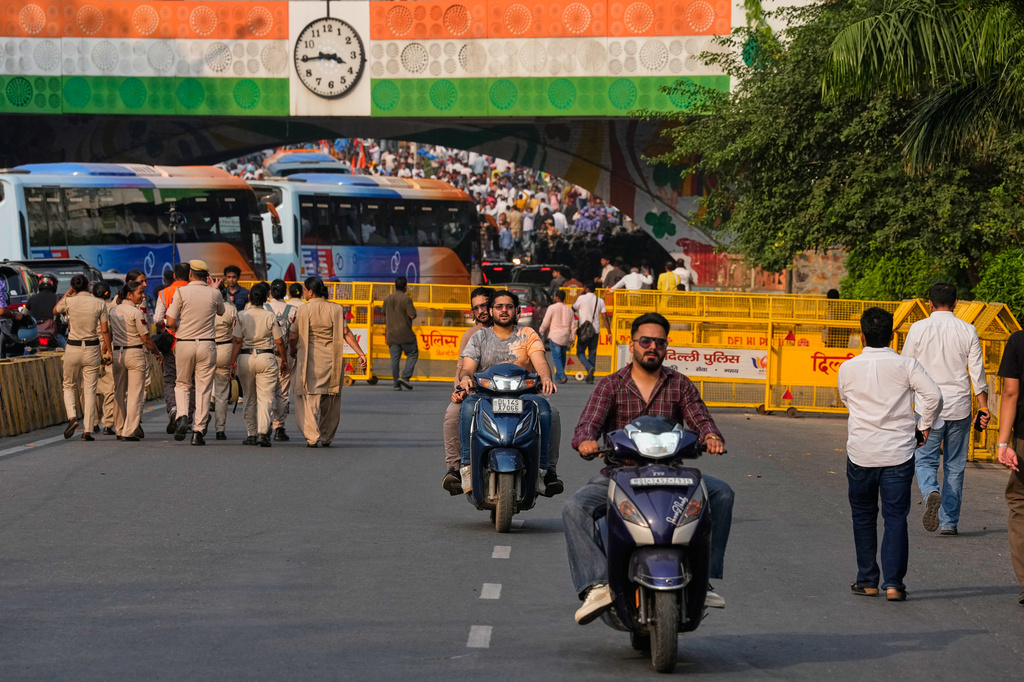
In India’s capital this week, riot police, barricades and buses waiting to carry away protesters became a familiar sight as opposition lawmakers staged planned and impromptu demonstrations. Several were detained as police blocked marches through central Delhi.
The Cockroach Janta Party, which led one of India’s biggest student protest movements in years in July that forced out the education minister, is planning another major demonstration in the capital on Saturday. The campaign has also drawn support from other student groups and influential farmers’ organizations.
The latest tensions were triggered by an investigation in a local newspaper accusing Chief Election Commissioner Gyanesh Kumar of ignoring concerns raised by two election officials over the electoral roll changes, which have resulted in more than 130 million names being removed from the register. The ECI has denied the claims.
“The controversy over electoral rolls and the protests over exam irregularities are linked because they both raise doubts about whether public institutions can be trusted to act impartially and transparently,” said Milan Vaishnav, a senior fellow and director of the South Asia Program at the Carnegie Endowment for International Peace. “Once institutional trust has eroded, it is not easy to build it back up.”
The stakes are high for both the opposition and Prime Minister Narendra Modi’s ruling party, with several key state elections due in the coming months, including the prize of Uttar Pradesh, home to about 250 million people.
The protests come just months after young Indians took to the streets to demand action over a series of examination failures and express frustration over limited job prospects. The show of force took many by surprise and put the government on the back foot, ultimately resulting in the resignation of the education minister — the first time in Modi’s 12 years in power that a cabinet minister had stepped down under public pressure.
This time, the anger is focused on the Special Intensive Revision, or SIR, a massive exercise launched last year to revise India’s electoral rolls by removing dead, duplicate and ineligible voters. Critics have said that eligible voters are also being removed in the process, potentially affecting election outcomes.
Those concerns have been sharpened by the results in West Bengal, where Modi’s BJP won a surprise landslide victory earlier this year after the state underwent a voter-roll revision. The extent to which the exercise influenced the outcome, if at all, remains unclear.
In late September, the Indian Express reported that two election commissioners had raised concerns about the process with Kumar at least 14 times over a 10-month period. India’s top court has also weighed in on the dispute this week, questioning changes to a form used to register new voters.
“The voter roll crisis is a gift to the Indian opposition,” said Michael Kugelman, senior fellow for South Asia at the Atlantic Council. “The opposition will hope that these large street mobilizations, which are now threatening to occur with unprecedented frequency in the Modi era, translate to blows against the BJP in upcoming state elections.”
Rare unity
The Election Commission has denied the Indian Express report, saying its decisions were unanimous and that differing views are a normal part of the decision-making process. It has also eased some of the requirements for voters to prove their eligibility and ordered a special campaign to help those left off the rolls register again.
Modi’s party has dismissed the demonstrations as an attempt by the opposition to discredit democratic institutions after failing to win elections. BJP leaders have accused the main Indian National Congress party of trying to foment unrest and revive Rahul Gandhi’s political fortunes, while defending the Election Commission’s voter-roll revisions as necessary to remove ineligible voters.
“By so closely identifying itself with the exercise, the party has assumed a degree of political ownership over it,” said Vaishnav.
For the opposition, the controversy has provided a rare point of unity, bringing together parties that are rivals in several states. On Tuesday, hundreds of lawmakers attempted to march to the Election Commission’s office but were blocked by police. Rahul Gandhi and his sister Priyanka Gandhi Vadra, senior Congress leaders, led an impromptu sit-in at a nearby government building, which lasted several hours before police detained them. The demonstrations continued on Wednesday and Thursday, with opposition parties vowing to keep up the pressure.
READ MORE: Indian PM promises fast-track courts to deal with paper leaks under pressure
That leaves New Delhi with few easy options to defuse the protests. Kugelman said the confrontation is unlikely to lose momentum until protesters believe government institutions are addressing their concerns and functioning better.
“The government is caught between the devil and the deep blue sea,” he said. “By giving in to protestors, it will only galvanize them to demand more. But if New Delhi rejects their concerns, the protestors will only grow angrier, with the possibility of more mobilizations.”
