

Relaxed entry policies, digital payments infrastructure prove a magnet for global tourists

As a hand-rowing boat drifts across Hangzhou's famed West Lake, Austrian traveler Florian Eisinger finds himself surrounded by willow-lined shores, ancient temples and centuries of history, with the gleaming skyline of one of China's most dynamic cities rising in the distance.
For the 23-year-old who was visiting China for the first time in May, the scene captured what surprised him most about the country.
"It was probably one of the most mesmerizing countries I visited in my life," Eisinger said. "From the cities to the landscapes to the people, everything was beyond what I had imagined."
Two places stood out. "West Lake is just incredible scenery and a lot of history packed into one 'district', all while you have the very modern city of Hangzhou in the background," he said. "I did a boat tour over parts of the lake, and it was jaw-droppingly beautiful."
The other place is Shanghai. Some streets, while being nestled within the bustling heart of the metropolis, especially in the evening, are incredibly beautiful, and it is surreal to imagine this being in one of the largest cities in the world, he said.

Encouraged by positive stories from a family member and his own Mandarin studies, Eisinger traveled to China with high expectations. The trip exceeded them. His experience reflects a broader rebound in inbound tourism, driven by easier entry, improved travel services and a growing stream of firsthand accounts that are changing how overseas visitors see China.
According to the National Bureau of Statistics, China recorded more than 30 million visa-free entries by foreign nationals last year, up 49.5 percent year-on-year. Visa-free travelers accounted for more than 73 percent of all foreign arrivals, highlighting the central role of expanding visa-free access in the recovery.
China now offers unilateral visa-free entry to citizens of 50 countries and has mutual visa exemption agreements with another 29. Austria is among the countries covered by the unilateral policy, making trips such as Eisinger's considerably easier to plan.
Han Feng, head of marketing at Trip.com Group, said the expansion has fundamentally changed how overseas travelers view China by removing a major obstacle to a visit. "This change has reduced planning barriers for many potential travelers," she said.
According to the company's China Inbound Tourism Development Report, visitors from visa-free countries accounted for most of the growth, led by Spain, Italy, France, the United Kingdom and Australia. But easier entry is only the beginning of the story.
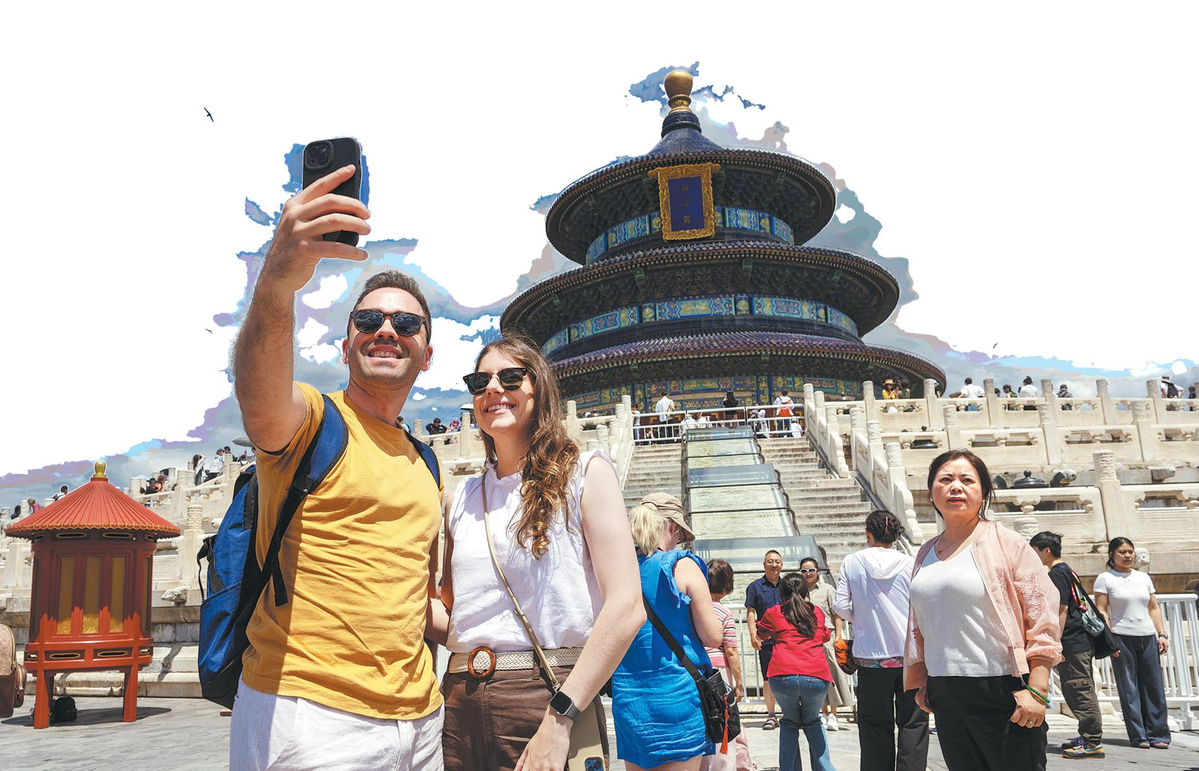
Across social media platforms such as TikTok and RedNote — also known as Xiaohongshu in China — foreign travelers are sharing videos of China's high-speed trains, mobile payments, ancient temples, mountain landscapes and futuristic skylines. The accumulation of these firsthand accounts is giving overseas audiences a more immediate picture of everyday travel in China and, in many cases, turning curiosity into bookings.
"Social media has become a powerful driver of inbound travel demand," Han said. "Authentic traveler-generated content, especially the #ChinaTravel trend on TikTok and Xiaohongshu, has successfully turned global curiosity into firm bookings."
Mainstream television has reinforced that visibility. Last year, the fifth series of the Race Across the World began airing on BBC, with contestants setting off from the Great Wall before traveling across the country and continuing through Nepal and India. British broadcaster and adventurer Ben Fogle also spent six weeks traveling across China to film the three-part Channel 5 series China with Ben Fogle.
Having never visited the Chinese mainland before, Fogle admitted arriving with preconceived ideas. "I have to say I went with a stereotype of what my experience was going to be like, and you all surprised me," he said.
"I was surprised, I was challenged, but most of all I was charmed," he said after the journey, adding the trip allowed him to "scratch beneath the surface" and discover "a real China".
Key catalyst
Oliver Sedlinger, an expert on the Chinese travel market and founder of Sedlinger & Associates, said improved visa policies have been the key catalyst for the recovery because they encouraged many travelers to consider China for the first time.
"The key driver are the improved visa policies," he said. "Those were very welcome news for the global tourism industry, and I believe it made many travelers consider China as a leisure destination for the first time."
Sedlinger noted that China is now offering visa-free entry to citizens of around 80 countries, while only about 30 of those countries currently provide similar visa-free access to Chinese travelers. China's decision to extend the policy even to countries that have yet to reciprocate reflects both its openness to the world and growing confidence in its appeal as an international tourism destination, he said.
That confidence, he added, is also helping stimulate domestic consumption by encouraging more overseas visitors to spend within China.
In addition, Sedlinger said a simpler visa policy works because the experience after arrival has become easier.
"Also very important are the flight connectivity, especially those maintained by Chinese airlines, and the improvements in services that were achieved, such as digital payments, online bookings, ride-hailing and translation," he said.
For Eisinger, that convenience was one of the defining features of his trip. "For everyday things like public transport or payments, I am yet to find another country that is more efficient and convenient than China through its wide adoption of Alipay, WeChat Pay and the Mini Programs," he said.
"I took trains and public transportation in and to every city I visited, and all of it went seamlessly — including taking long-distance trains between cities."
China's extensive high-speed rail network, digital payment systems and other travel services have made it easier for visitors to move beyond the traditional gateways of Beijing and Shanghai. Han of Trip.com said modern infrastructure can itself become part of the experience.
"When a traveler hails an autonomous EV, watches a drone show or checks into a hotel staffed by robots, they aren't just navigating China — they are experiencing tomorrow, today," she said.
Yet the accounts of repeat visitors suggest that technology and efficiency are often what make deeper cultural experiences possible rather than the main reason people return. Han said European visitors still favor landmarks such as the Great Wall, but interest is increasingly spreading to nature, local culture and destinations beyond the best-known cities.
British traveler Ann Bilverstone has seen that breadth over three visits since 2017, traveling from Beijing and Xi'an to Chengdu and Hunan province.
"My overall impression of China is of a very friendly, welcoming people," she said. "If you visit China and only go to the cities, you miss so much of what China has to offer.
"Traveling by train allows you to see so much more. Every few minutes the landscape changes."
During her latest visit, Bilverstone spent Mid-Autumn Festival with the family of a Chinese friend in rural Hunan. Experiences such as these point to a shift from simply visiting famous sights toward spending more time in neighborhoods, communities and everyday settings.
"There is a genuine shift from sightseeing to immersion," Han said. "Travelers are going beyond traditional routes — wandering into neighborhood markets, joining community festivals, trying their hand at local crafts, and taking public transport alongside residents."
Trip.com's China Inbound Tourism Development Report also points to increasingly distinct visitor profiles across major source markets, suggesting that the inbound recovery is becoming more diversified.
South Korean travelers, helped by geographic proximity and convenient transport links, are emerging as a "weekend micro-holiday" segment, favoring short breaks in Shanghai and the Yangtze River Delta, along with youthful, trendy and good-value hotels and cultural tourism products.
Southeast Asian visitors are more strongly influenced by overseas social media and word of mouth, with particular interest in distinctive attractions and experiences that can be shared online.
Long-haul markets show different patterns. Australian visitors face one-way flights of more than 12 hours and higher travel costs, encouraging longer stays and multicity itineraries.
Trip.com's report said culturally distinctive destinations such as Guilin can be combined with Beijing, Shanghai and cities in Guangdong, creating opportunities for spending along extended routes.
Travelers from the Middle East represent a fast-growing, high-spending market, with annual growth reaching 100 percent.
Their interest in China has risen significantly, alongside demand for halal-friendly facilities, personalized services and distinctive cultural experiences.
Indonesia, the world's largest Muslim-majority country, similarly offers potential for halal-friendly tourism products, while Vietnamese travelers show a preference for distinctive urban landscapes.
Both Indonesia and Vietnam continue to see growth in their underlying customer bases, making them potential sources of future tourism growth.
European visitors, by contrast, are described as a mature and rational segment with strong environmental awareness. Their preference for low-carbon transport fits well with China's extensive high-speed rail network and intercity connectivity, while their relatively stable consumption patterns and willingness to make repeat purchases could support further growth in urban cultural tourism.
Informal storytellers
For Han, this is also where the wider significance of the inbound tourism rebound lies: visitors who experience the country for themselves become informal storytellers when they return home.
"The real significance of inbound tourism lies not in arrival figures, but in opening doors for the world to see China with their own eyes," she said.
"International travelers become authentic storytellers, sharing real travel experiences — the local food they savor, the services they receive, the destinations they explore, and the spontaneous encounters they have with locals along the way," she added.
Sedlinger, the Chinese travel market expert, said China's combination of cultural diversity and increasingly convenient travel gives the country strong potential to convert first-time visitors into repeat travelers.
"As a travel destination, China has a huge potential both for leisure and business travel," he said.
"Since China has such a diverse offer and travel within the country has become very convenient, I am convinced traveling to China can remain attractive for a long time and generate a high percentage of repeat visitors."
He expects the momentum to continue if favorable visa policies, flight connectivity and convenient services remain in place.
For Eisinger, one journey was enough to spark plans for another. "I sort of fell in love with the country, so I cannot wait to go back and see more of it."
Bilverstone shares the same enthusiasm after three visits. "I am recommending China as a place to visit frequently," she said.
Their experiences suggest the rebound in inbound tourism is being driven by two closely connected changes: it has become easier for overseas visitors to reach and navigate China, and those journeys are giving them more opportunities to form impressions through direct experience. The result is not only more arrivals, but a growing number of travelers returning home with their own stories to tell.
Contact the writer at wangmingjie@chinadailyuk.com
