

Deal expected to bring more certainty to supply chains, expand business scope
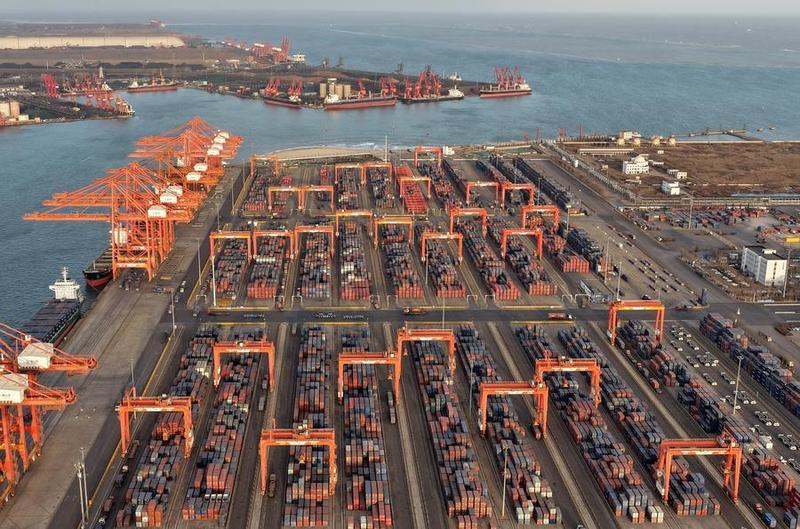
China and the United States have released reciprocal lists of products worth about $30 billion each for tariff cuts under the newly established Board of Trade framework, a move that is expected to further strengthen bilateral trade, the Ministry of Commerce said on Monday.
The board will provide a key platform and institutional guarantee for the two countries to expand their list of cooperation and shorten the list of problems in economic and trade affairs, the ministry said in a statement.
Market watchers and business executives said the deal is expected to bring greater certainty to bilateral trade and global supply chains, and create more business opportunities for both sides as China and the US turn recent high-level consensus into concrete trade measures.
READ MORE: China-US economic and trade consultations yield positive consensus
According to a separate online statement issued by the ministry's Department of American and Oceanian Affairs, China and the US agreed during their eighth round of economic and trade talks in the US last week to extend their Kuala Lumpur agreement — that suspended the implementation of some of their respective tariff and nontariff measures — through Jan 10, 2027, while continuing discussions on longer-term solutions. The original deal is set to expire on Nov 10.
The ministry's statement said the reciprocal arrangement will see tariffs on around 90 percent of the goods covered to be lowered to most-favored-nation rates, adding that the two sides will implement tariff reductions simultaneously after completing their respective domestic procedures. For Chinese goods exported to the US, the items covered by the list include toys, home appliances, baby products, kitchen products and holiday gifts. For US goods entering China, the listed items range from agricultural commodities and personal care products to coal and medical devices.
The ministry's statement said the two sides have also agreed to set up an agricultural working group under the Board of Trade framework to discuss two-way market access and regulatory issues. The group's first meeting is to be scheduled before the end of the year.
The two countries have agreed to establish a bilateral investment board to hold regular discussions on potential investment opportunities and enhance policy transparency.
The ministry said the arrangements will help strengthen bilateral trade cooperation in areas including agricultural commodities, energy, manufactured goods and consumer products.
China and the US will also continue their dialogue on artificial intelligence, with the next round scheduled before the end of November, and establish a communications channel for AI-related incidents, it added.
Experts said that tariff reductions indicate a more pragmatic approach to managing bilateral economic ties. Scott Kennedy, senior adviser at the Center for Strategic and International Studies, a nonprofit policy research group based in Washington, DC, said the focus is increasingly on practical outcomes, rather than sweeping agreements, with tariff reductions and other targeted measures offering ways to keep bilateral economic ties manageable.
Sean Stein, president of the US-China Business Council, said bilateral trade delivers tangible mutual benefits to citizens in both countries, while a growing number of US companies are actively seeking the right Chinese partners.
ALSO READ: Time to transform hard-earned positive consensus into actions, solutions and results
For businesses, the significance of more stable China-US trade ties extends beyond tariff cuts.
Achim Loeffler, global business leader at Gore-Tex, said that China is the US performance materials manufacturer's fastest-growing market, driven by rising demand for high-performance products across outdoor, urban and lifestyle scenarios.
JAC Auto Parts (Ningbo) Co, an automotive parts manufacturer based in Zhejiang province, ships about one-third of its exports to the US. The company's US exports exceeded 38 million yuan ($5.6 million) in the first eight months of 2026, up more than 50 percent year-on-year, according to Ningbo Customs. "Stable ties will provide certainty for companies on both sides," said Yang Weiguo, director of the foreign trade unit of JAC Auto Parts.
Contact the writers at zhongnan@chinadaily.com.cn
