

The rebuilt Huanggang Port, opening soon, is expected to reshape cross-boundary inno-tech and logistics, boosting long-term industrial collaboration with other central and western border checkpoints. Comprehensive facilitation measures are needed to support these goals. Li Bingcun reports from Shenzhen.

Editor’s note: As key transportation hubs in the Guangdong-Hong Kong-Macao Greater Bay Area, Shenzhen and Hong Kong ports are seeking to substantially increase their value with a refreshed outlook and more integrated functions to turbocharge both industries’ and cities’ economies. China Daily presents a three-part series to document the transformation, with the third article exploring the central and western port cluster’s value in fueling inno-tech ambitions.
After three years in the making, Sparklinka — a pioneering Hong Kong satellite startup geared to creating an Asian network modeled on Elon Musk’s Starlink aerospace internet service — has set up its Shenzhen office near the mainland-Hong Kong boundary area, eyeing a big splash in the emerging commercial space business.
The company’s foothold on the vast mainland hinterland is anchored at Hong Kong Science and Technology Parks’ outlet in the Hetao Shenzhen-Hong Kong Science and Technology Innovation Cooperation Zone. Combining the mainland’s strong research-and-development, and manufacturing capabilities with the special administrative region’s strengths in finance and global market access, Sparklinka is aiming to carve out a niche in the capital-intensive, highly globalized hard tech industry.
READ MORE: Huanggang Port upgrade nears completion as HK-side area begins commissioning
Zhao Wei, executive director of Sparklinka, says they are motivated to be in Shenzhen by the soon-to-open, revamped Huanggang Port — a mega state-of-the-art land crossing with Hong Kong that will redefine the landscape in innovation partnership between the two cities.
A new gateway
Along with other key checkpoints in the central and western boundary region, such a closely linked high-powered tech cluster is fast turning the zone into a breeding ground for emerging industries in new-stage inno-tech coordination.
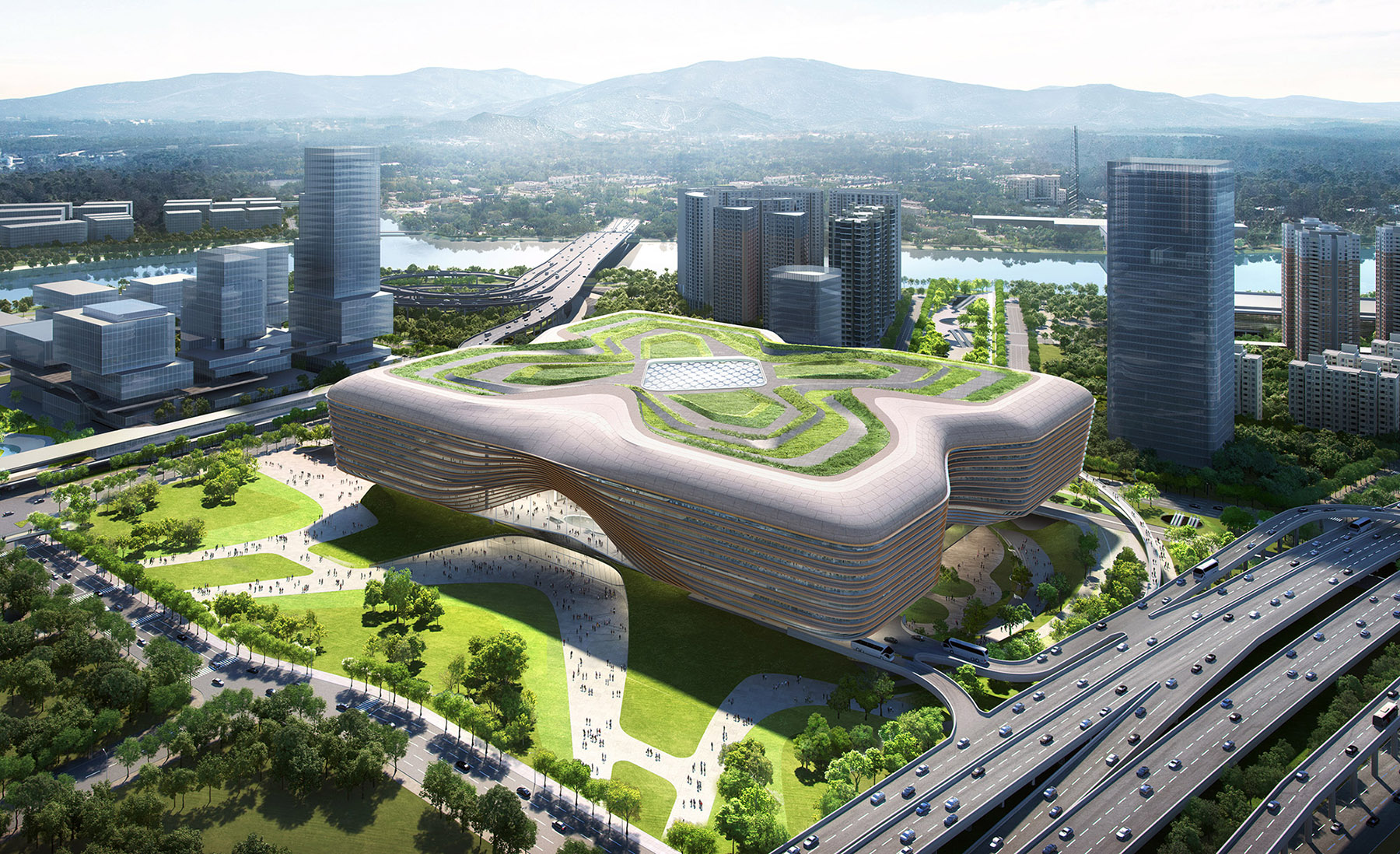
The new Huanggang Port, in the heart of the frontier region, represents a modern, streamlined, square metal structure that has risen after seven years of construction. It will be the world’s largest land border crossing and the only 24-hour land checkpoint between the HKSAR and Shenzhen. Hong Kong officials say it is all systems go after a series of closely coordinated tests and stress drills with the Shenzhen side ahead of its official opening this year.
Its appearance resembles a smooth piece of jade polished by flowing water, symbolizing a cornerstone for the new era of cross-boundary travel and collaboration across the Guangdong-Hong Kong-Macao Greater Bay Area. The building’s exterior-and-interior layout stands in stark contrast to that of the previous facility that became operational around the clock in 2003. The old port, featuring low-rise buildings in a traditional Chinese architectural setting, had been in service for more than three decades, initially as a key freight hub that saw the rapid growth of foreign trade in the Pearl River Delta.
The “collaborative inspection and joint clearance” model adopted at the new crossing requires only a single inspection mode within the building, eliminating the hassle of commuters having to wait in line for separate checks at control points in Hong Kong and Shenzhen that were connected by shuttle buses. The nine-story joint-inspection building’s “vertical stacking” design allows a more seamless link between the port and public transportation.
Zhao says he believes these revolutionary changes will foster more interactions between the Hong Kong and Shenzhen teams of companies with a cross-boundary presence. The port’s 24-hour operation also caters to researchers’ late-night commutes when they are engaged in overseas dealings across different time zones.
As for the industrial ecosystem, Huanggang Port will hasten deeper integration of the Hetao technology parks spanning both cities. Coupled with supporting measures like green channels for the movement of research personnel and scientific supplies, and cross-park rule alignment, the revitalized nexus’ value in facilitating the flow of innovation vitality will be greatly amplified, he says.
By May this year, the scale of emerging industries at Hetao’s Shenzhen Park, including artificial intelligence and biopharmaceuticals, had exceeded 12 billion yuan ($1.79 billion) — up 18 percent year-on-year. In less than a year since it began operations, the Hong Kong Park has attracted more than 100 tech firms to establish a presence there. It is expected to generate an annual economic contribution of 50 to 90 billion yuan when fully operational.
“Human civilization has always relied on such gateways for development. Beyond leveraging foot traffic to stimulate commerce, their core function in this era is to catalyze inno-tech development by bringing together scientists, investors, professional service providers and high-quality inno-tech enterprises,” says Zhao.
A checkpoint of such magnitude should not be merely a place for travelers to rush through in a hurry, he says. It should retain talent, capital and scientific research information, and amplify the collision of ideas. If research and development can be carried out near such crossings, it could significantly reduce commuting times and raise cooperation standards.
Border cluster boost
Jesse Shang Hailong, who helms the Hong Kong Top Talent Services Association and is also a former Hong Kong lawmaker, says he believes that optimized border crossing transportation will help Hetao’s Hong Kong Park, which is still in its infancy, build on Shenzhen’s mature facilities to draw more enterprises and investment. It will also further bridge the scientific ecosystems on both sides and speed up cross-boundary research projects.
Huanggang Port’s renovation is expected to free up more than 600,000 square meters of land in Shenzhen and Hong Kong — nearly 70 percent of the land area of Hetao’s Hong Kong Park. These tracts of land, fully-owned by the government, are highly valuable, whether for Shenzhen, which needs to save land by moving industries into high-rise buildings, or for the SAR, where much of the northern land is privately-owned and difficult to redevelop. If put to good use, these scarce boundary areas would immensely foster the prosperity of inno-tech industry, says Shang.
“Compared to the eastern boundary crossings, Huanggang and other ports in the central and western areas — Futian Port, Shenzhen Bay Port and the future Qianhai Port — are directly connected to the most vital hubs of technological innovation and modern services in Shenzhen and Hong Kong, further facilitating the development of new quality productive forces,” says Kenny Shui Chi-wai — vice-president of Our Hong Kong Foundation and executive director of its Public Policy Institute.
“The port cluster links up Shenzhen’s three strategic platforms with the strongest growth momentum — Futian central business district, the Hetao Shenzhen-Hong Kong Science and Technology Innovation Cooperation Zone and the Qianhai Shenzhen-Hong Kong Modern Service Industry Cooperation Zone — as well as key development areas in Hong Kong’s Northern Metropolis, such as Hung Shui Kiu, Lok Ma Chau and San Tin,” he says.
Most of the commuters are researchers, financial professionals, executives of multinational corporations, and legal and accounting professionals based in Shenzhen and Hong Kong, representing an exchange of high-level human capital, says Shui.
“Adjacent to high-value-added industries like finance, technology, modern services and high-end logistics, the corridor boasts a very high concentration of economic output within the Greater Bay Area,” says Fan Kwok-yuen, an assistant professor in the Department of Economics and Finance at The Hang Seng University of Hong Kong.
The project’s Shenzhen side connects the city’s Futian and Nanshan districts, which lead the country in overall economic output and land productivity. The technology and logistics centers of the Northern Metropolitan area, located on the cluster’s Hong Kong side, are expected to rev up the SAR’s trade and digital economy worth tens of trillions of dollars.
“Rather than converting foot traffic into consumer spending, this cluster is more likely to spur long-term industrial collaboration, making a more enduring contribution to growth,” says Fan.
Western ports rising
With Huanggang’s landmark overhaul, Shenzhen Bay Port — a key passenger and cargo gateway supporting western Shenzhen’s tech sector — will see its logistics functions further consolidated, replacing the former as the most vital channel for cross-boundary logistics.
To release more space in the central regions for industrial upgrading, Huanggang Port — previously the only 24-hour freight lifeline between Shenzhen and Hong Kong, which often endured long queues of cargo trucks running day and night — removed its cargo functions late last year, mainly by redirecting shipments to Shenzhen Bay Port in the western border region and Liantang Port in the eastern area.
Wang Guowen — director of the Center for Logistics and Supply Chain Management at the China Development Institute — estimates that, with stronger logistics capability, improved transportation links and close proximity to the Pearl River Delta’s hinterland, Shenzhen Bay Port would take up about 70 percent of freight traffic from Huanggang.
He says he believes cross-boundary logistics centered on Shenzhen Bay Port will continue to expand as industrial integration deepens and the Northern Metropolis takes shape. He expects to see increased exports of time-sensitive high-tech products through Hong Kong’s mature airfreight network, tighter Shenzhen-to-Hong Kong urban delivery links from warehousing parks, and a spillover of storage demand for the SAR’s maritime freight.
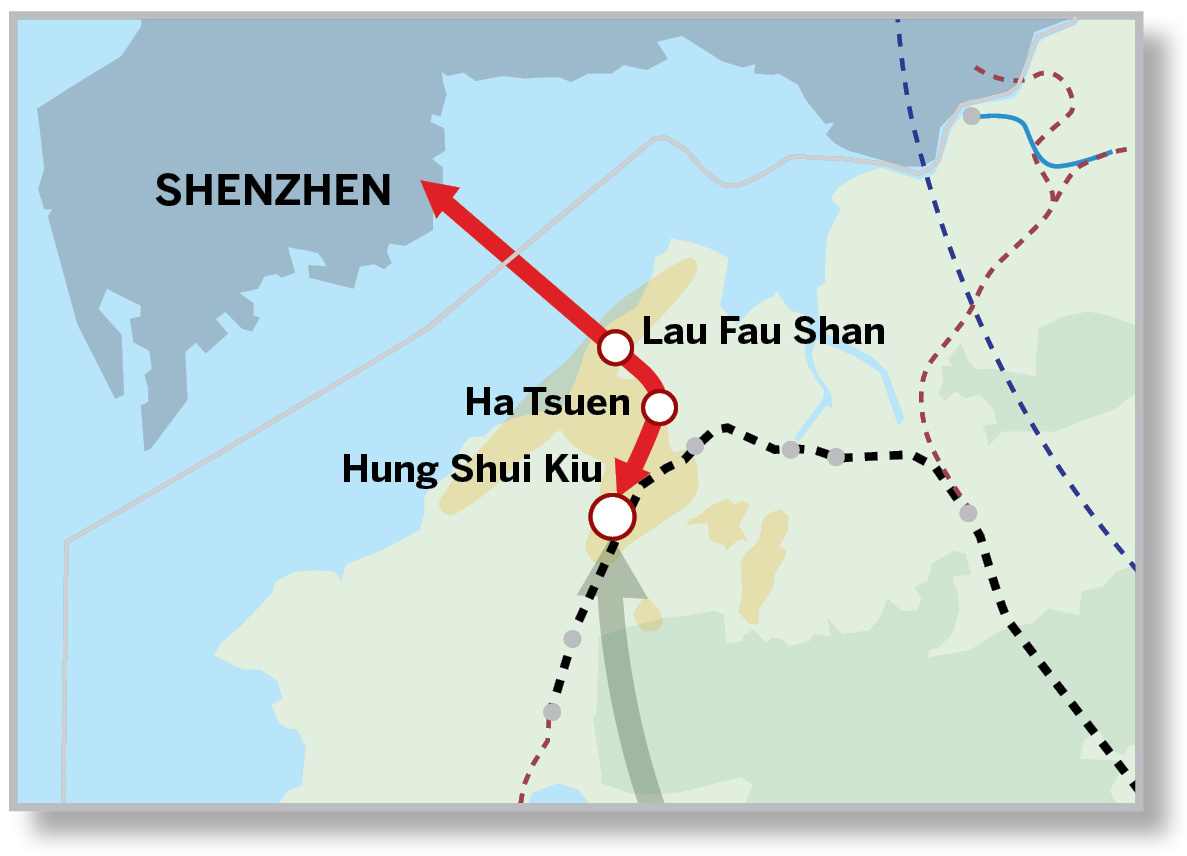
Although it will take about 10 years before entering service, Qianhai Port — a new border crossing that will extend the railway into the road-transport driven western border region and connect Shenzhen and Hong Kong in just 15 minutes — has immense potential to invigorate nearby industries.
Connecting Qianhai and Hung Shui Kiu with the planned Hong Kong-Shenzhen Western Railway Link, Qianhai Port could meet the demand for scheduled, high-frequency, large-scale cross-boundary services. It could also help professional services and high-end logistics businesses on both sides establish long-term collaboration with deepened interaction and enable them to decide where to locate their headquarters, operations and housing for staff along the boundary areas more flexibly.
The planned university town at Hung Shui Kiu is positioned to focus on applied higher education. The new railway is expected to help universities in Shenzhen and Hong Kong operate dual campuses in Qianhai and Hung Shui Kiu and share large research equipment. Entrepreneurs cultivated at the university town would be able to quickly access startup resources in Qianhai to commercialize research outcomes, says Shui.
Integration’s real test
Although these central and western gateways could supercharge industrial development, Fan says he believes the real challenge lies in their ability to handle the growing cross-boundary traffic and capitalize on the benefits they bring.
Major obstacles would include limited operating capacity during peak hours, the length of time required to complete intermodal public-transport connections, bottlenecks in the flow of key scientific and production factors, as well as inadequate supply of housing that would constrain their ability to retain talent, he says.
ALSO READ: A game changer in regional connectivity
Shui says he believes that public transport support remains a key issue, as the port cluster’s railway network will take about 10 years to fully develop. He suggested adding parking at the new Huanggang Port and running short shuttle routes to redirect passengers. He also called for faster railway construction and reserving track capacity for extending the cross-boundary western rail link into southern Hong Kong to improve overall transport coverage.
“Boundary crossings can bring people together more quickly, but they do not automatically lead to innovation. They’re a necessary condition for integration, but this isn’t the whole story. Without supporting infrastructure, foot traffic would be limited to just duty free shops and weekend dining,” says Fan.
Contact the writer at bingcun@chinadailyhk.com
