

Automatons increasingly performing more than just 'viral' mundane tasks
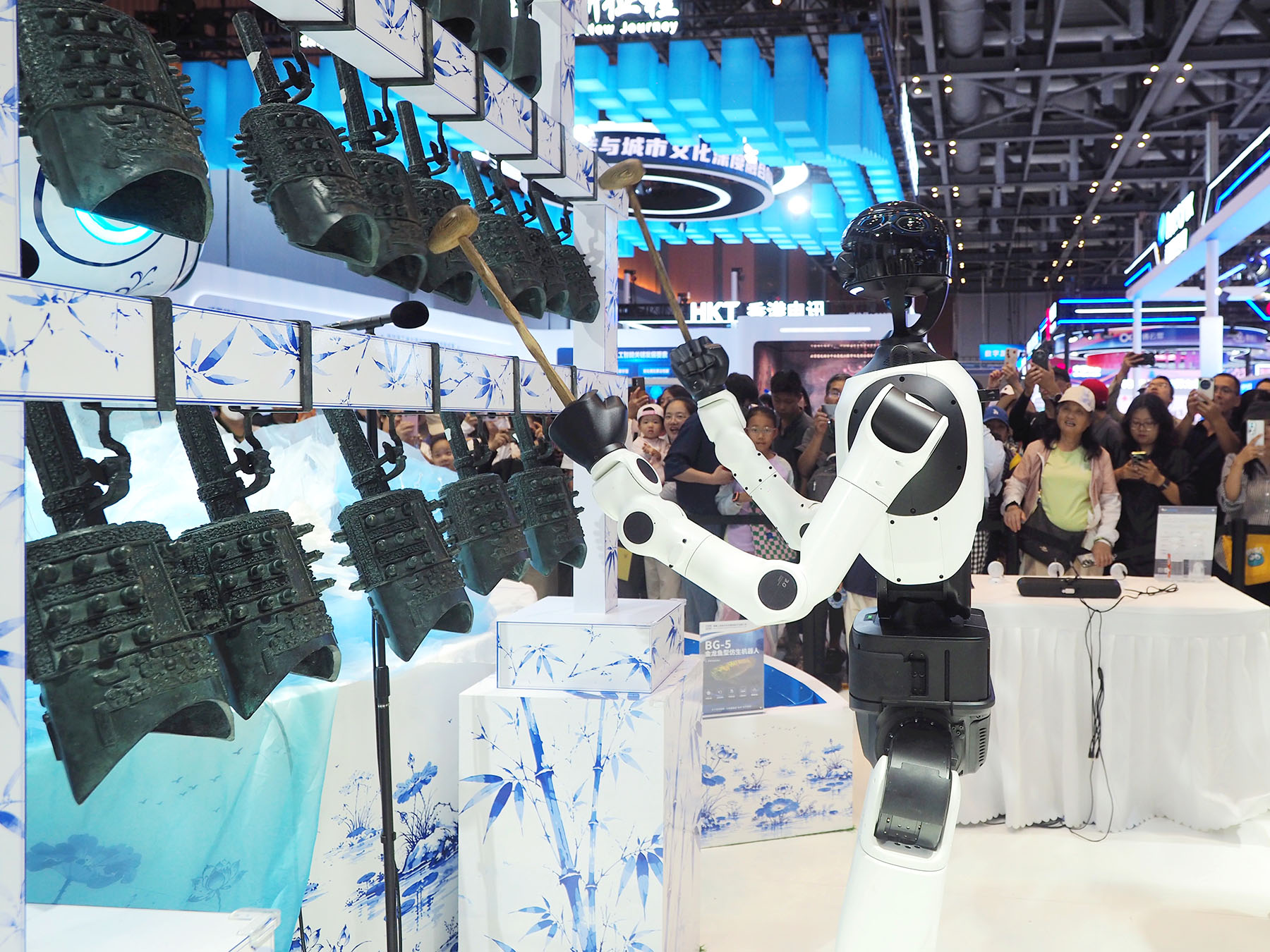
BEIJING — A robotic hand picks up a calligraphy brush, dips it in ink and writes fu, a Chinese character meaning good fortune, on a square of red paper, delighting the onlooking crowds.
Chinese robots like this one are no longer just event performers and mere practitioners of parlor tricks. They are increasingly clocking in for real work, and an entire industry is forming around teaching them how.
At the five-day China International Fair for Trade in Services, which wrapped up on Sept 13 in Beijing, Galbot G1 — which went viral after folding laundry in a video clip for this year's globally broadcasted Spring Festival Gala — staffed an unmanned convenience pod.
Such pods are already operating at sites including Beijing's Summer Palace, a former imperial garden, where each is expected to serve more than 1,000 visitors a day. The first overseas store of this type opened in Hong Kong on Sept 1.
READ MORE: Robot on the line
Robots are also being deployed to perform other useful tasks. At an "unstaffed post office" booth, a robot stamps postcards, drops them into a mailbox and fetches blind-box toys for customers.
A few meters away, a pancake robot flips crepes to order, while a coffee robot pours latte art onto a fresh cup.
"We have a coffee-making robot on campus, but these are more advanced," said visitor Olga, a Belarusian professor at Beijing Foreign Studies University.
It takes humans considerable effort to create latte art, she added, but robots do it with ease.
For all the novelty, a wide gap remains between demonstration and deployment: training.
"China's domestic shipments of humanoid robots reached 23,000 units in the first half, but fewer than 5 percent are working stably on real production lines," said Zhu Kai, general manager of the Beijing Shijingshan Humanoid Robot Data Training Center.
Production lines are far messier than a stage. "High-quality, multimodal real-robot data fit for industrial training doesn't reach even 1 percent of actual demand," Zhu said, adding that the shortage is the core obstacle to moving robots "from performing to actually working".
Closing that gap starts in a "vocational school" for robots. The training center, a short walk from the CIFTIS fairground in Shougang Park, is where much of the "homework" gets done.
Nearly 270 robots work there at full capacity on chores, caregiving drills and factory tasks such as automatically placing circuit boards onto a production line, producing nearly 20 million high-quality data entries a year.
The "school" opened its doors to visitors during the fair, and the lessons translate into human-like movements: rows of robots practiced fetching and setting down boxes or ironing trousers, each following a human mentor demonstrating the moves.
Those mentors now have an official title. On the fair's opening on Sept 9, China formally recognized a new occupation: embodied-intelligence robot application technicians, with two new trades within it — robot data collectors and robot trainers.
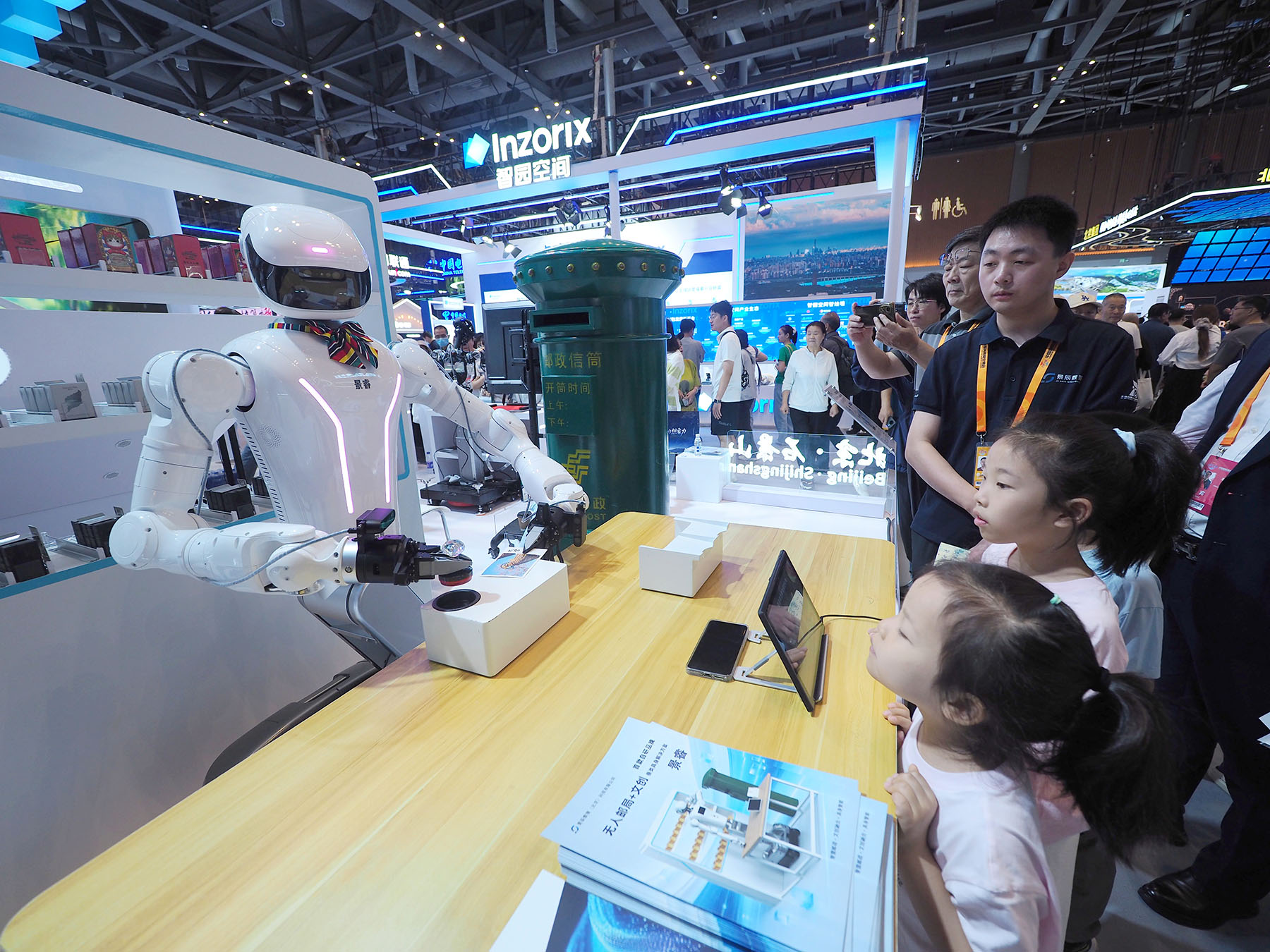
The tools are changing, too. Data collectors once manned machines from fixed lab consoles to orchestrate robots' every move. But with new capture rigs mounted, they can now easily enter real-world work scenarios, recording human hands at work.
At one booth, virtual reality firm Nolo displayed its EgoCapture, a head-mounted rig that records 360 degrees of real human operations.
Wear it on a trail run, and it generates exactly the data a robot would need to judge a long-distance turn. Clients can buy the service instead of the full set of gear.
Other booths harvest the rest of a robot's education: tactile sensors from Tashan Technology capture the sensation and force of a grip, while dexterous hands from Casia-Hand Robotics — with a built-in "brain" model — learn to act autonomously.
The output of this schooling shows up on the fairground itself: much of the training data behind the exhibits in the fair came from the center, said Zhu.
Data itself is becoming a commodity, and this year's CIFTIS gave it a pathway to cross borders.
At a forum, the fair launched China's first industry-level platform aiming to provide international services for embodied-intelligence data, built by Beijing Shijingshan Science and Technology Innovation Group, in partnership with China Telecom's Beijing branch.
The groundwork has been established in Shijingshan district of Beijing: China's first 3D high-quality dataset for large-model training has been registered, four data service stations have opened and more than 200 data products have been listed, while Beijing as a whole aims for 100 high-quality industrial datasets by 2028.
"The government sets the stage, and the companies perform. CIFTIS works like an amplifier, turning Beijing's industrial strengths into international cooperation opportunities," Zhu said.
ALSO READ: Humanoid robots make quantum leaps
The robots are already earning their keep with overseas deployment. Anyverse Dynamics, a Beijing embodied-artificial intelligence startup participating in the fair, has signed a 500-million-yuan ($74.6 million) deal with green-tech group Envision, and the first batch of its K15 semi-humanoids arrived at Envision's battery gigafactory in France this month for autonomous loading and unloading work.
But the machines are only part of the business. The training and the services that keep them working overseas are increasingly where China's services trade will be concentrated in the future.
The fairground tells the same story. The information and communications technology hall alone featured more than 30 debut products, from high-jumping and cooking robots, to wall-climbers and holographic cabins.
"Visitors can feel an intelligent economy where carbon-based (humans) and silicon-based (robots) beings coexist," said He Qionghua, head of the ICT exhibition area.
Back at the calligraphy booth, the lucky fu character is a blessing for visitors, while the fortune it points to is increasingly being created by robotic hands.
