

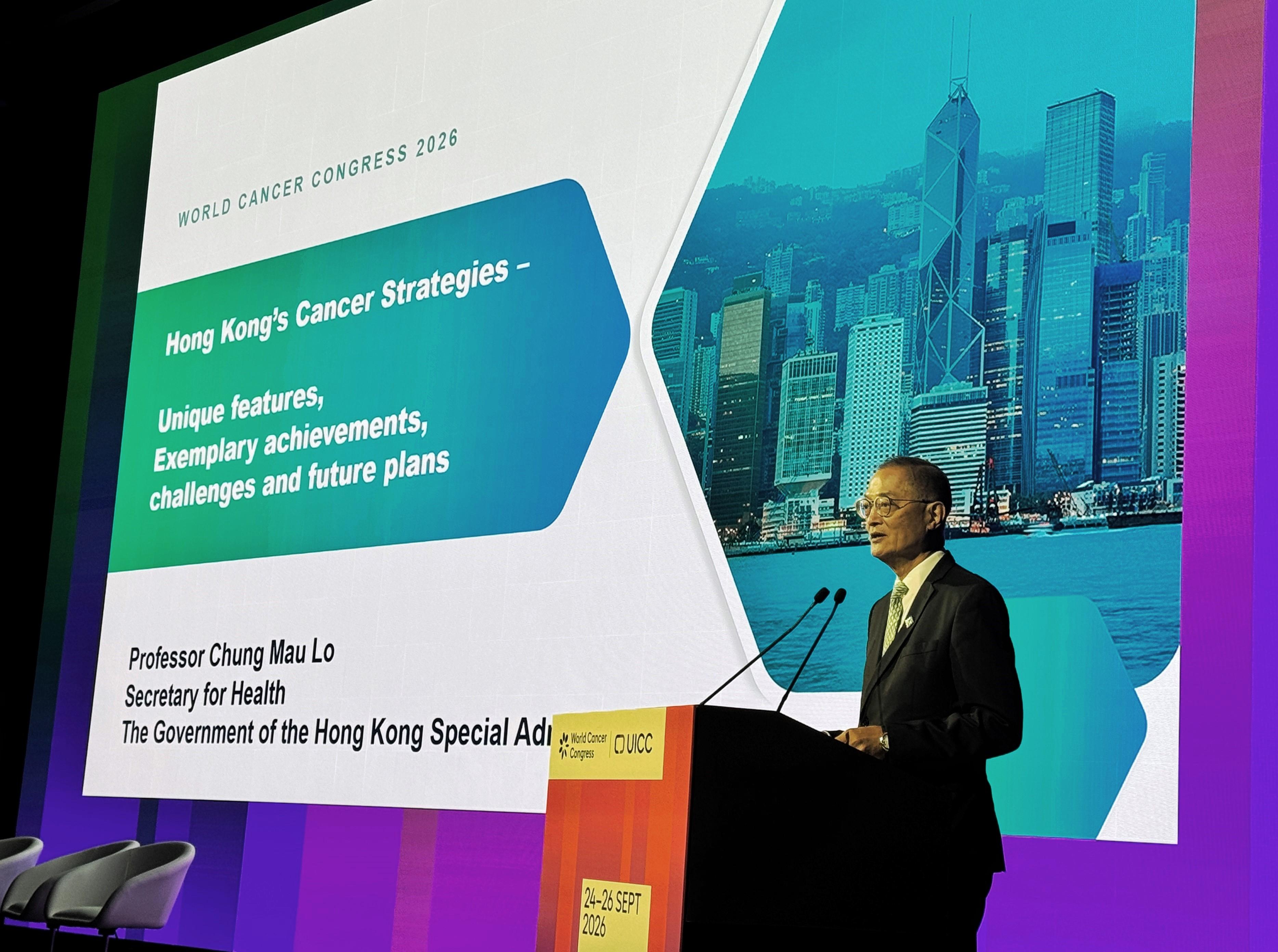
Hong Kong is making significant lifesaving progress against cancer with standardized cancer mortality rates in the city dropping by over 40 percent in the last three decades, Secretary for Health Lo Chung-mau said on Thursday.
In a speech at the World Cancer Congress 2026, Lo said that while the number of new cancer cases in Hong Kong continues to rise with its aging population and more advanced diagnostics, mortality rates have declined annually by 2.8 percent for men and 1.7 percent for women in the last decade.
He also said that smoking prevalence in the city has dropped from 23.3 percent in the 1980s to a historic low of 8.5 percent last year.
“Such progress in cancer control would not be possible without policy support, strategic planning, coordination and investment from the government,” Lo said.
ALSO READ: New era in cancer fight
“The World Health Organization's World No Tobacco Day Award to me this year is a tremendous encouragement, and due recognition of Hong Kong's efforts in tobacco control,” he added.
Lo noted that Hong Kong has the world's highest life expectancy — 88.7 years for women and 83.3 years for men in 2025 — due to active urban lifestyles and a safe environment, public health policies, and accessible affordable public healthcare.
For nearly one in four Hong Kong residents over the age of 65, cancer remains the leading cause of death in the city, accounting for nearly 30 percent of all deaths, Lo said.
He added that the top five cancers are lung, breast, colorectum, prostate and liver, while the top cancer deaths were lung, colon, liver, pancreas and breast.
ALSO READ: HK launches cancer prevention declaration backed by global experts
Cancer is not only treatable but also preventable, notably by vaccination against oncovirus and a healthy lifestyle, Lo said.
He said the Hong Kong Childhood Immunisation Programme provides free universal mandatory vaccines for eligible Hong Kong children, covering 12 infectious diseases, including two oncoviruses — the hepatitis B virus (HBV) and the human papilloma virus (HPV).
“HBV vaccinations for all newborns since 1988, together with prenatal HBV screening and the widespread availability of antiviral treatment, have resulted in a remarkable control in liver cancer,” he said.
The number of new cases dropped by 8.2 percent and deaths by 7.6 percent in the last decade, Lo said, adding that school-based HPV vaccination for primary school girls has achieved a coverage rate of over 90 percent among 15-year-old girls, achieving the vaccination target of the WHO's global strategy to eliminate cervical cancer.
Looking ahead, Lo said Hong Kong’s first five-year plan — announced last week — set the strategic goal of developing Hong Kong into a health and medical innovation hub.
READ MORE: HK restates support for cell and gene therapy amid biotech push
He said Hong Kong will provide lifesaving innovative cancer drugs and devices to patients “faster than ever before” by reforming its drugs and medical device regulatory regime, while promoting precision medicine for personalized cancer care by increasing genetic and related testing capacities.
Artificial intelligence also holds enormous promise for earlier cancer detection, more accurate diagnosis, and more efficient care delivery, Lo said, while adding that AI must be introduced carefully, ethically, and “in a way that complements, rather than replaces, the judgement of clinicians.”
“These developments are not just about Hong Kong. Hong Kong has the unique advantage of enjoying strong support from the motherland while being closely connected to the world,” Lo said.
“We will continue to leverage this position to foster healthcare cooperation within and beyond the Guangdong-Hong Kong-Macao Greater Bay Area, contributing to the important national strategy of ‘Healthy China’.”
