

Zhejiang firm's products do far more than jump, climb stairs, play table tennis
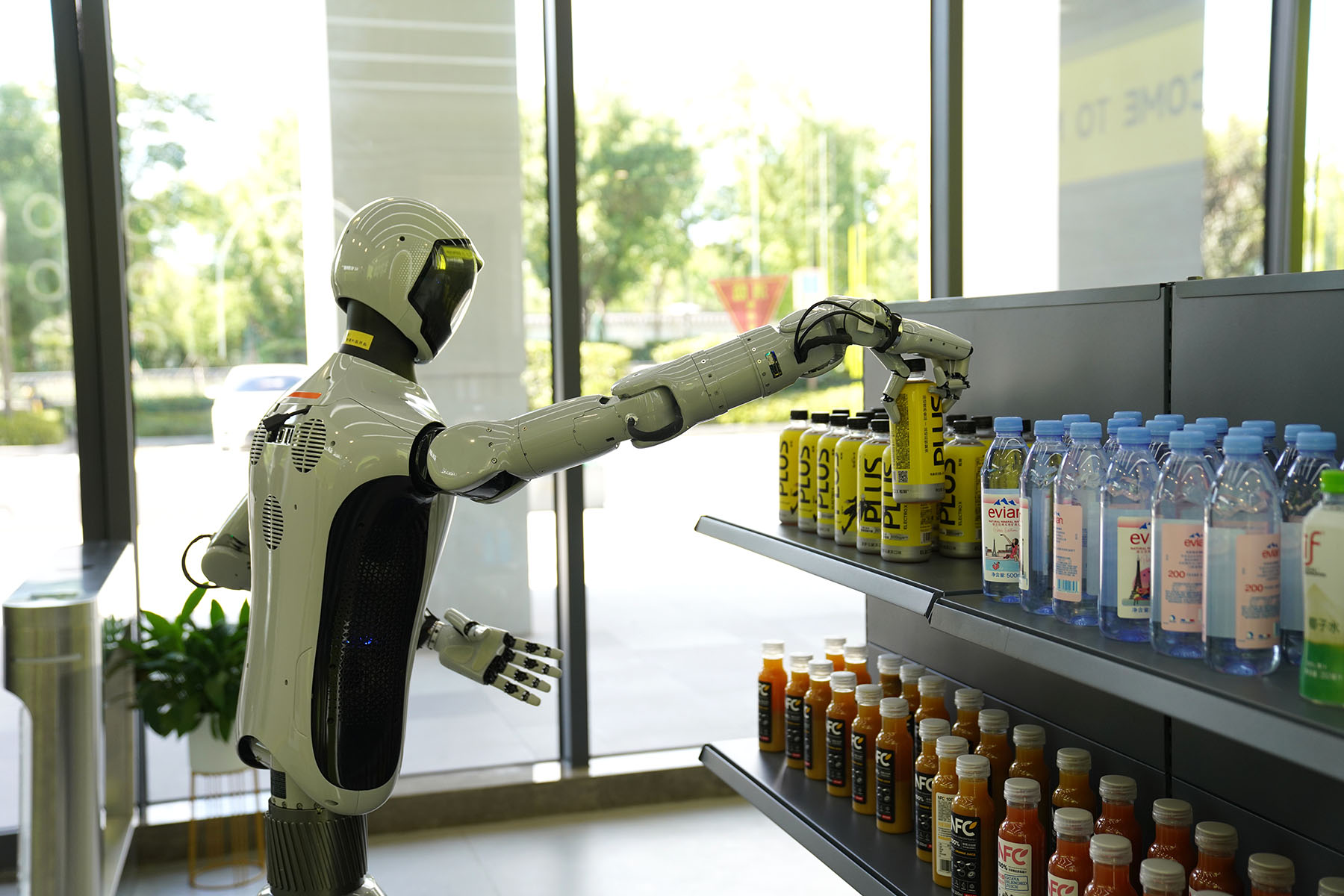
Can you imagine a robot doing all of your housework? Robots developed by Zhejiang Humanoid Robot Innovation Center Co Ltd in Ningbo, East China's Zhejiang province, are turning imagination into reality.
During a typical morning on a workday, a robot irons your shirt, while another robot sweeps the floor. Not far away in the kitchen, a different robot washes the dishes. With the help of humanoid robots, a busy morning is not so busy anymore.
Apart from housework, humanoid robots developed by the company are applied in industrial scenarios and retail scenarios, covering work such as clothing manufacturing, high-precision component assembly and retail work in supermarkets.
Xiong Rong is chief scientist and general manager at Zhejiang Humanoid Robot Innovation Center Co Ltd. At end-2023, Xiong — together with eight doctoral graduates from Zhejiang University — founded the company in Ningbo.
READ MORE: China leads global humanoid robot development with over 400 products
The company focuses on key technology research and development, product development, industry application and promotion of embodied intelligent humanoid robots. It focuses on cutting-edge exploration of cutting-edge models and embodied intelligence, and is committed to developing humanoid robot products that can truly serve in multiple scenarios.
The firm's core R&D team has accumulated continuous experience in the field of intelligent robots for 26 years, and has been deeply involved in the field of humanoid robots for 20 years. The technology path covers the entire chain of motion, movement and operation, from robotic arms and mobile platforms to humanoid robots.
Xu Xuecheng, chief technology officer and deputy general manager of Zhejiang Humanoid Robot Innovation Center Co Ltd, said that the team started to develop intelligent robots in 2000, and their earliest breakthrough was in mobility — automated guided vehicles in warehousing and logistics. Between 2013 and 2014, the team shouldered the National High-tech R&D Program (863 Program), and started to develop bipedal humanoid robots.
"Based on the 863 Program, we developed a bipedal robot that can play table tennis, overcoming key technical challenges," Xu said.
Now, the company has established a full stack product matrix, which is divided into three categories: fixed, wheel arm and bipedal. Fixed type mainly targets workstations that do not need to be moved, such as textile manufacturing, and is more economical from a cost-analysis perspective. Wheel arm type with a mobile chassis is suitable for scenarios that require frequent movement, such as handling packages and assembly line work; bipedal type is at the forefront of robotics technology, capable of walking up and down stairs and overcoming obstacles. It is suitable for security inspections, exhibition hall guidance, entertainment and commercial performances, and other scenarios.
Among the products, a wheel arm universal flexible operation intelligent robot is currently the most widely promoted main product. "It can cover more scenarios with its generalization, high-precision operation and stable mobility without significant cost increases. This robot is equipped with an upgraded humanoid arm, with a repeat positioning accuracy of 0.02 millimeter at the end, a poweredup range of six hours, and the ability to climb and descend inclines of 20 degrees," Xu said.
In industrial settings, the company has clearly defined directions such as handling and sorting, precision assembly and textile production.
"The difficulty of textile manufacturing lies in the fact that fabrics are flexible and difficult to recognize, and deformation during operation cannot be simulated in the simulation environment," he said.
In April, Zhejiang Humanoid Robot Innovation Center Co Ltd inked a deal with global sewing equipment giant Jack Technology Co Ltd for 2,000 units of customized humanoid robots, setting a record for the first large-scale application project of humanoid robots in the global textile industry. In the field of clothing manufacturing, the company has achieved a success rate of 98 percent in fabric slicing, a single operation time of three seconds, and a positioning accuracy of 2 mm.
According to the company, the efficiency of robots in clothing production scenarios can reach 80 percent of human capability. "The remaining 20 percent can be optimized through automation, which is a systematic optimization project. We should leverage the value of humanoid robots' 'brain thinking' rather than letting them do repetitive work," Xu said.
In commercial scenarios, the company's humanoid robots are being applied in many commercial streets. They can complete the entire process of guiding, picking up cups, making ice cream and delivering goods, with a voice delay of no more than three seconds, a visual recognition accuracy of 98 percent and a capture success rate of 99.9 percent.
Xiong said the most difficult thing in the industry now is not the lack of robots, but the uneven level of automation. For example, in the automotive manufacturing sector, chassis manufacturing is very "smart", but assembly is still very "stupid", and traditional methods find it difficult to achieve autonomous adaptation and rapid deployment.
"The pain points are not limited to a particular sector. There is great demand in the industry, but the specific application scenarios are often very trivial. There is actually interconnectivity between industries and scenarios, such as basic actions such as plugging, unboxing, retrieving and twisting, which are needed almost everywhere," she said.
"At the same time, we need to consider collaborating with industry partners, because in order to truly implement applications, we need to start from the overall perspective and think about the automation collaboration of the entire workshop and production line. Many industry automation companies have years of accumulated experience, so in addition to building tailored intelligent models and complete machine systems, we also construct convenient and easy-to-use toolchains to facilitate industry partners so as to promote professional solutions for the integration of new technologies," she added.
At present, for humanoid robots, in addition to standing steadily and walking well, there is also a threshold that truly stands in the way of practicality. Why do many robots run and jump in demonstration situations, performing well, but have no use in real life and production? The key is that the current algorithm adaptability and intelligence level are not high enough to support robots to work stably in complex and dynamic real-time scenarios for extended periods.
ALSO READ: Embodied AI sector posts robust growth
The answer is to immerse humanoid robots in real scenes and combine reality and virtuality. The training method of embodied intelligent humanoid robots is different from traditional machine learning. Only by constantly interacting and training in an unpredictable brick-and-mortar environment can its actual abilities be verified. Merely by watching videos and reading text, embodied intelligence cannot master action skills like humans, industry experts said.
Lin Xianping, an associate professor at Hangzhou City University, said: "Overall, China's humanoid robots have emerged from the laboratory demonstration stage and entered a critical window period of rapid technological iteration and pilot scene implementation. Relying on the complete manufacturing industry chain and the dividends of the large-scale model industry, domestic enterprises have significant advantages in machine motion control and scene-based algorithm iteration speed.
"However, the industry is still in the early stage of being able to perform, but difficult to stabilize. It's able to build prototypes but difficult to mass produce, and there are multiple bottlenecks before large-scale commercialization. Future improvement lies in autonomy of core components, upgrading of motion control and durability performance, deep integration of embodied intelligence, optimization of endurance and energy systems, and commercialization and standardization construction," he said.
Contact the writers at zhengyiran@chinadaily.com.cn
