

From a bureaucrat's grievance to questions about hunting, ancient texts capture moments of everyday life, Lin Qi reports.
A written bamboo slip documenting a workplace dispute 2,200 years ago could strike a chord with people today who have grown weary of delicate people-to-people relationships.
For Zhao, a township head during the reign of Emperor Qinshihuang, who established the Qin Dynasty (221-206 BC), the summer of 219 BC was an unhappy one.
In a later report, Zhao said he had caught a female bird on the orders of his superior, the county magistrate. He handed over the bird, together with the accompanying official document, to Wen, a countylevel official responsible for delivering them to the county court.
Wen, however, refused to accept them. He erased his name from the document and passed the task to his junior clerk, Shi, who dared not take it on. Wen then vented his anger on Shi and went on to hit Zhao with a boat oar and curse him.
Zhao said he reported the incident and asked the county court to judge Wen's misconduct. He also said he had a witness who heard the insults.
Zhao's unpleasant workplace experience may evoke some empathy today. The bamboo slip on which he recorded his complaint is now on display at the National Museum of China in Beijing.
The slip is among more than 36,000 bamboo slips, bearing over 200,000 characters, discovered during an archaeological excavation in Liye town, Xiangxi Tujia and Miao autonomous prefecture, Hunan province, in 2002.
Known collectively as "Liye Qin slips", the documents are believed to be administrative records of Qianling county, under whose jurisdiction Zhao's township fell. They cover a wide range of subjects, including politics, military affairs, the economy and law, offering an encyclopedic picture of Qin administration and helping people understand how China's first unified imperial dynasty functioned at the grassroots level.
Yet, fully understanding Zhao's report is no easy task. The characters inscribed on the slip look markedly different from those used today. Visitors must rely on explanatory texts to decipher them, a process made possible by decades of research by archaeologists, historians and paleographers.
The display of Zhao's slip at the exhibition, Wonderful Chinese Characters: Recent Advancements of the Paleography and Chinese Civilization Inheritance and Development Program (2021-2025), celebrates years of research in the field.
The exhibition traces the origins and evolution of Chinese characters through inscriptions and manuscripts on a range of materials, including oracle bones, stone, bamboo, bronze, paper and silk.
Hanzi, the Chinese script, has been in continuous use for several thousand years. In November 2020, several governmental bodies, including the Ministry of Education and the National Cultural Heritage Administration, jointly launched the Paleography and Chinese Civilization Inheritance and Development Program. Over the past five years, researchers have made new discoveries by studying recently unearthed and newly collected ancient written materials.
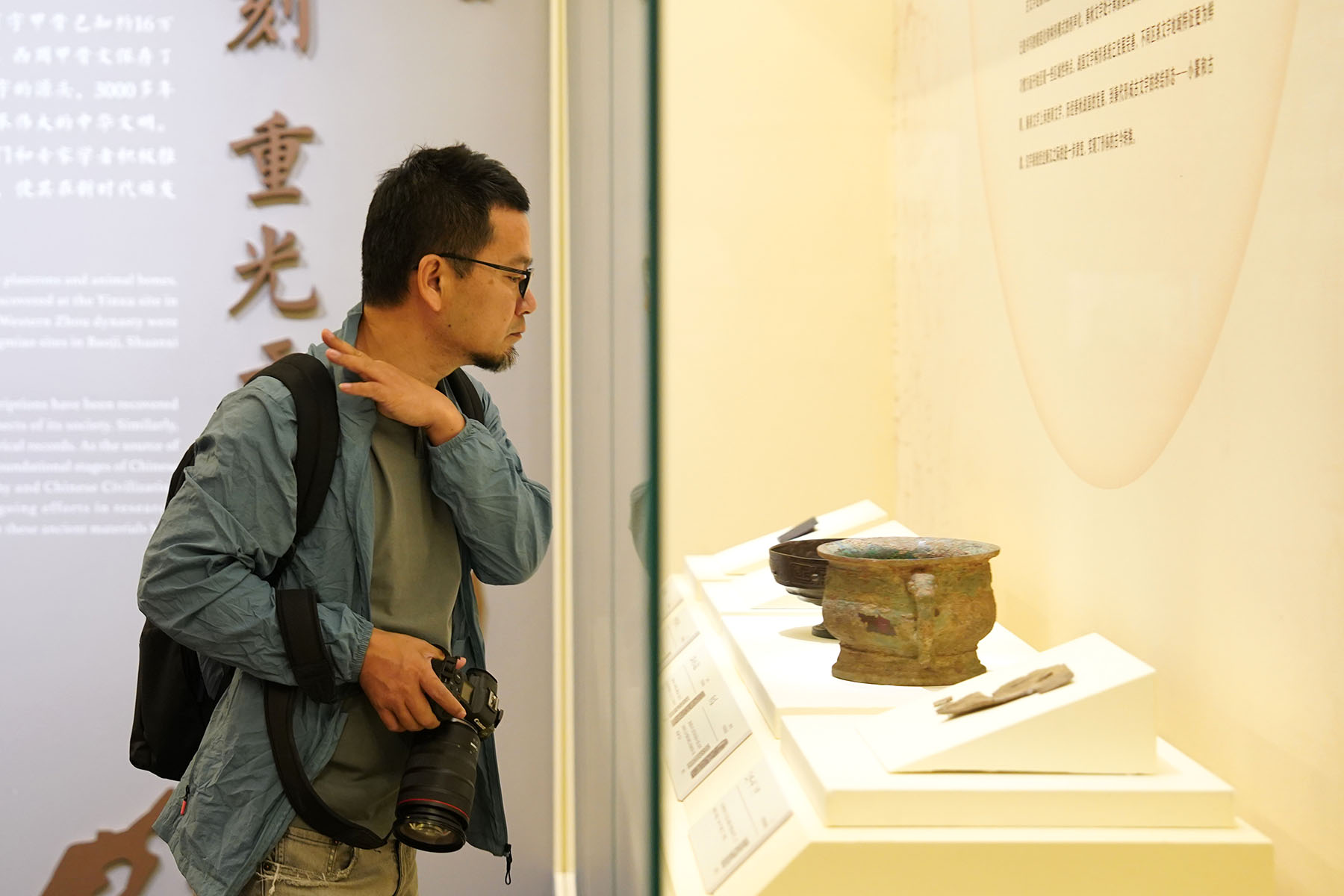
The exhibition, which runs through Oct 16, brings together more than 270 artifacts from 20 museums, research institutions and universities across China, according to Tian Wei, its curator and a researcher at the National Museum of China.
"The exhibition surveys the evolution of writing through clues preserved in various forms, such as oracle bone inscriptions, bronze inscriptions, bamboo and silk manuscripts, seal impressions, and inscriptions on coins," Tian says.
The juxtaposition of artifacts dating from the Shang (c. 16th century-11th century BC) to the Han (206 BCAD 220) dynasties, together with translations and scholarly explanations, makes the study of paleography less daunting for visitors.
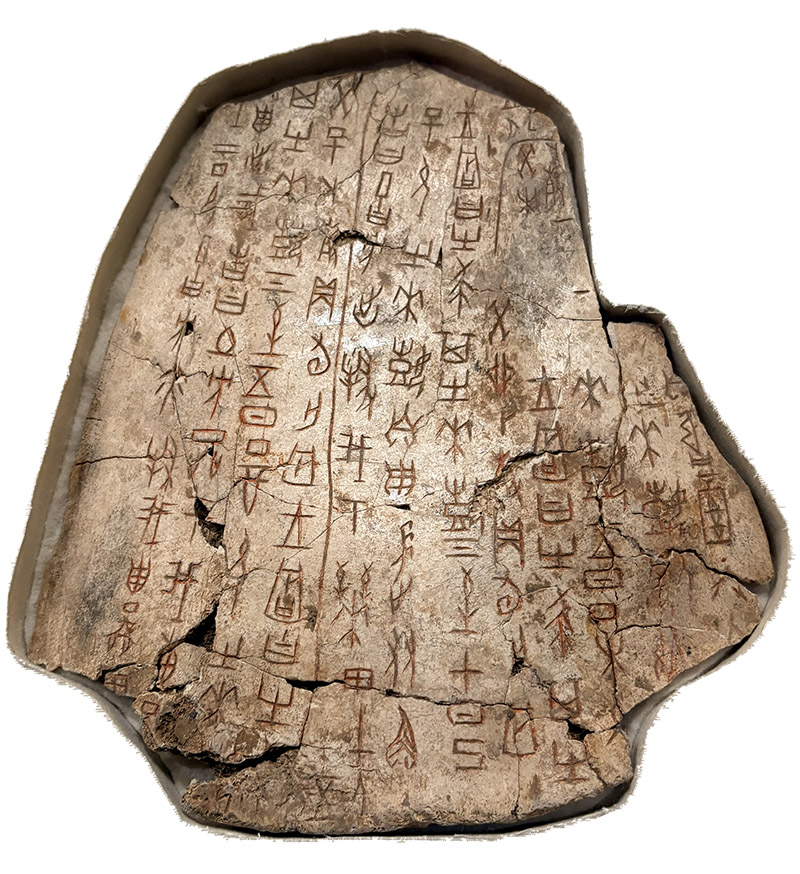
For example, the "scratches" carved more than 3,000 years ago on animal bones, mainly ox shoulder blades and the flat undersides of turtle shells, record questions posed during divination while revealing many aspects of Shang society.
One anxious father and king asked whether one of his princes would recover from an illness. Another king sought the forebears' blessing before setting out for battle. A third divination asked whether animals should be driven or caught with nets during a hunt.
One of the exhibition's notable oracle bones is a "tufang ruqin" ("enemy states to invade") piece, whose inscriptions are written in cinnabar. Made from a bovine scapula, it is considered one of the major specimens cataloged in Yinxu Shuqi Jinghua (Selective Oracle Bone Inscriptions at the Yinxu Ruins), a publication by Luo Zhenyu (1866-1940), a prominent paleographer and collector of inscribed oracle bones.
"In the book, Luo named the specimen the 'king of scapular bones for divination'," says Huang Tianshu, a professor at the Research and Conservation Center for Unearthed Texts, Tsinghua University.
Tian, the exhibition's curator, says the bone is not only relatively well-preserved but also contains important historical information.
"People asked whether any unfortunate incident would occur, and the divination said there would be. The text goes on to confirm that the small enemy states to the northwest of the Shang capital invaded, and that slaves escaped from prisons," he explains.
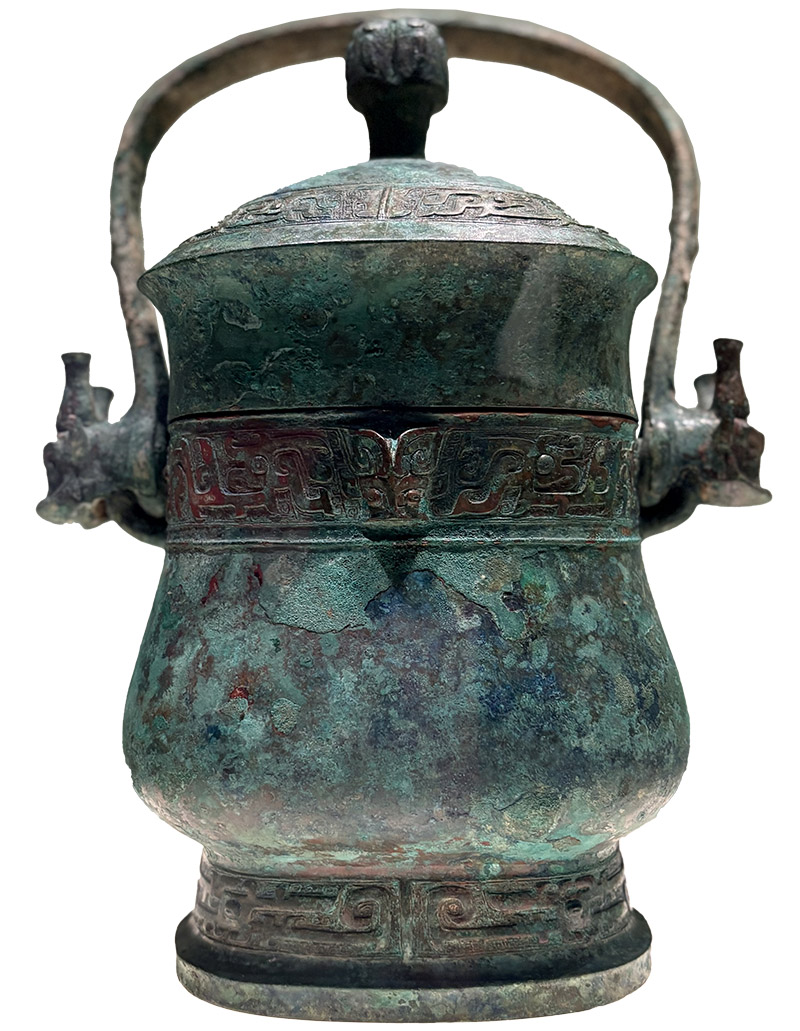
Another notable artifact illustrates the prolific inscriptions on Western Zhou Dynasty (c. 11th century-771 BC) bronze vessels, which recorded important state affairs. It is the "zuoce huan" you ware.
A you is a type of wine container resembling a bucket, with a swing handle and a knobbed lid. Researchers excavated the vessel in 2021 at the Liulihe site in Beijing's Fangshan district. Historians generally agree that the site was the capital and original fief of the Yan vassal state under the Western Zhou Dynasty. It is also the earliest city ruins discovered by archaeologists in Beijing and is therefore known as the "origin of the city of Beijing".
The zuoce vessel provides vivid evidence of the site's history. "Its inscription says that Taibao (the Grand Protector) came to Yan and oversaw the construction of its city walls," Tian says.
Taibao is believed to have been Shaogong Shi, a high-ranking minister in the early Western Zhou who was granted Yan as his enfeoffed domain.
By the Warring States Period (475-221 BC), bronze inscriptions had become more concise, and their subjects were no longer confined to the activities of rulers and high officials. They also recorded the everyday life of ordinary people.
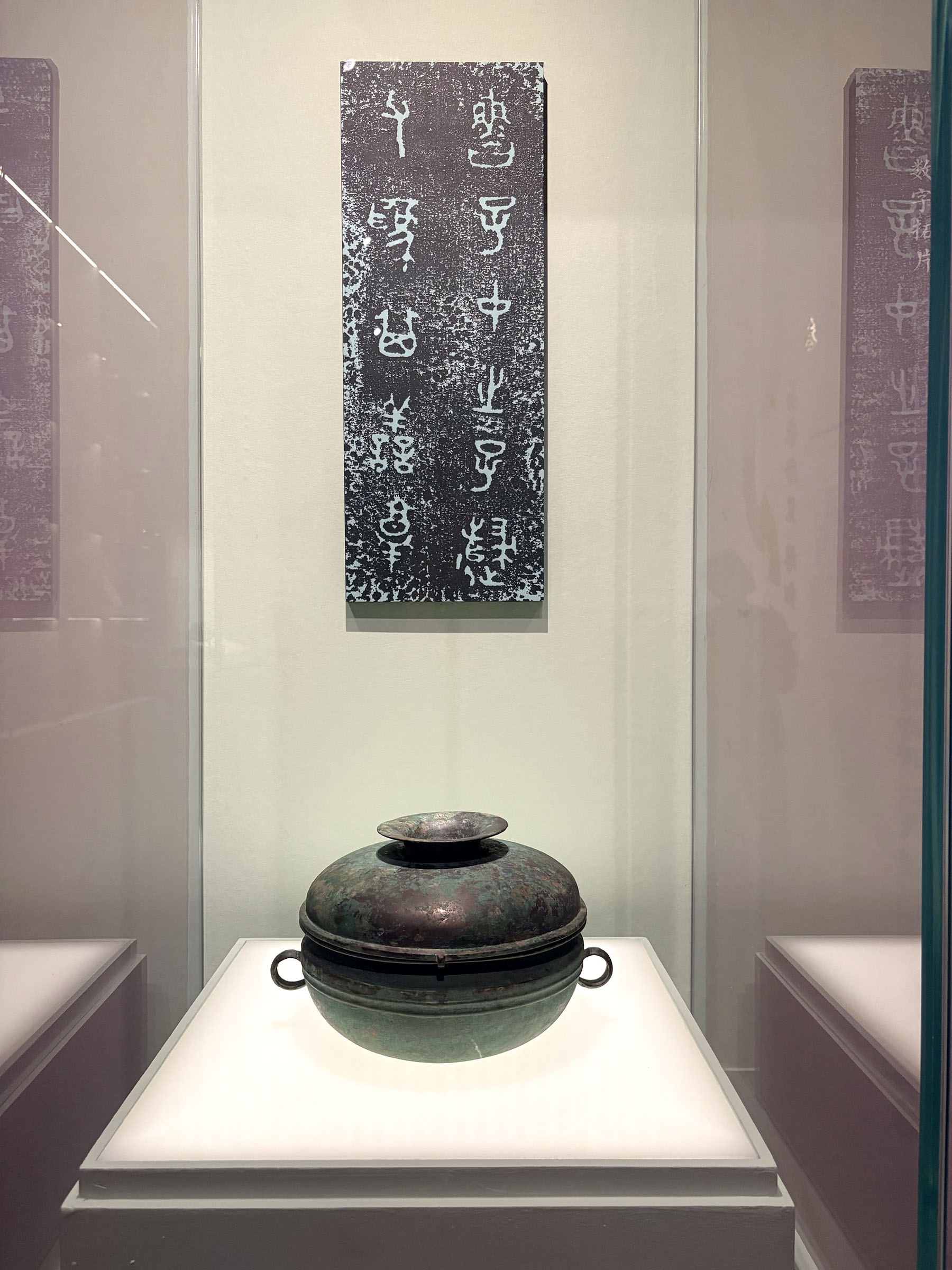
The exhibition enlarges bronze inscriptions on a wall, allowing visitors to see how the same character could vary considerably from one state to another.
Tian says the comparison vividly demonstrates the importance of standardizing the writing system after the establishment of the Qin Dynasty, China's first unified imperial dynasty.
The exhibition also presents publications and online platforms that give people access to inscribed artifacts in China and abroad, as well as scholarly interpretations.
Huang Dekuan, another professor at the Research and Conservation Center for Unearthed Texts, Tsinghua University, says the structures of ancient characters embody the ways of thinking of their creators and offer insights into how societies functioned.
Tracing the evolution of writing, from carved markings to a mature writing system, he says, is also a way to survey the development of Chinese civilization and understand how that civilization has been passed down to the present day.
Contact the writer at linqi@chinadaily.com.cn
