

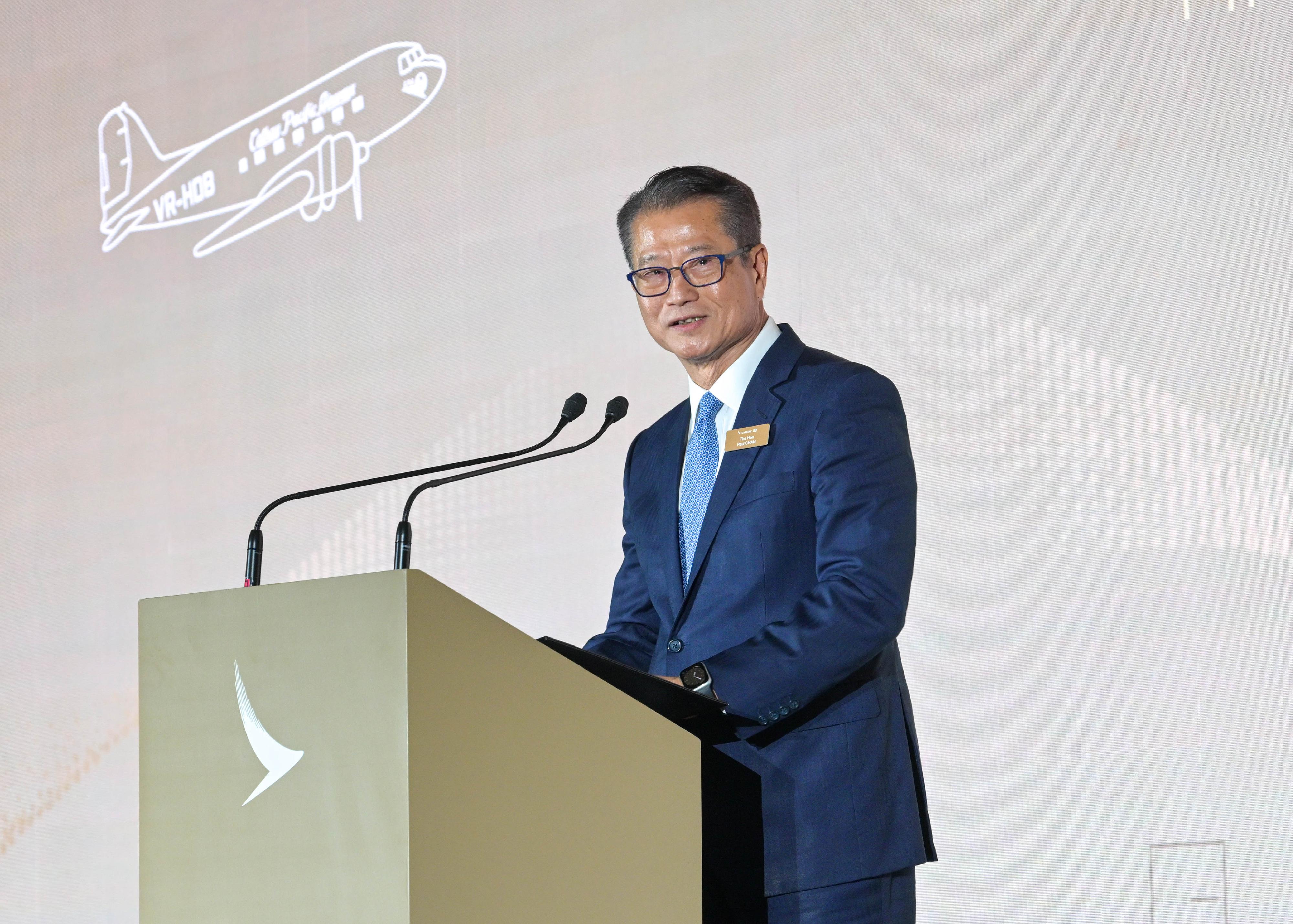
Hong Kong is giving businesses greater certainty in its economic strategy by linking its first Five-Year Plan for Economic and Social Development (2026-2030) more closely with annual policies, as the city steps up efforts to attract investment in emerging industries while reinforcing its traditional strengths.
Financial Secretary Paul Chan Mo-po said in his weekly blog on Sunday that the special administrative region’s inaugural five-year blueprint, delivered on Sept 16, sets out the direction, targets, indicators and timetable for development in the next five years.
He said the 2026 Policy Address serves as a road map for implementing the plan and can be adjusted in response to changing domestic and international conditions, adding that both documents are closely aligned and mutually reinforcing.
ALSO READ: Lee: HK’s five-year plan took a leaf from mainland’s experiences
“The more volatile the external environment, the more the market needs certainty that extends beyond a single year,” Chan said.
The Northern Metropolis, which accounts for about one-third of the HKSAR’s total area and projected population, has moved gradually from blueprint to implementation, and will provide space for the development of innovation and technology, he said.
Under the latest development plans, at least 200 hectares of spade-ready sites will be made available over the next two financial years. Of the nine new development areas, four are already under construction.
More than 100 innovation and technology companies and organizations have set up operations at Hong Kong Park of the Hetao Shenzhen-Hong Kong Science and Technology Innovation Cooperation Zone, while both wet-laboratory buildings have been fully leased.
The finance chief said the 210-hectare San Tin Technopole will form an industrial chain with Hetao, with the latter focusing more on research and development, and San Tin on pilot production and manufacturing.
ALSO READ: HK's 5-year plan, policy address aim to improve housing, help grassroots
To support companies in the Northern Metropolis, he said the HKSAR government plans to submit amendments to the legislature by the end of the year to offer a five-percent, or half-rate, tax concession to key enterprises engaged in finance, advanced manufacturing, research and development, headquarters operations, logistics and supply-chain management.
The Hong Kong Monetary Authority and the Hong Kong Association of Banks have also established a Northern Metropolis Financial Advisory Taskforce involving 23 banks to develop tailored financing solutions for companies moving into the area.
“Emerging industries need to be nurtured, while traditional strengths must also be consolidated. The two are not mutually exclusive, but mutually reinforcing,” Chan said.
Hong Kong will continue to strengthen its position as an international financial center by improving its securities market and listing regime to facilitate listings by more high-quality companies from home and abroad.
READ MORE: CE stresses national integration, core system in HK's 1st 5-yr plan
The HKSAR government also plans to expand the dim sum bond market and develop renminbi-denominated gold and commodity markets, helping China to strengthen its international pricing power in those areas.
Offshore renminbi lending in Hong Kong reached a record 935 billion yuan ($139.6 billion) in 2025, while the size of the RMB Business Facility, introduced last year to provide banks with a stable and relatively lower-cost source of renminbi funds, has been expanded to 500 billion yuan, according to official data.
In his blog, Chan also paid tribute to Hong Kong’s first chief executive, Tung Chee-hwa, who died on Sept 8, aged 89, and whose funeral was held on Sunday.
He described Tung as a “far-sighted” leader who had put forward many development directions of great long-term strategic value. “Looking back today, time has proved his foresight.”
Chan will leave for Beijing on Sunday for a visit during which he will call on the Ministry of Finance, relevant central government ministries and commissions, as well as financial regulatory authorities.
Secretary for Financial Services and the Treasury Christopher Hui Ching-yu, Chief Executive of the Hong Kong Monetary Authority Eddie Yue Wai-man, and Chief Executive Officer of the Securities and Futures Commission Julia Leung Fung-yee will join all or part of the visit.
Contact the writer at: irisli@chinadailyhk.com
