

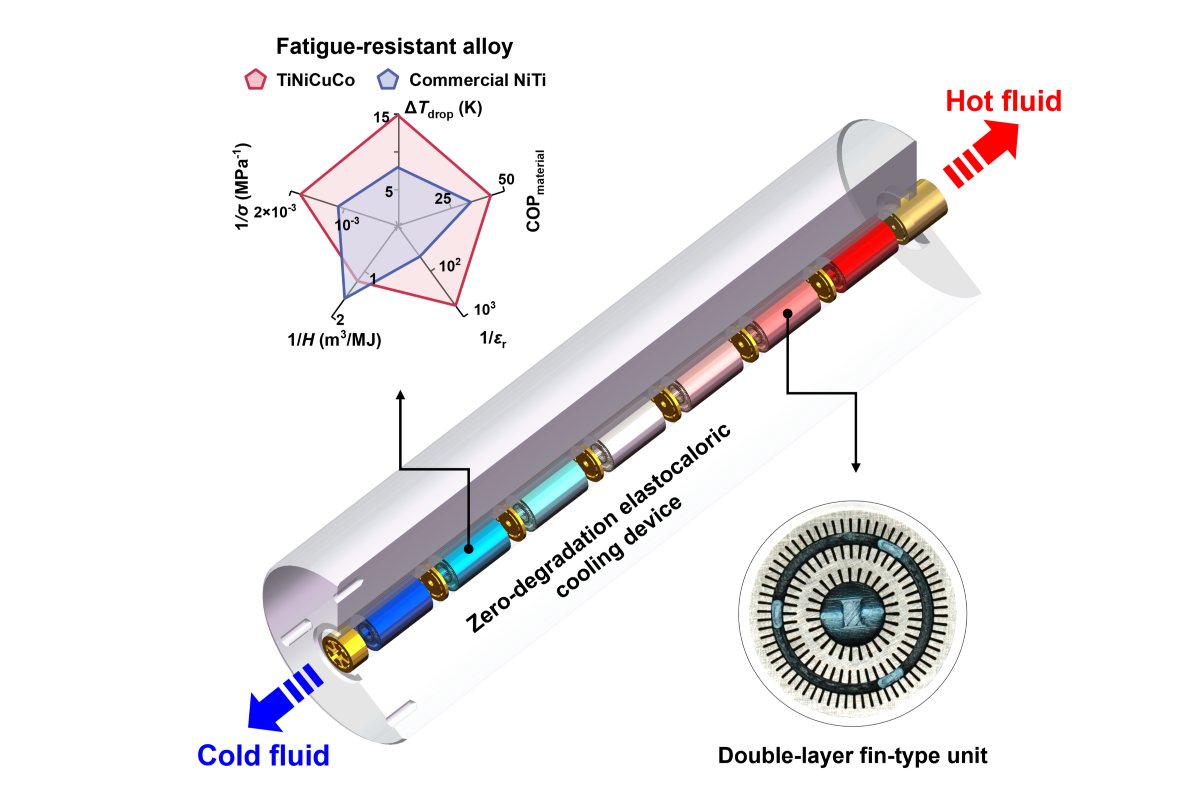
Researchers from The Hong Kong University of Science and Technology have unveiled the world’s first zero-degradation elastocaloric cooling device which, they hope, could revolutionize sustainable refrigeration technology.
Powered by a fatigue-resistant, solid-state refrigerant, the innovation delivers durable and green cooling, maintaining its stable performance even over a stunning one million operational cycles, the university said, adding that the breakthrough will usher in highly efficient eco-friendly cooling, driving progress towards sustainable global development.
The findings have been published in Joule – a leading academic journal in the energy field – under the title “A zero-degradation elastocaloric cooling device using fatigue-resistant refrigerant”.
According to researchers, refrigeration faces challenges from traditional vapor-compression systems, which are energy-intensive and employ refrigerants that exacerbate the greenhouse effect and damage the ozone layer.
RELATED ARTICLES
- Chan: HKUST medical school to put city at forefront of innovation
- HKUST-developed AI model 'able to forecast storms 4 hrs ahead'
- HKUST study looks into ‘healthy longevity’ of Chinese people
- HKUST sets to fast-track establishment of third medical school
- HKUST physicist awarded 2025 Future Science Prize
Elastocaloric cooling, which is based on the reversible stress-induced phase transformation of shape memory alloys, offers a promising green alternative to traditional refrigeration, but its commercialization has been impeded by performance degradation and low reliability.
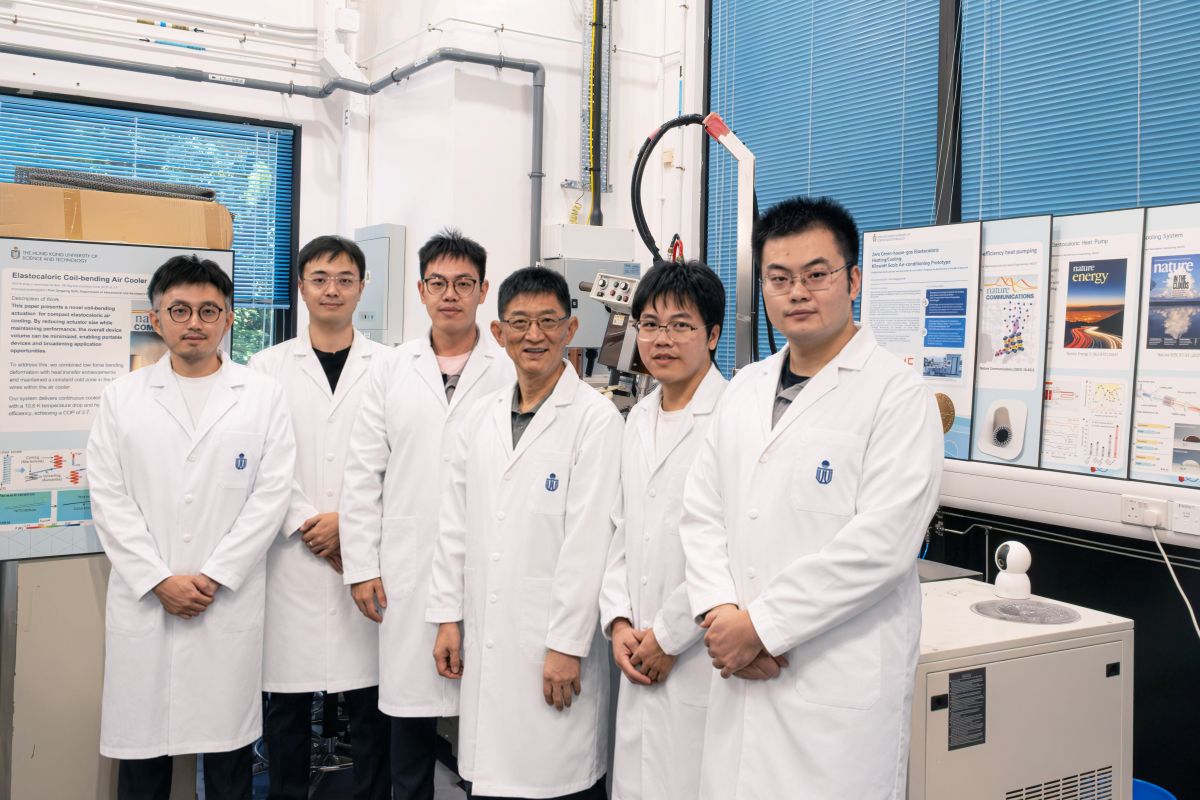
To overcome the bottleneck, a team led by Sun Qingping, chair professor at the HKUST’s Department of Mechanical and Aerospace Engineering, developed a fatigue-resistant shape memory alloy and integrated it into an innovative refrigerant structure. By combining advanced SMA materials with device-level design and engineering, they have successfully addressed the critical issues of material functional fatigue and structural reliability.
The innovation has resulted in a zero-degradation elastocaloric cooling device capable of maintaining stable cooling performance over long-term operation, according to the team.
“This breakthrough in cooling stability, achieved at both the material and device levels, brings the technology one step closer to real-world applications beyond laboratory demonstrations,” said Sun, who is the corresponding author of the paper.
The team is currently developing an air-conditioner based on the technology, he said, adding: “Moving forward, we aim to further enhance energy efficiency, power density and cost competitiveness of elastocaloric refrigeration systems to accelerate their market adoption as a sustainable cooling solution.”
Contact the writer at shamim@chinadailyhk.com
