

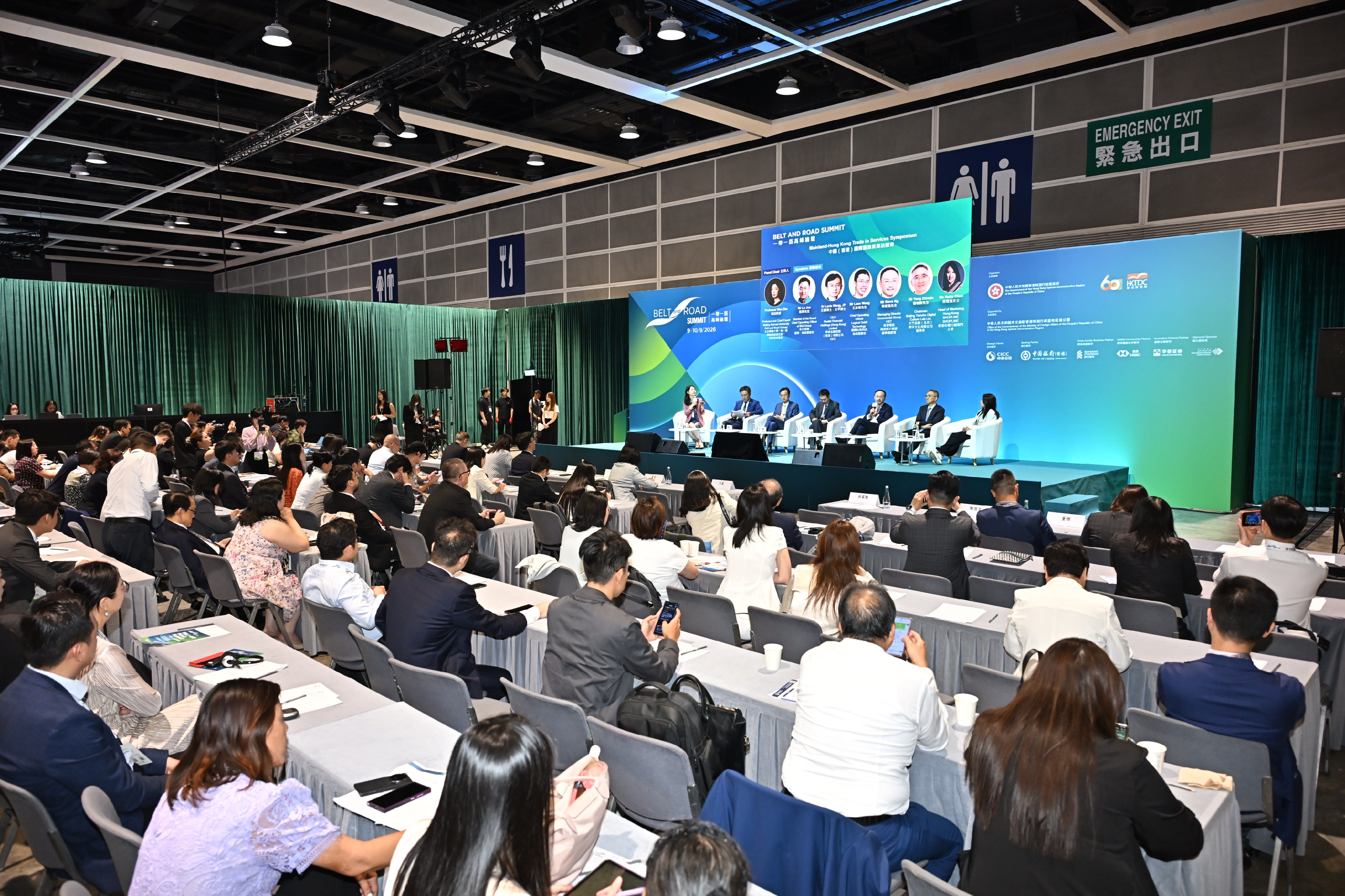
The Hong Kong Special Administrative Region should strengthen its role as a high-value services hub for Chinese mainland enterprises expanding overseas, as China’s services trade continues to grow and companies face rising demand for financing, risk management and innovation support, officials and business leaders said on Wednesday.
Speaking at the Mainland-Hong Kong Trade In Services Symposium — a thematic breakout session of the 11th Belt and Road Summit — Levin Wang Lei, CEO of Huatai Financial Holdings (Hong Kong) Ltd, said companies today need more than a one-off transaction. Instead, they require financing that matches their real business needs — where they earn revenue, where they pay costs and when their debt falls due.
For many mainland companies, production costs are largely denominated in renminbi, while sales to Europe, the United States and Southeast Asia generate foreign-currency income, Wang said. “The biggest problem is not getting the money,” he said. “The real headache is the mismatch.”
If companies fail to manage such mismatches, exchange-rate swings and interest-rate changes can quickly wipe out their profit margins, he added.
ALSO READ: Unlocking new market opportunities
Wang said Hong Kong can help companies address these challenges in one place. Firms can raise debt or equity, choose the most suitable currency, and use foreign-exchange and interest-rate tools to lock in costs and hedge risks. Through the city’s Connect programs, they also gain access to a deep pool of global investors, he said.
To consolidate and elevate Hong Kong’s status as a leading financial center in Asia and globally, Wang said, “The city must turn the opportunities from China’s industrial upgrading and innovation into high-quality assets that global investors can easily understand, price, and hold for the long term.”
He said Hong Kong’s financial services industry should evolve from being a superconnector to a super value-adder, with a stronger focus on wealth management and risk management.
That means the city should upgrade itself from an offshore renminbi liquidity pool into a comprehensive wealth management hub, Wang said, as capital will remain in Hong Kong only if it can be deployed effectively.
READ MORE: Belt and Road Summit to see over 60 pacts sealed
The problem is not a lack of global capital, but whether investors have the tools to manage the risks that come with it, Wang said. Hong Kong therefore needs to expand its range of products for hedging interest-rate, currency and credit risks, and allow a wider variety of cross-border collateral, he added.
In keynote remarks at the symposium, Zhang Xiaoliang, deputy director-general of the Department of Trade in Services and Commercial Services at China’s Ministry of Commerce, said in the first seven months of this year, the mainland’s services imports and exports reached 4.4 trillion yuan ($660 billion), up 8.3 percent from a year earlier, reflecting the sector’s vast potential.
“The Hong Kong SAR has always been an important services trade partner of the mainland,” Zhang said, adding that their services imports and exports recorded double-digit growth in 2025.
“(Both sides) should use opening-up to improve the business environment and reduce trade barriers that restrict the flow of production factors,” he said.
READ MORE: Belt & Road countries see value of HK strategic connectivity role
Anna Cheung Sze-wai, associate executive director of the Hong Kong Trade Development Council, said the country’s rapid technological advancement in recent years, particularly in artificial intelligence and data, has created new opportunities for the services trade.
Such innovation has helped mainland companies upgrade and transform, while also “providing more high-quality development solutions for global markets”, she said.
Cheung said the Belt and Road Summit has showcased more than 2,800 investment projects since its launch 10 years ago. As Belt and Road cooperation deepens, the conference’s focus has expanded from infrastructure projects to sectors including technology and finance, she said.
Under Secretary for Commerce and Economic Development Bernard Chan Pak-li said Hong Kong, one of the world’s most services-driven economies, should build itself into a “more resilient and strategically valuable” international trade center.
Chan said the city will continue to strengthen connectivity with Belt and Road countries and regions, and promote cooperation in AI, digital economy, culture and tourism. “We hope to promote Hong Kong’s standards and rules in overseas markets.”
The HKSAR government will also step up efforts to attract businesses and investment, leveraging industrial policies, tax incentives and land supply to guide the growth of key industries, Chan added.
Contact the writer at irisli@chinadailyhk.com
